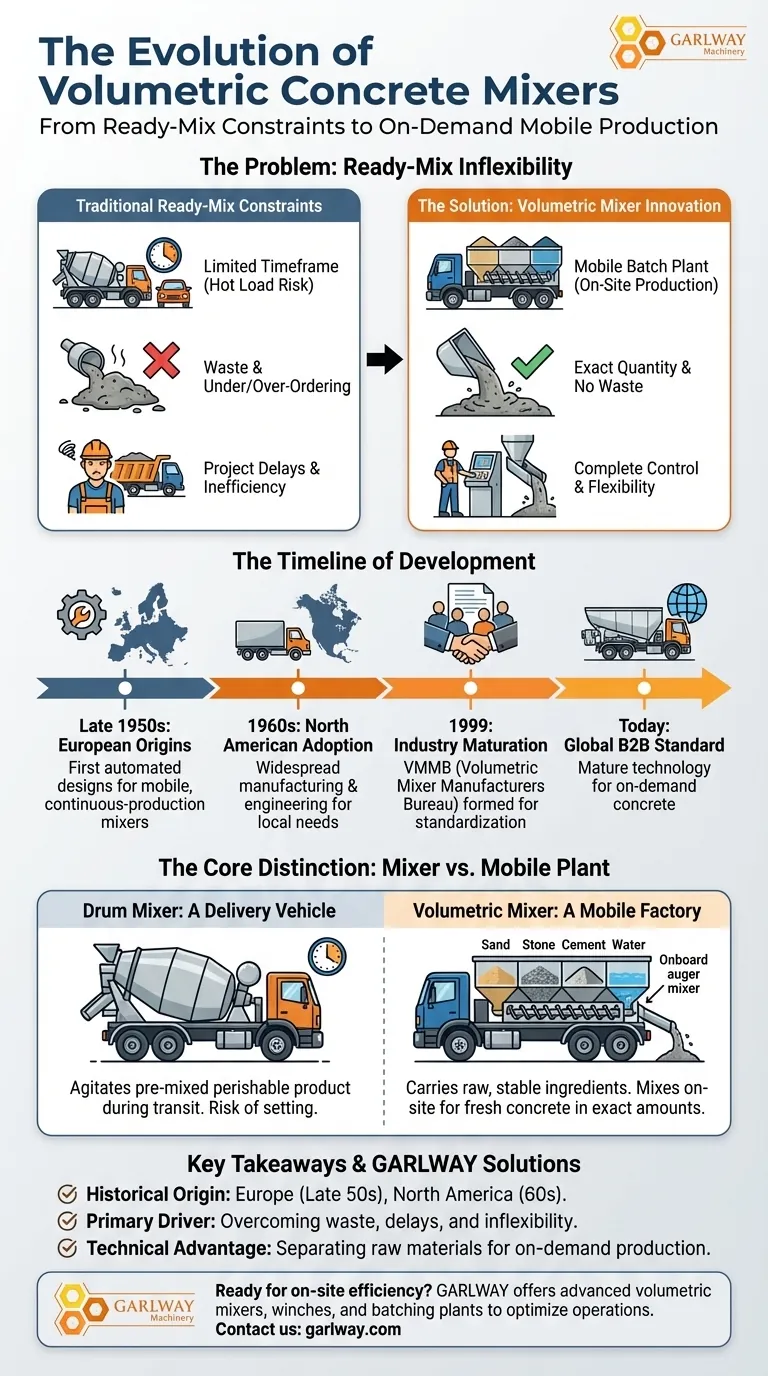
The core technology for volumetric concrete mixers emerged in the late 1950s and was widely developed throughout the 1960s. The earliest automated designs first appeared in Europe before being imported to North America. By the mid-1960s, multiple manufacturers began engineering their own versions to meet a growing demand for more efficient, on-site concrete production.
While the first general concrete mixer was invented in 1900, the volumetric mixer was a specific 1960s innovation designed to solve a different problem: it wasn't about mixing concrete, but about turning the truck into a mobile batch plant for ultimate flexibility.
The Problem That Sparked the Innovation
Before the volumetric mixer, construction sites were entirely dependent on ready-mix trucks arriving from a central plant. While a revolutionary system in its own right, it had inherent logistical challenges that created a clear need for a new solution.
The Inflexibility of Ready-Mix
Traditional ready-mix trucks transport concrete that has already been batched and mixed with water. This starts a chemical reaction with a limited timeframe, creating significant constraints for any project.
The "Hot Load" Problem
If a ready-mix truck was delayed in traffic or at the job site, the concrete could begin to cure in the drum. This resulted in wasted material, project delays, and financial loss.
Inefficiency and Waste
Contractors often had to order more concrete than needed to ensure they didn't run short, leading to waste. Conversely, under-ordering meant waiting for another truck, causing costly downtime for the entire crew.
The Timeline of Volumetric Mixer Development
The creation of the volumetric mixer was an evolutionary response to the practical demands of the construction industry. It represented a fundamental shift from a delivery model to an on-demand manufacturing model.
European Origins (Late 1950s)
The first automated designs for a mobile, continuous-production concrete mixer were developed in Europe. These early machines established the core principle of carrying unmixed materials—sand, stone, cement, and water—in separate compartments.
North American Adoption and Innovation (1960s)
The technology was soon imported to North America, where its value was immediately recognized. By the mid-1960s, entrepreneurs and manufacturers, such as the Reimer family in Ontario, began engineering and building their own robust versions tailored to local market needs.
Industry Maturation (1999)
The technology became so established that equipment manufacturers formed the Volumetric Mixer Manufacturers Bureau (VMMB). This trade association was created to standardize equipment and promote its benefits, cementing the volumetric mixer's place as a mature and vital industry tool.
The Core Distinction: Mixer vs. Mobile Plant
To truly understand the innovation, it's critical to distinguish between a traditional drum mixer and a volumetric mixer. They solve related but distinct problems.
The Drum Mixer: A Delivery Vehicle
A drum mixer (or ready-mix truck) is essentially a transportation vehicle for a perishable product. Its primary job is to agitate a pre-mixed batch of concrete to keep it from setting during transit.
The Volumetric Mixer: A Mobile Factory
A volumetric mixer is a mobile batch plant. It carries raw, stable ingredients and produces fresh concrete on-site, in the exact quantity needed. The mixing process happens at the job, not hours before. This eliminates the "hot load" problem and allows for complete control over the final product.
Key Takeaways for Your Understanding
Understanding the history of this technology provides insight into its modern applications and benefits.
- If your primary focus is historical accuracy: The concept originated in Europe in the late 1950s, with widespread manufacturing taking hold in North America through the 1960s.
- If your primary focus is the 'why': This technology was born from the need to overcome the waste, wait times, and inflexibility of the traditional ready-mix delivery model.
- If your primary focus is the technical advantage: The crucial innovation was separating the raw materials, transforming the truck from a simple delivery vehicle into a sophisticated, on-demand production system.
Ultimately, the development of the volumetric mixer was a pivotal moment that shifted the power of concrete production directly to the job site.
Summary Table:
| Aspect | Key Information |
|---|---|
| Initial Development | Late 1950s (Europe) |
| Widespread Manufacturing | 1960s (North America) |
| Core Innovation | Mobile batch plant producing concrete on-demand |
| Primary Driver | Solve waste and delays of traditional ready-mix trucks |
| Industry Maturation | Volumetric Mixer Manufacturers Bureau (VMMB) formed in 1999 |
Ready to bring the flexibility and efficiency of on-site concrete production to your projects?
GARLWAY specializes in construction machinery, offering advanced volumetric mixers, winches, and concrete batching plants for construction companies and contractors globally. Our solutions are designed to eliminate waste, reduce downtime, and give you complete control over your concrete.
Contact GARLWAY today to discuss how our machinery can optimize your operations and boost your profitability.
Visual Guide
Related Products
- Belle Cement Mixer JS2000 Volumetric Concrete Mixer for Harbor Freight
- JS1000 Volumetric Concrete Mortar Mixer for Sale Skid Steer Cement Mixer
- Harbor Freight JS1500 On Site Concrete Mixing Volumetric Cement Mixer
- Portable Concrete Mixer Machine Equipment for Mixing Concrete
- HZS25 Best Cement Mixer for Quick Mix Concrete at Bunnings
People Also Ask
- What is a volumetric concrete mixer? A Mobile Concrete Batch Plant for On-Demand Mixing
- What is the predicted future for volumetric concrete mixers? Growth Driven by On-Demand Efficiency
- How does a volumetric concrete mixer contribute to sustainability? Reduce Waste, Water, and Emissions On-Site
- How does volumetric concrete compare to ready-mix concrete? Choose the Right Method for Your Project
- What types of concrete can be produced with volumetric mixers? Achieve On-Demand Mixing for Any Project