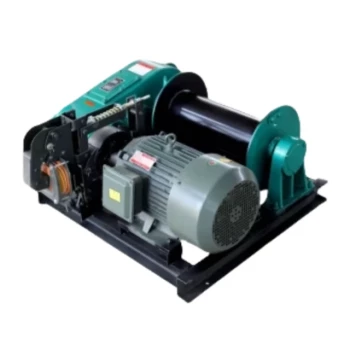
At its core, a winch is a mechanical device used to apply controlled pulling or lifting force, making it an indispensable tool across a vast range of applications. Its primary uses can be broadly categorized into vehicle recovery, material handling in industrial settings, and specialized positioning tasks. You will find them everywhere from the front of an off-road truck to massive installations on construction sites, mines, and marine vessels.
A winch is not defined by a single application but by its fundamental capability: to provide significant mechanical advantage for pulling or lifting heavy loads. Understanding this core function is the key to seeing its universal utility in nearly every heavy industry.
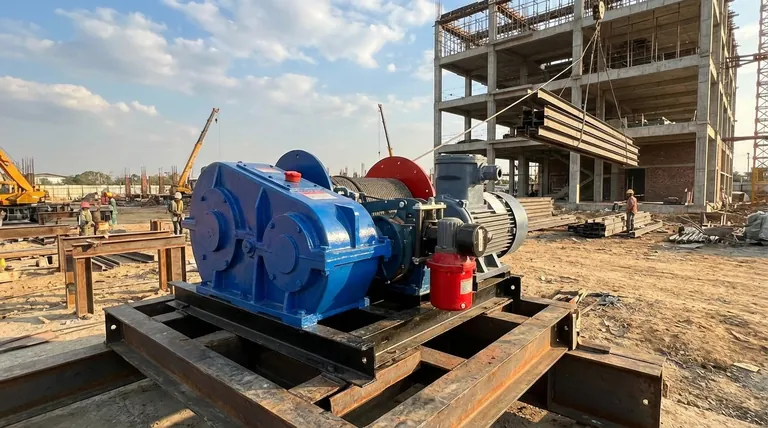
The Core Function: Applying Controlled Force
A winch works by converting rotational energy, typically from a motor or a manual crank, into the linear pull of a cable, rope, or chain. This simple principle is the source of its power and versatility.
Horizontal Pulling and Recovery
This is the most common application many people visualize. It involves pulling a load across a surface.
The most prominent example is off-road vehicle recovery. A winch is standard equipment for pulling a stuck vehicle from mud, sand, snow, or difficult terrain.
It is also critical for loading and unloading. Winches are used to pull vehicles, boats, or heavy equipment securely onto trailers.
In emergencies, winches are used for clearing obstacles, such as pulling fallen trees or debris from a roadway.
Vertical Lifting and Hoisting
Beyond pulling, winches are essential for lifting loads against gravity. This is a common requirement in many industrial fields.
On construction sites, winches act as hoists to lift building materials, tools, and structural components to upper levels.
In mining operations, powerful winches are used to hoist minerals and equipment from deep within the earth.
Positioning and Mooring
A more specialized but critical application is using a winch for precise positioning.
In maritime operations, winches are fundamental for mooring ships to docks, adjusting their position, and handling anchors or cargo nets.
In large-scale manufacturing, winches can be used to carefully position heavy machinery or components during assembly.
A Look Across Major Industries
The winch's fundamental capabilities make it a staple tool in nearly every industry that deals with heavy materials or equipment.
Construction and Infrastructure
Winches are used for lifting materials, tensioning cables in road and bridge construction, and in the assembly of large structures like hydroelectric dams.
Mining, Metallurgy, and Extraction
These heavy industries rely on winches for mineral extraction, oil and gas drilling operations, and moving massive quantities of raw materials.
Marine and Maritime Operations
From small boat trailers to massive container ships, winches are used for mooring, anchoring, and positioning vessels at docks and ports.
Forestry and Utilities
In forestry, winches are used to pull and position logs. Utility companies may use them to tension power lines or position heavy equipment in remote locations.
Understanding the Trade-offs: Winch Types
The term "winch" covers a range of devices, and the right choice depends entirely on the application's power requirements and environment.
Manual / Hand Winches
These simple, effective devices are powered by a hand crank. They are relatively inexpensive, easy to maintain, and invaluable in locations without access to electrical power.
They are ideal for smaller jobs in boating, construction, or for workshops where controlled, low-speed pulling is needed.
Electric Winches
Powered by a DC or AC electric motor, these are the most common type found on off-road vehicles, trailers, and in many utility applications.
They offer a fantastic balance of power, convenience, and speed but require a robust electrical source, such as a vehicle's battery and charging system.
Hydraulic Winches
For the most demanding industrial applications, hydraulic winches offer immense pulling power and the ability to run continuously without overheating.
They are powered by a hydraulic system and are typically found on heavy commercial equipment, tow trucks, and in large-scale marine or mining machinery.
Making the Right Choice for Your Goal
To select the right tool, you must first define the task. The environment, the weight of the load, and the availability of power are the critical factors.
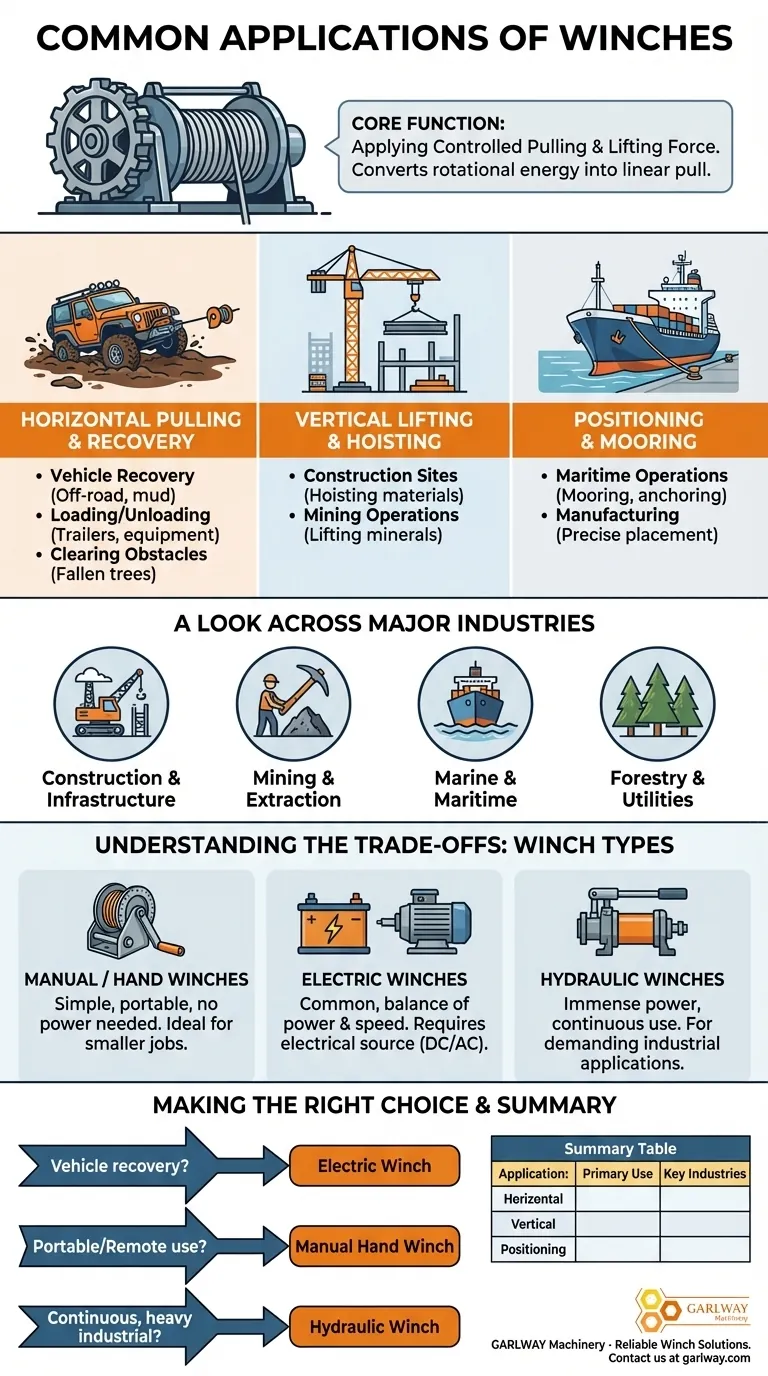
- If your primary focus is vehicle recovery or intermittent pulling: An electric winch mounted on the vehicle is the industry standard for its power and ease of use.
- If your primary focus is portable lifting or use in remote areas without power: A manual hand winch provides unmatched reliability, simplicity, and safety for smaller loads.
- If your primary focus is continuous, heavy industrial operation: A specialized hydraulic or large-scale electric winch is necessary for the power and duty cycle required in construction, mining, or marine settings.
Ultimately, understanding the core task—whether it's pulling, lifting, or positioning—will always guide you to the correct application of this powerful tool.
Summary Table:
| Application Category | Primary Use | Key Industries |
|---|---|---|
| Horizontal Pulling | Vehicle Recovery, Loading/Unloading | Off-Roading, Transportation |
| Vertical Lifting | Hoisting Materials, Equipment | Construction, Mining |
| Positioning/Mooring | Precise Placement, Securing Vessels | Marine, Manufacturing |
Need a reliable winch solution for your project?
GARLWAY specializes in providing robust construction machinery, including powerful winches, concrete mixers, and batching plants, tailored for construction companies and contractors worldwide. Our equipment is engineered for durability and performance in the most demanding conditions.
Contact GARLWAY today to discuss your specific requirements and discover how our solutions can enhance your operational efficiency and safety.
Visual Guide
Related Products
- Warn Winch Windlass Boat Trailer Winch
- Electric and Hydraulic Winch for Heavy Duty Applications
- Hydraulic Winding Engine Harbor Freight Winch
- Small Electric Winch 120V and 240V for Compact Applications
- Quick Windlass Portable Winch for Truck and Boat Best Boat Winch
People Also Ask
- What are the main components of a boat trailer winch? A Guide to Safe & Efficient Boat Loading
- What factors should be considered when choosing a boat trailer winch? Ensure Safe and Effortless Boat Loading
- What is the purpose of boat trailer winches? Safely and Efficiently Load Your Boat
- What are the two main types of boat trailer winches? Manual vs. Electric Explained
- How often should a boat trailer winch be replaced? Your Guide to Safety and Longevity