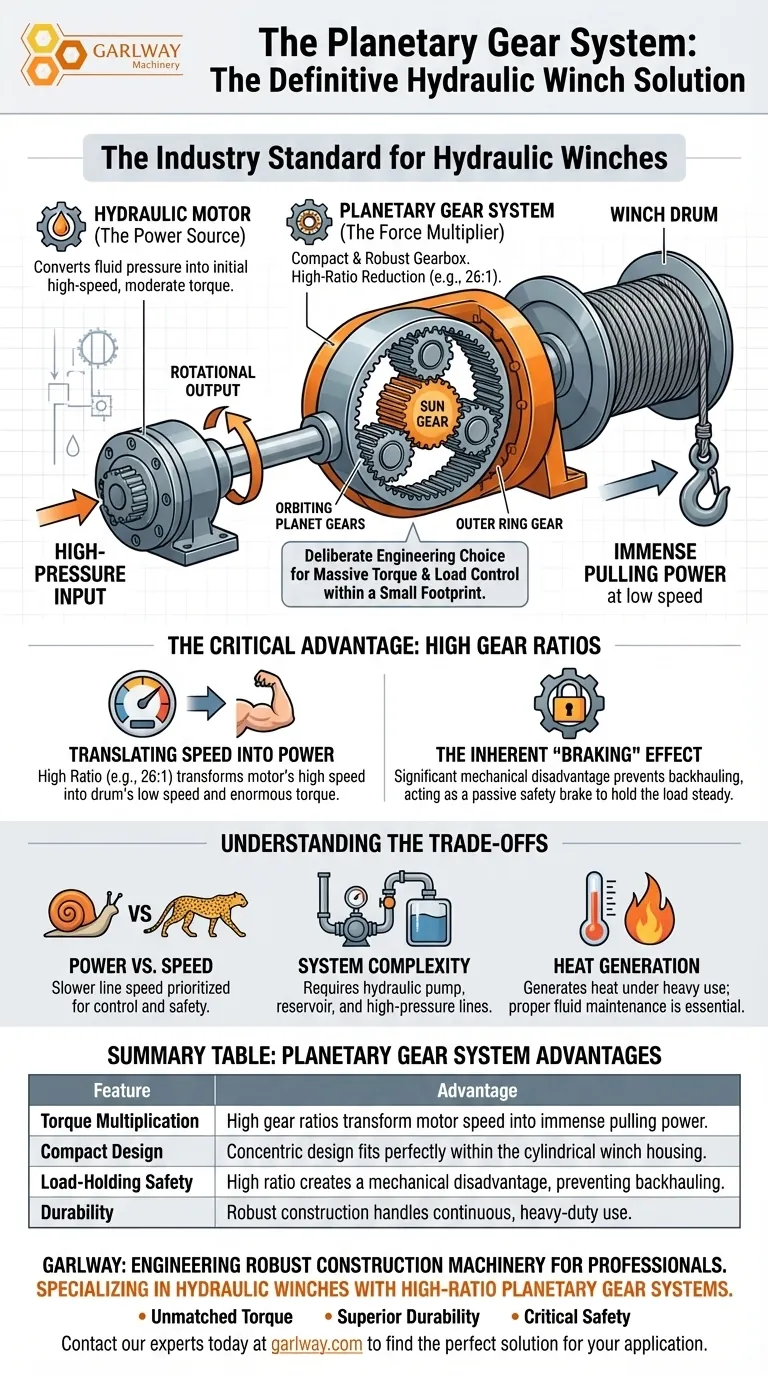
The definitive gear system used in nearly all modern hydraulic winches is the planetary gearset. This compact and robust system is specifically chosen for its ability to handle immense torque within a small footprint and is typically engineered with a very high gear ratio to provide the necessary pulling power and load control.
The use of a planetary gear system in a hydraulic winch is a deliberate engineering choice. Its compact design delivers the massive torque multiplication required for heavy loads while its high gear ratio provides an inherent load-holding capability, which is a critical safety feature.
The Anatomy of a Hydraulic Winch Drivetrain
To understand why the planetary gear system is the industry standard, it's important to see how it works in conjunction with its power source. The drivetrain consists of two primary components working in unison.
The Power Source: The Hydraulic Motor
The process begins with the hydraulic motor, often a roller stator or gerotor design. This component's sole job is to convert the high-pressure flow of hydraulic fluid from a pump into initial rotational force, or torque. While powerful, this initial torque is not nearly enough to pull a heavy load on its own.
The Force Multiplier: The Planetary Gear System
The rotational force from the motor is fed directly into the planetary gear system. This gearbox consists of a central "sun" gear, several "planet" gears that orbit it, and an outer "ring" gear. This configuration allows for significant gear reduction in a very compact, inline space, making it perfect for the cylindrical shape of a winch.
The Critical Advantage: High Gear Ratios
The effectiveness of a winch is defined by its gear ratio. A high ratio, often 26:1 or greater, is the key to transforming the motor's high speed and moderate torque into the winch drum's low speed and immense torque.
Translating Speed into Power
A gear ratio of 26:1 means that for every 26 full rotations of the hydraulic motor, the winch drum turns only once. This massive reduction in speed directly multiplies the motor's torque, generating the enormous pulling force required for recovery and industrial applications.
The Inherent "Braking" Effect
This high ratio also creates a significant mechanical disadvantage for any force trying to drive the system backward from the load. The weight of the load on the winch cable is rarely sufficient to overcome the internal friction and gearing required to back-drive the motor. This is what's known as preventing backhauling, and it acts as a crucial, passive safety brake that helps hold the load steady.
Understanding the Trade-offs
While this system is exceptionally powerful and reliable, its design comes with inherent trade-offs that are important to recognize.
Power Comes at the Cost of Speed
The most obvious trade-off is speed. The same high gear ratio that creates incredible pulling power also results in a very slow line speed. This is a deliberate choice prioritizing control and safety over swiftness.
System Complexity and Power Source
Unlike an electric winch that connects to a battery, a hydraulic winch is part of a larger system. It requires a hydraulic pump (often driven by the vehicle's engine), a fluid reservoir, and high-pressure lines. This adds installation complexity but is the foundation of its superior power and duty cycle.
Heat Generation
Both the hydraulic system and the gear reduction process generate heat under heavy, continuous use. Proper system design and fluid maintenance are essential to manage this heat and ensure the longevity and reliability of the winch.
Making the Right Choice for Your Goal
Selecting the right equipment begins with understanding the principles behind its design.
- If your primary focus is maximum pulling power and durability: A hydraulic winch with a high-ratio planetary gear system is the professional standard for heavy recovery and continuous-duty industrial work.
- If your primary focus is safety and precise load control: The inherent load-holding capability of the high-ratio planetary gearset is a critical feature that provides a significant safety margin.
- If your primary focus is occasional use or faster line speed: An electric winch may be a simpler solution, but you will be sacrificing the raw power, thermal endurance, and fine control of a hydraulic system.
Understanding how the hydraulic motor and planetary gears work together empowers you to select and operate your equipment with both confidence and safety.
Summary Table:
| Feature | Planetary Gear System Advantage |
|---|---|
| Torque Multiplication | High gear ratios (e.g., 26:1) transform motor speed into immense pulling power. |
| Compact Design | Concentric design fits perfectly within the cylindrical winch housing. |
| Load-Holding Safety | High ratio creates a mechanical disadvantage, preventing backhauling for secure load control. |
| Durability | Robust construction handles continuous, heavy-duty use in industrial and recovery applications. |
Ready to harness the power and reliability of a planetary gear hydraulic winch?
At GARLWAY, we specialize in engineering robust construction machinery for professionals who demand performance and safety. Our hydraulic winches, featuring high-ratio planetary gear systems, are built to deliver:
- Unmatched Torque for the most demanding recovery and lifting tasks.
- Superior Durability for continuous operation on job sites worldwide.
- Critical Safety with inherent load-holding capabilities.
Whether you're a construction company, a heavy equipment contractor, or in the industrial sector, GARLWAY provides the reliable power you need.
Contact our experts today to find the perfect hydraulic winch solution for your specific application and get a quote!
Visual Guide
Related Products
- Hydraulic Winding Engine Harbor Freight Winch
- Electric and Hydraulic Winch for Heavy Duty Applications
- Small Electric Winch 120V and 240V for Compact Applications
- Electric 120V Boat Winch by Badlands
- 12000 lb Electric Boat Trailer Winch with Windlass Anchor Warn
People Also Ask
- What role does hydraulic fluid play in hydraulic winches? It's the Lifeblood of Your Heavy-Duty Pulling Power
- What vehicles commonly use hydraulic winches? For Industrial Trucks Needing Unmatched Power
- What are the features of hydraulic winches? Unmatched Power and Continuous Duty for Heavy Loads
- What preventive measures can be taken to avoid oil leakage in hydraulic winches? Ensure Long-Term Reliability
- What does 'power out' mean in a hydraulic winch? Achieve Absolute Control When Lowering Heavy Loads