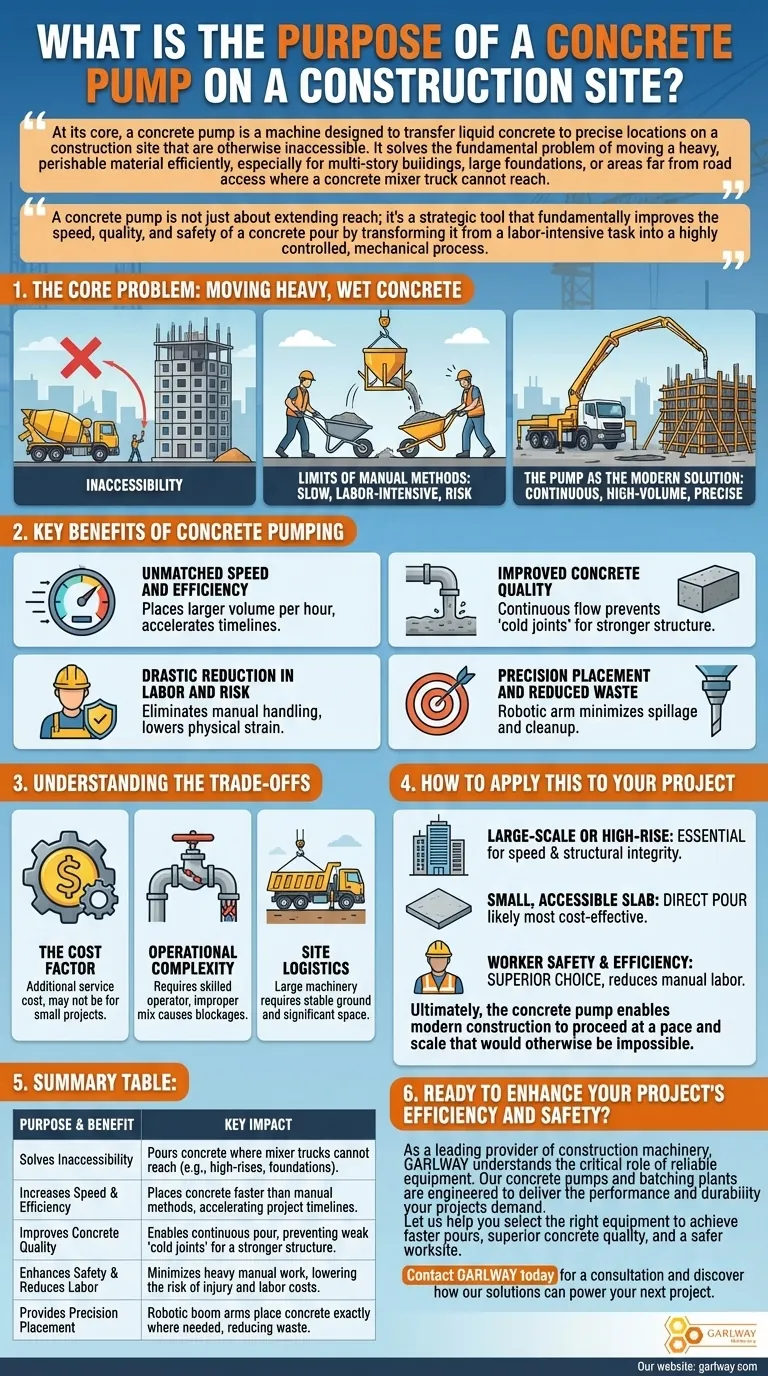
At its core, a concrete pump is a machine designed to transfer liquid concrete to precise locations on a construction site that are otherwise inaccessible. It solves the fundamental problem of moving a heavy, perishable material efficiently, especially for multi-story buildings, large foundations, or areas far from road access where a concrete mixer truck cannot reach.
A concrete pump is not just about extending reach; it's a strategic tool that fundamentally improves the speed, quality, and safety of a concrete pour by transforming it from a labor-intensive task into a highly controlled, mechanical process.
The Core Problem: Moving Heavy, Wet Concrete
The Challenge of Inaccessibility
A standard concrete mixer truck must be able to back up directly to the edge of the formwork to pour its contents. This becomes impossible in countless scenarios, from constructing the 10th floor of a building to pouring a basement foundation behind an existing structure.
The Limits of Manual Methods
Before pumps became common, this challenge was met with wheelbarrows or crane-lifted "buckets." These methods are incredibly slow, demand immense physical labor, and increase the risk of the concrete beginning to set before it's properly placed.
The Pump as the Modern Solution
The concrete pump uses a valve system to draw liquid concrete from a hopper and push it through a series of pipes and hoses. This creates a continuous, high-volume flow that can be directed with remarkable precision over, around, and through obstacles.
Key Benefits of Concrete Pumping
Unmatched Speed and Efficiency
A concrete pump can place a significantly larger volume of concrete per hour than any manual method. This speed reduces the overall time for a pour, cutting down on labor costs and accelerating project timelines.
Improved Concrete Quality
Pumping allows for a continuous flow of concrete. This prevents the formation of "cold joints," which are weak points that can occur when one batch of concrete starts to harden before the next batch is poured against it. The result is a stronger, more monolithic final structure.
Drastic Reduction in Labor and Risk
Moving concrete manually is one of the most physically demanding jobs on a construction site. Pumping eliminates the need for a large crew with wheelbarrows, significantly reducing the risk of physical strain and injury while lowering labor expenses.
Precision Placement and Reduced Waste
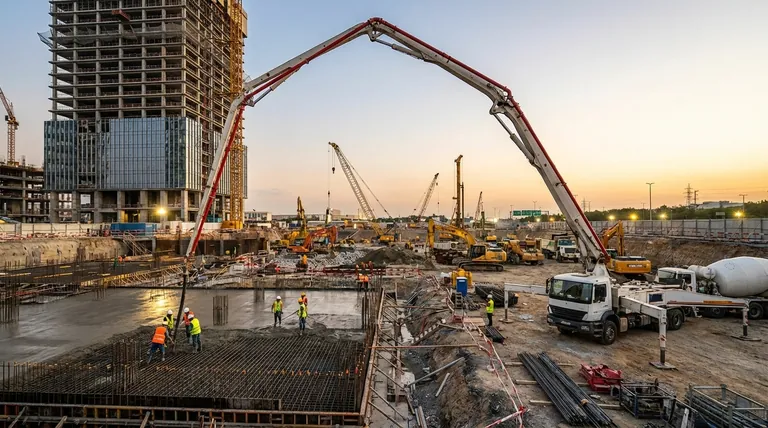
Modern concrete pumps, especially boom pumps, have a robotic arm that can be maneuvered by a skilled operator to place concrete exactly where it is needed. This precision minimizes spillage, reduces the need for post-pour cleanup, and ensures material is not wasted.
Understanding the Trade-offs
The Cost Factor
Using a concrete pump is an additional service with an associated cost. For very small, easily accessible ground-level slabs like a simple patio, the expense may not be justified compared to pouring directly from the mixer's chute.
Operational Complexity
Operating a concrete pump requires a skilled and certified professional. An improper concrete mix can cause blockages in the pipes, leading to costly and time-consuming delays on site.
Site Logistics
The pump truck itself is a large piece of heavy machinery. It requires stable ground and significant space to extend its outriggers for stability, which can be a constraint on a crowded or compact construction site.
How to Apply This to Your Project
Deciding whether to use a concrete pump hinges on the scale, accessibility, and goals of your project.
- If your primary focus is a large-scale or high-rise project: A concrete pump is essential for maintaining project speed and ensuring structural integrity.
- If your primary focus is a small, easily accessible ground-level slab: Direct pouring from the mixer truck is likely the most cost-effective method.
- If your primary focus is worker safety and project efficiency: The pump is the superior choice, as it drastically reduces manual labor and accelerates the pour.
Ultimately, the concrete pump enables modern construction to proceed at a pace and scale that would otherwise be impossible.
Summary Table:
| Purpose & Benefit | Key Impact |
|---|---|
| Solves Inaccessibility | Pours concrete where mixer trucks cannot reach (e.g., high-rises, foundations). |
| Increases Speed & Efficiency | Places concrete faster than manual methods, accelerating project timelines. |
| Improves Concrete Quality | Enables continuous pour, preventing weak 'cold joints' for a stronger structure. |
| Enhances Safety & Reduces Labor | Minimizes heavy manual work, lowering the risk of injury and labor costs. |
| Provides Precision Placement | Robotic boom arms place concrete exactly where needed, reducing waste. |
Ready to enhance your project's efficiency and safety?
As a leading provider of construction machinery, GARLWAY understands the critical role of reliable equipment. Our concrete pumps and batching plants are engineered to deliver the performance and durability your projects demand.
Let us help you select the right equipment to achieve faster pours, superior concrete quality, and a safer worksite.
Contact GARLWAY today for a consultation and discover how our solutions can power your next project.
Visual Guide
Related Products
- Commercial Electric Concrete Mixer Machine HZS 50 Small Batch Plant for Sale
- JDY350 Electric Hydraulic Mortar Mud Concrete Mixer
- Hydraulic Concrete Mixer Machine Cement Mixing Equipment for Mixture Concrete
- Portable Electric Concrete Mixer Machine for Cement Mixing
- HZS35 Small Cement Concrete Mixing Batch Plant
People Also Ask
- What are the types of concrete mixers used in batching plants? Choose the Right Mixer for Your Project
- What is the core component of a concrete batching plant? The Mixer Unit Defines Your Concrete Quality
- Why is proper maintenance important for a concrete batch mix plant? Maximize Uptime & Profitability
- Why buy concrete batch plant parts only from the manufacturer? Protect Your Investment and Maximize Uptime
- What are the two main types of concrete batch mixers? Choose the Right Mixer for Your Project