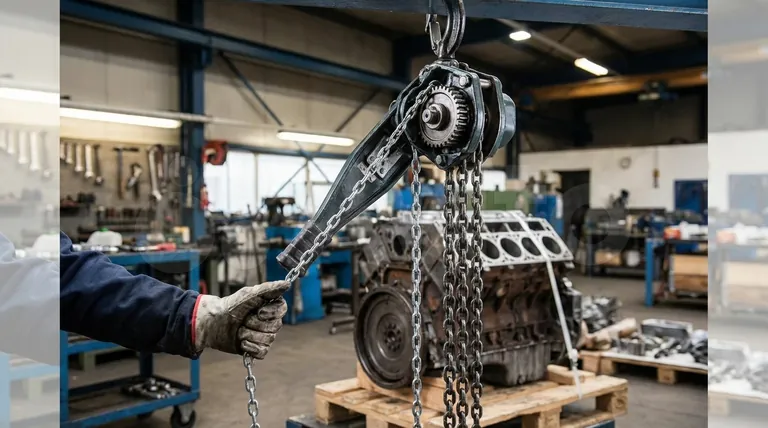
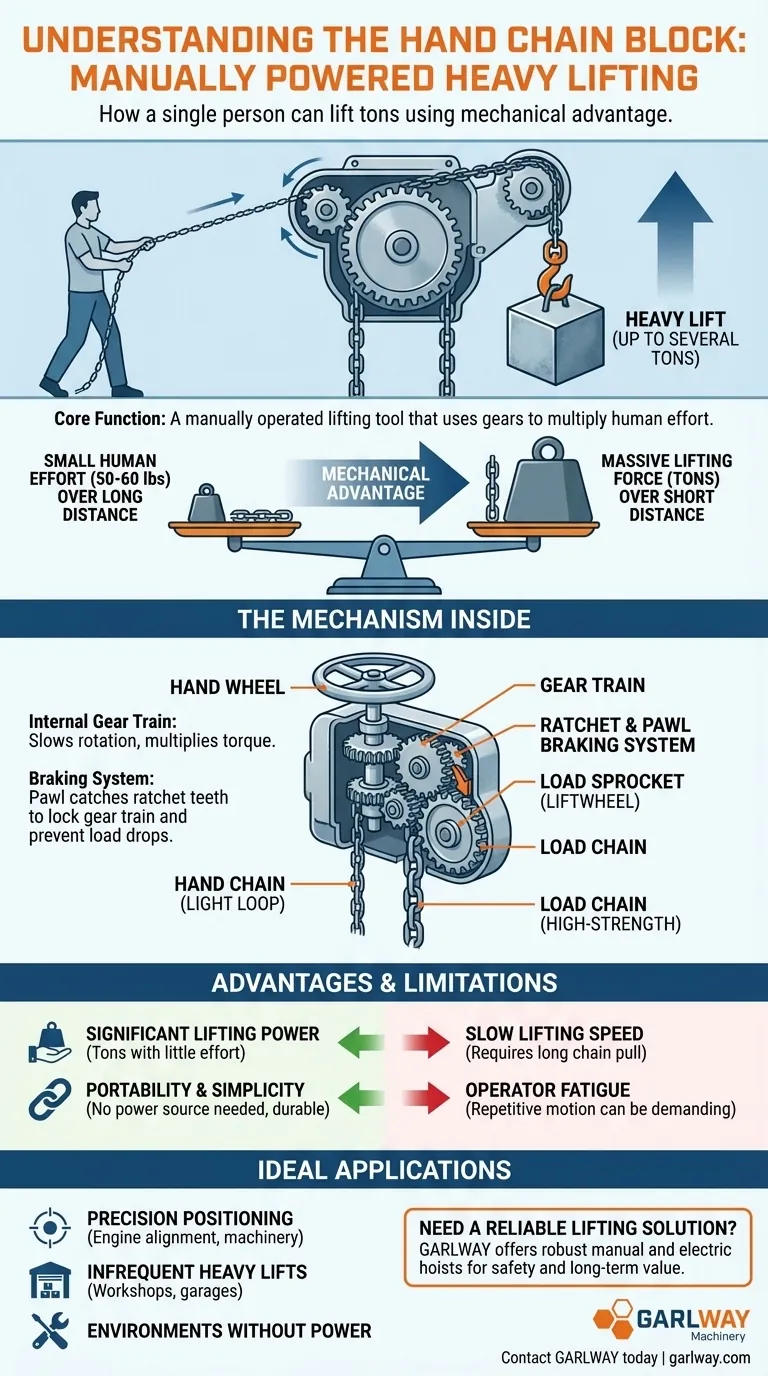
At its core, a hand chain block is a manually operated lifting tool that uses a system of gears to multiply human effort, allowing a single person to lift objects weighing several tons. It works by having the operator pull a light "hand chain" in a continuous loop, which turns a series of internal reduction gears. These gears drive a load-bearing sprocket that slowly and powerfully pulls up a heavy "load chain" attached to the object.
A hand chain block is a remarkable application of mechanical advantage. It intentionally sacrifices speed to gain immense lifting power, providing a safe and controlled way to lift heavy loads without needing electricity or hydraulic power.
The Core Principle: Mechanical Advantage in Action
To truly understand a hand chain block, you must understand the principle of trading distance and speed for force. The device is engineered to make this trade-off incredibly efficient.
Trading Speed for Power
The fundamental concept is that you pull many feet of the light hand chain to make the heavy load chain lift just a few inches. This disparity is where the force multiplication, or mechanical advantage, comes from. Your small effort, applied over a long distance, is converted into a massive force applied over a short distance.
The Internal Gear System
The "magic" happens inside the block's housing within the gear train. When you pull the hand chain, you rotate a small input gear (a pinion). This small gear meshes with a much larger gear, which then might connect to another small gear that turns an even larger one. Each step in this sequence slows the rotation down but significantly increases the torque, or turning force.
The Two-Chain System
It's critical to distinguish between the two separate chains.
- The hand chain is a long, continuous loop of light chain that you pull. It fits into a grooved wheel and its only job is to receive your input effort.
- The load chain is a much thicker, high-strength chain with a grab hook on the end. This is the chain that bears the full weight of the object being lifted.
A Look Inside the Mechanism
While designs vary, nearly all hand chain blocks share the same key components that work in concert to lift and secure a load safely.
The Hand Wheel and Gear Train
The hand chain drapes over the hand wheel. As you pull the chain, this wheel rotates a central drive shaft. This shaft connects directly to the gear train, beginning the process of force multiplication. Think of it like putting your bicycle in its easiest gear—one turn of the pedals results in slow but powerful movement of the wheel.
The Load Sprocket (Liftwheel)
After the force has been multiplied by the gears, it is transferred to the load sprocket, often called a liftwheel. This is a special sprocket with precisely formed pockets that securely grip the links of the load chain, ensuring a non-slip lift.
The Ratchet and Pawl Braking System
This is the most critical safety feature. Attached to the main drive shaft is a ratchet gear with angled teeth. A small, spring-loaded lever called a pawl rests against these teeth. When you are lifting, the pawl clicks over the teeth. If you stop pulling, the weight of the load tries to reverse the gears, but the pawl immediately catches a tooth on the ratchet, locking the entire gear train and preventing the load from falling.
Understanding the Trade-offs
A hand chain block is an exceptional tool, but its design is based on specific compromises. Understanding these is key to using it correctly.
Advantage: Significant Lifting Power
With a typical gear ratio, a person applying just 50-60 pounds of force on the hand chain can lift a load of one or two tons. This makes it an invaluable tool in workshops, garages, and construction sites.
Advantage: Portability and Simplicity
Because it requires no external power source, a hand chain block is highly portable. It can be used anywhere it can be safely anchored. Its purely mechanical nature also makes it durable and relatively easy to maintain.
Limitation: Lifting Speed
The primary trade-off is speed. Lifting a heavy object even a few feet can require pulling a significant length of hand chain. It is not suitable for applications that require rapid or high-volume lifting.
Limitation: Operator Fatigue
While the required force is low, the repetitive motion of pulling the chain for a significant lift can be physically demanding. For frequent or continuous use, a powered hoist is a better option.
Is a Hand Chain Block Right for Your Task?
Choosing the right tool depends entirely on the job's requirements for power, precision, and speed.
- If your primary focus is precision and control: A hand chain block is excellent for tasks like positioning an engine or carefully aligning heavy machinery where slow, steady movement is an advantage.
- If your primary focus is heavy, infrequent lifts: It is the ideal, cost-effective solution for a workshop or garage that needs to lift heavy items occasionally without the expense of an electric hoist.
- If your primary focus is speed and high-volume lifting: A hand chain block is the wrong tool; you should choose an electric or pneumatic hoist designed for production environments.
By understanding its simple yet powerful mechanical principles, you can confidently leverage the hand chain block for safe and effective lifting.
Summary Table:
| Aspect | Key Takeaway |
|---|---|
| Core Function | Manually lifts heavy loads (up to several tons) using a system of gears and chains. |
| How It Works | Pulling a light hand chain turns internal gears, which slowly and powerfully pull a heavy load chain. |
| Key Principle | Mechanical Advantage: Trades speed and distance for immense lifting force. |
| Primary Advantage | Significant lifting power without electricity; highly portable and simple to use. |
| Primary Limitation | Slow lifting speed; can cause operator fatigue for long or frequent lifts. |
| Ideal For | Precise positioning, infrequent heavy lifts, and environments without power. |
Need a Reliable Lifting Solution for Your Project?
GARLWAY specializes in providing robust and durable construction machinery, including high-performance manual and electric hoists perfect for workshops, construction sites, and industrial applications. Our equipment is engineered for safety, precision, and long-term value.
Let us help you lift with confidence.
Contact GARLWAY today to discuss your specific lifting needs and find the perfect hoist solution for your business.
Visual Guide
Related Products
- Electric Hoist Winch Boat Anchor Windlass for Marine Applications
- Small Electric Winch 120V and 240V for Compact Applications
- HZS35 Small Cement Concrete Mixing Batch Plant
- 12000 lb Electric Boat Trailer Winch with Windlass Anchor Warn
- Auto Concrete Cement Mixer Machine New
People Also Ask
- How does an electric anchor winch work? Power, Safety, and Reliable Operation Explained
- What are the advantages of installing an electric anchor winch on a boat? Boost Safety & Ease for Boaters
- What are the operational differences between electric hoists and winches? A Guide to Safe Lifting vs. Pulling
- What are the main benefits of a boat anchor winch? Boost Safety & Efficiency for Your Vessel
- How does a boat anchor winch work? A Guide to Reliable Anchor Handling