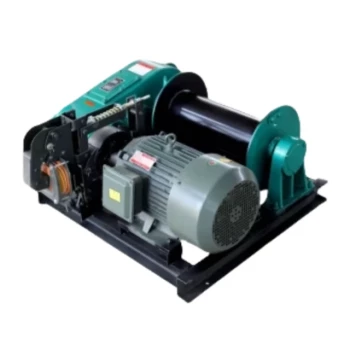
The right winch size depends entirely on its job. A winch for pulling your boat onto a trailer is sized completely differently from an anchor winch (windlass) used to retrieve your anchor. For a trailer winch, a good starting point is a capacity of at least half your fully loaded boat weight. For an anchor winch, the rule is a pulling power of at least three times the total weight of your anchor and rode (chain/rope).
Choosing the correct winch is not about the boat's size alone, but about the specific load it must handle. A trailer winch overcomes rolling friction and incline, while an anchor winch lifts the dead weight of your ground tackle against gravity and current.
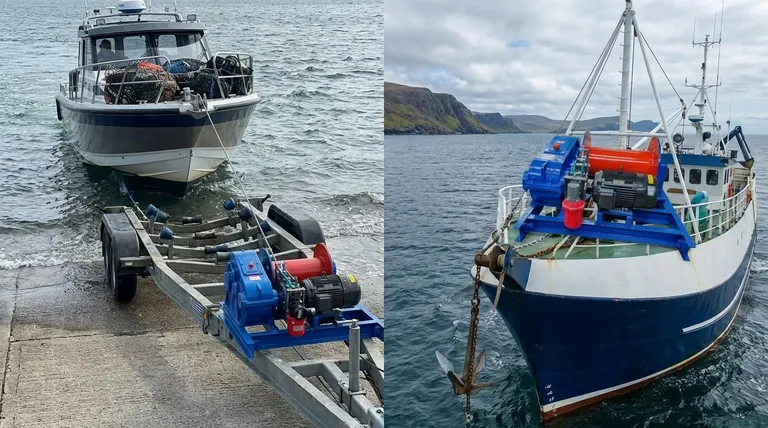
The First Critical Question: Trailer Winch or Anchor Windlass?
Before you can select a size, you must identify the winch's primary function. These two types of winches solve very different problems and are not interchangeable.
Trailer Winch: For Loading and Unloading
A trailer winch is mounted on the trailer's winch post. Its sole purpose is to pull the boat out of the water and securely onto the trailer bunks or rollers. Sizing is based on the boat's total weight and the friction of the ramp.
Anchor Windlass: For Managing Ground Tackle
An anchor windlass is mounted on the bow of your boat. It is designed to deploy and, more importantly, retrieve your anchor and rode (the line connecting the anchor to the boat). Sizing is based on the weight of this equipment.
Sizing a Boat Trailer Winch
Choosing a trailer winch is a balance between your boat's weight and the conditions you typically encounter at the boat ramp.
The Core Calculation: Weight and Incline
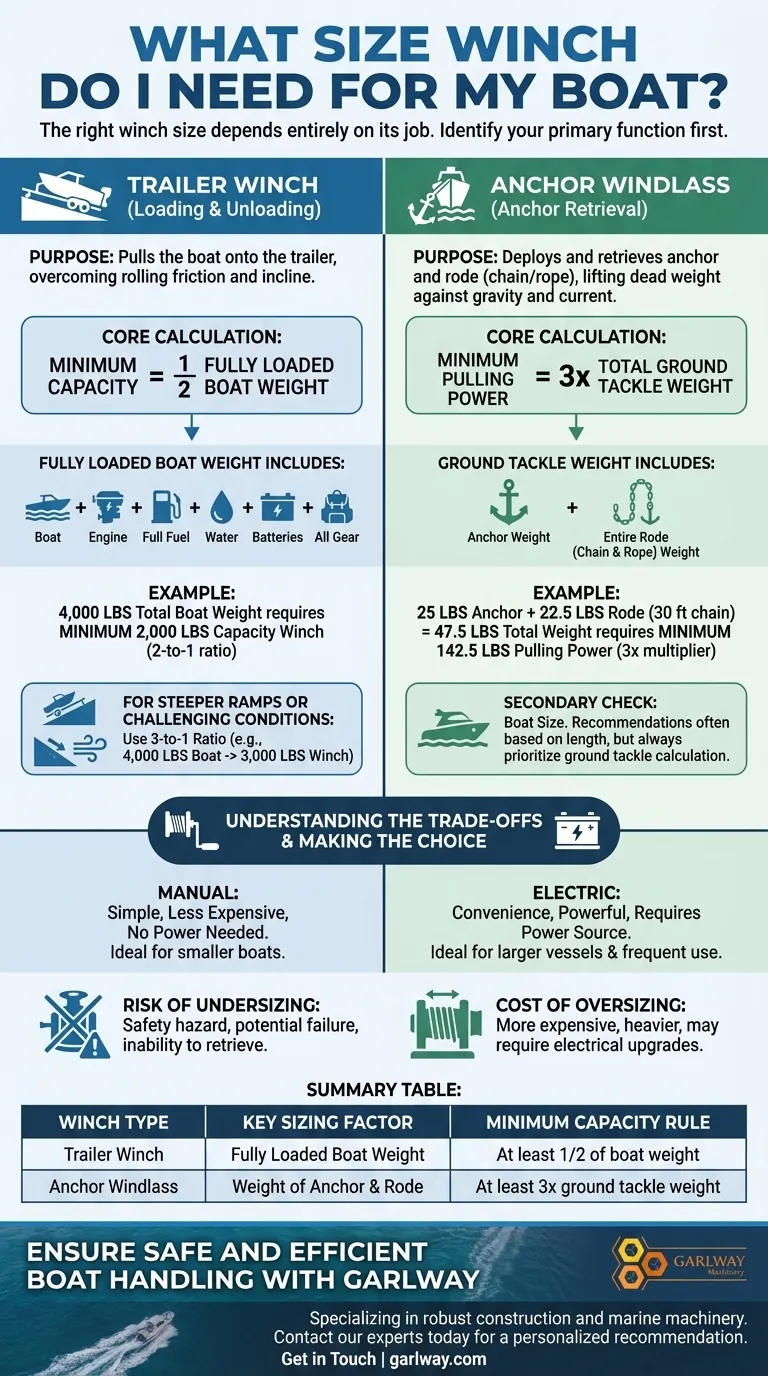
The most common rule of thumb is to choose a winch with a capacity rating of at least half your boat's total weight.
For example, a boat with a total weight of 4,000 lbs would require a minimum 2,000 lb capacity winch for a standard, low-incline ramp.
Why Total Weight Matters
"Boat weight" is not the dry weight listed by the manufacturer. You must calculate the fully loaded weight.
This includes the boat, the engine, a full tank of fuel, water, batteries, and all your gear. Forgetting this extra weight is a common and dangerous sizing error.
Adjusting for Real-World Conditions
The 2-to-1 ratio is a minimum for ideal conditions. Steeper boat ramps, windy days, or strong currents dramatically increase the required pulling force.
For steeper ramps or challenging conditions, it is much safer to use a 3-to-1 ratio (e.g., 4,000 lb boat requires a 3,000 lb winch).
Sizing an Anchor Winch (Windlass)
Sizing an anchor windlass has nothing to do with the boat's weight. It is exclusively about the weight of your ground tackle.
The Core Calculation: Ground Tackle Weight
The standard formula is to select a windlass with a maximum pulling power (or working load) of at least three times the total weight of your ground tackle.
This 3x multiplier provides the necessary safety margin to break the anchor free from the seabed and handle the shock loads from waves and wind.
How to Calculate Your Ground Tackle Weight
First, add the weight of your anchor to the weight of your entire rode (chain and/or rope).
For example:
- Anchor: 25 lbs
- Chain: 30 feet of 1/4" chain at ~0.75 lbs/ft = 22.5 lbs
- Total Ground Tackle Weight: 25 + 22.5 = 47.5 lbs
- Minimum Windlass Pull: 47.5 lbs x 3 = 142.5 lbs
Boat Size as a Cross-Check
While the ground tackle calculation is primary, manufacturers often provide recommendations based on boat length (e.g., a 700-1000 watt windlass for a 10-meter boat).
Use this as a secondary check. If your calculation suggests a much smaller windlass than recommended for your boat size, you may be using undersized ground tackle for your vessel.
Understanding the Trade-offs
Choosing a winch involves more than just a capacity number. You must consider the practical implications of your choice.
Manual vs. Electric Power
A manual winch is simple, less expensive, and requires no electrical installation. An electric winch offers significant convenience and power but requires a reliable power source and more complex installation.
The Risk of Undersizing
An undersized winch is a serious safety hazard. A trailer winch can fail, allowing the boat to roll back down the ramp. An underpowered windlass can stall or fail when you need it most, potentially leaving you unable to retrieve your anchor in deteriorating weather.
The Cost of Oversizing
While oversizing is safer than undersizing, it has downsides. A more powerful winch is more expensive, heavier, and may require significant upgrades to your boat's electrical system to handle the high power draw.
Making the Right Choice for Your Goal
Use your primary goal to guide your final decision.
- If you are buying a trailer winch for easy loading: Calculate your boat's fully loaded weight and choose a winch with at least half that capacity, increasing it for steep or difficult ramps.
- If you are installing an anchor windlass for safety and convenience: Calculate the total weight of your anchor and rode, then multiply by three to find your minimum required pulling power.
- If you operate in demanding conditions (steep ramps, rough seas): Always select a capacity well above the calculated minimum to ensure a robust safety margin.
By matching the winch type and capacity to its specific job, you ensure safe, reliable, and stress-free operation on the water and at the ramp.
Summary Table:
| Winch Type | Key Sizing Factor | Minimum Capacity Rule |
|---|---|---|
| Trailer Winch | Fully Loaded Boat Weight | At least 1/2 of boat weight |
| Anchor Windlass | Weight of Anchor & Rode | At least 3x the ground tackle weight |
Ensure Safe and Efficient Boat Handling with GARLWAY
Choosing the right winch is critical for the safety of your vessel and crew. GARLWAY specializes in robust construction and marine machinery, offering a range of durable winches perfect for demanding marine environments.
Our winches provide the reliable power and performance that construction companies and contractors globally depend on. Let us help you select the perfect winch for your specific needs.
Contact our experts today to discuss your requirements and get a personalized recommendation: Get in Touch
Visual Guide
Related Products
- 12000 lb Electric Boat Trailer Winch with Windlass Anchor Warn
- Warn Winch Windlass Boat Trailer Winch
- Quick Windlass Portable Winch for Truck and Boat Best Boat Winch
- Best 18000 Pound Drum Anchor Trailer Winch
- 12000 lb Heavy Duty Electric Boat Winch
People Also Ask
- How does an electric boat trailer winch differ from a manual one? Effort vs. Control Explained
- How should a boat trailer winch be properly used? A Step-by-Step Guide for Safe Loading
- What maintenance steps are specific to boat trailer winches? Ensure Safety & Reliability at the Ramp
- How strong of a winch do I need for my boat? Get the Right Pulling Power for Trailering & Anchoring
- Is installation of boat trailer winches difficult? A Guide to DIY vs. Pro Installation