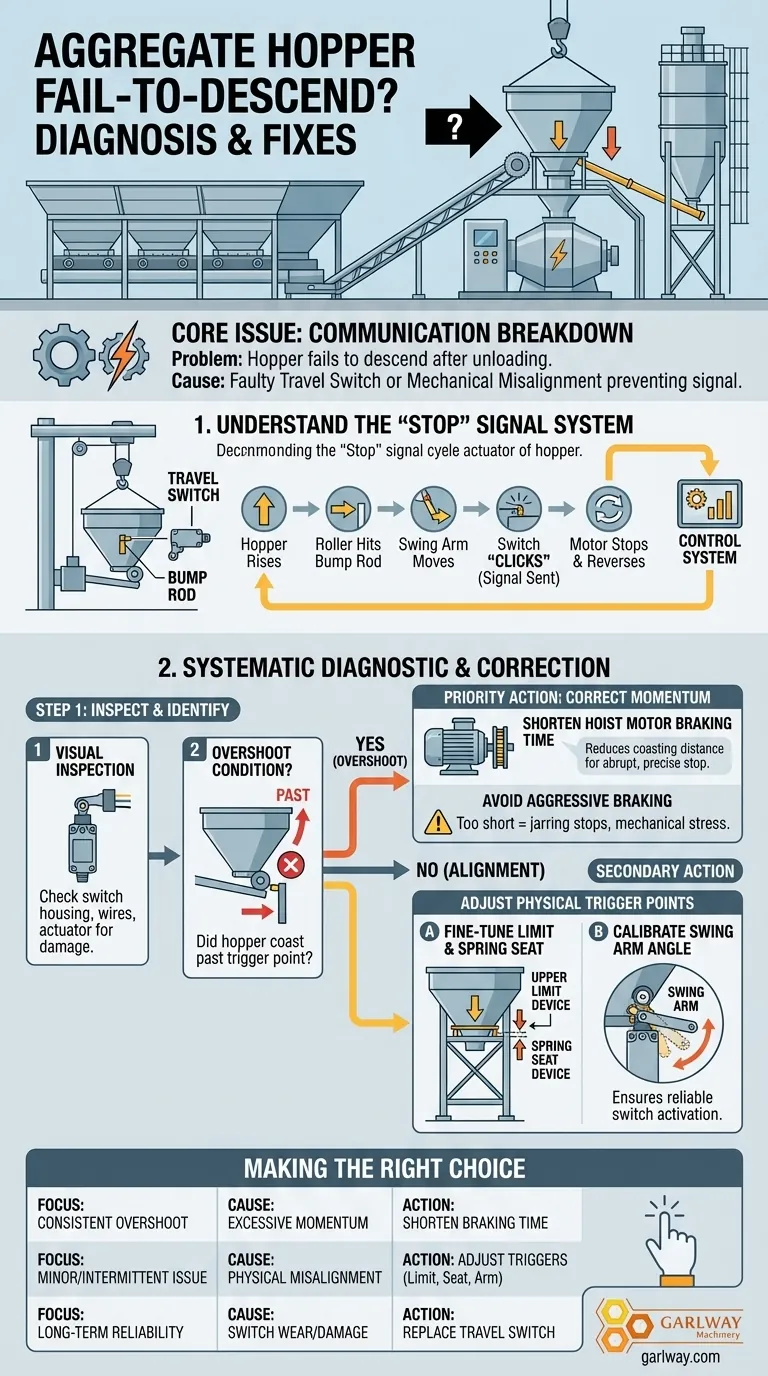
If your aggregate hopper fails to descend after unloading, the immediate focus should be on the travel switch and its activation mechanism. This system is responsible for signaling the hoist motor to stop and reverse, and its failure is the most common cause of this specific problem.
The core issue is a breakdown in communication between the hopper's physical position and the control system. This is almost always caused by either a faulty travel switch or a mechanical misalignment that prevents the switch from being triggered correctly.
Understanding the Hopper's "Stop" Signal
To diagnose the problem, you must first understand the components that tell the hopper it has reached its destination.
The Role of the Travel Switch
The travel switch (also known as a limit switch) is a simple but critical electrical component. Its sole job is to send a signal to the control system when the hopper reaches the correct upper limit.
This signal stops the hoist motor from lifting further and initiates the command for the hopper to descend.
How the Activation Mechanism Works
A mechanical chain of events triggers the switch:
- As the hopper rises, a roller attached to it approaches a bump rod or actuator.
- The roller makes contact with and pushes the bump rod.
- The bump rod moves a swing arm, which in turn presses the actuator on the travel switch.
- The travel switch "clicks," sending the "stop" signal to the motor controller.
If any part of this sequence fails, the hopper will not receive the signal to descend.
A Systematic Diagnostic Approach
Follow these steps in order to isolate and fix the fault efficiently.
Step 1: Inspect the Travel Switch Directly
Before adjusting anything, perform a visual and physical inspection. Look for obvious signs of failure like a broken housing, disconnected wires, or a stuck actuator. A damaged or faulty switch must be repaired or replaced.
Step 2: Identify an Overshoot Condition
Look closely at the hopper's resting position. Has the hopper roller traveled past the bump rod?
This is a classic overshoot, where the hoist motor's momentum caused the hopper to coast past the trigger point before coming to a complete stop. In this state, the switch may have been briefly triggered and then released, leaving the system "stuck" in the up position.
Correcting a Mechanical Overshoot
If you confirm the hopper has overshot its target, the goal is to realign the mechanical stopping point with the electrical signal.
Priority Action: Shorten the Hoist Motor's Braking Time
The most direct way to correct an overshoot is to reduce the hoist motor's coasting distance.
By shortening the braking time in the control system, you make the motor stop more abruptly and precisely. This is the first adjustment you should make.
Secondary Action: Adjust Physical Trigger Points
If adjusting the brake is not sufficient or possible, you must then adjust the physical components to ensure the switch is triggered correctly despite any minor coasting.
These adjustments should be made carefully and tested after each change.
Fine-Tuning the Limit and Spring Seat
Adjust the upper limit device or the spring seat device. These components help define the hopper's final physical stopping point and can be moved slightly to ensure proper contact with the switch actuator.
Calibrating the Swing Arm Angle
Finally, you can adjust the swing arm angle of the travel switch itself. Changing this angle alters the exact moment the switch is activated, allowing you to compensate for the motor's momentum and ensure the signal is sent and held correctly.
Common Pitfalls to Avoid
A methodical approach is crucial for safety and reliability. Avoid these common mistakes.
The Risk of Aggressive Braking
While shortening the brake time is effective, making it too short can cause jarring stops. This increases mechanical stress and wear on gears, cables, and the hopper frame over time. Make small, incremental adjustments.
The Danger of a Misaligned System
The ultimate goal is to ensure the travel switch operates sensitively and reliably every single time. A poorly aligned system that misses the stop signal can lead to catastrophic equipment failure. Always test the system multiple times after making any adjustments.
Making the Right Choice for Your Goal
Use this logic to guide your maintenance actions.
- If your primary focus is fixing a consistent overshoot: Your issue is likely excessive motor momentum. Start by shortening the hoist motor's braking time.
- If your primary focus is correcting a minor or intermittent issue: The problem is more likely in the physical alignment. Focus on fine-tuning the upper limit device, spring seat, and travel switch swing arm.
- If your primary focus is long-term reliability and safety: If the travel switch itself shows any signs of wear, damage, or inconsistent operation, replace it immediately.
A systematic approach that addresses both the motor's braking and the switch's physical alignment is the key to resolving this issue safely and effectively.
Summary Table:
| Problem | Primary Cause | Immediate Action |
|---|---|---|
| Hopper fails to descend after unloading | Faulty travel switch or mechanical misalignment | Inspect travel switch and check for overshoot |
| Hopper overshoots the bump rod | Excessive motor momentum | Shorten the hoist motor's braking time |
| Intermittent or minor alignment issues | Misaligned trigger points | Adjust upper limit device, spring seat, or swing arm angle |
Struggling with unreliable aggregate hopper performance? GARLWAY specializes in construction machinery, providing durable winches, concrete mixers, and batching plants trusted by contractors worldwide. Our experts can help you optimize your equipment for maximum uptime and safety. Contact GARLWAY today for tailored solutions and ensure your project runs smoothly!
Visual Guide
Related Products
- HZS35 Small Cement Concrete Mixing Batch Plant
- Auto Concrete Cement Mixer Machine New
- HZS180 Ready Mix Concrete Plant for Foundations with Sand and Cement
- Small Electric Winch 120V and 240V for Compact Applications
- HZS75 Concrete Batching Plant Cement Mixer Price Concrete Mixer Bunnings Mixing Plant
People Also Ask
- Why buy concrete batch plant parts only from the manufacturer? Protect Your Investment and Maximize Uptime
- Why is proper maintenance important for a concrete batch mix plant? Maximize Uptime & Profitability
- What is the advantage of a mobile concrete batching plant? Achieve On-Site Production & Total Control
- What are the advantages and disadvantages of concrete batching plants? Maximize Quality & Efficiency
- What are the two methods of material charging in a concrete mixing station? Single vs. Multiple Charging Explained