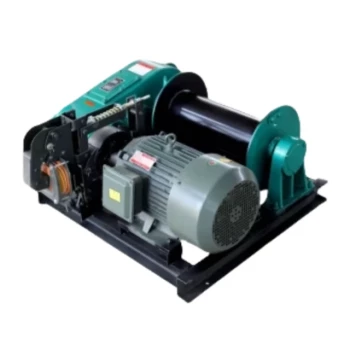
Before any daily operation, a hoist requires a systematic inspection covering its core mechanical components, safety systems, and the immediate work environment. This includes checking the wire rope for damage, verifying the anchor points are secure, testing the brakes and controls, and ensuring the operational area is clear.
A daily pre-operation inspection is not merely a procedural checklist; it is a fundamental safety discipline that verifies the hoist is mechanically sound, functionally responsive, and that the surrounding environment is prepared for a safe lift.
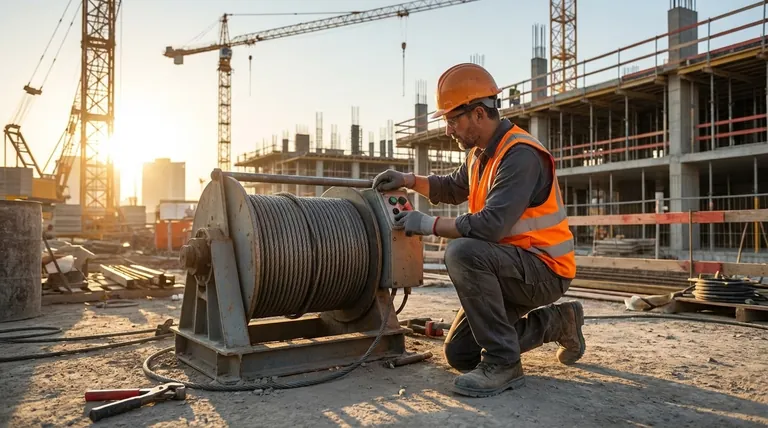
The Systematic Pre-Operation Inspection
A thorough pre-use check can be broken down into three distinct areas: the physical components of the hoist, its control and safety functions, and the operational zone itself. This approach ensures nothing is overlooked.
Mechanical Integrity Checks
The first step is a hands-on visual inspection of the core load-bearing and moving parts.
The wire rope is the most critical component. It must be free of broken wires, kinks, deformation, significant rust, or unauthorized joints. A compromised rope is a primary point of failure.
Next, inspect the anchor or fixed points. These must show no signs of movement, cracking, or deformation. The stability of the entire system relies on a solid anchor.
Examine the ground wheel and other moving parts. They should be intact, rotate smoothly without binding, and be free of cracks or visible damage.
Finally, check the core hoist mechanism itself, including the clutch, brake, ratchet, and pawl. These components control the load and must appear fully functional and properly engaged.
Control and Safety System Verification
Once the mechanical inspection is complete, you must verify that you have complete control over the machine.
Conduct brief tests of all operational controls to ensure they respond as expected. Also, perform a quick visual check of accessible wiring and connectors for any obvious damage or loose connections.
Crucially, you must locate and identify all emergency shut-offs and kill switches before starting any work. Every operator must know exactly how to stop the hoist instantly in an emergency and who to notify.
Essential Functional Tests
A visual check must be followed by a functional test to confirm the systems work under operational conditions.
Before introducing a load, perform a no-load test. Run the hoist through its functions to ensure everything operates smoothly.
It's also wise to manually rotate the gears one full turn (if the hoist design allows). This helps you feel for any binding or issues and provides a tactile check that the parts, especially the brake, are moving correctly.
Securing the Operational Zone
A safe hoist is useless in an unsafe environment. Preparing the area is a non-negotiable part of the pre-use check.
The area around and directly under the load's path must be completely clear of all personnel. This is the most important rule of any lifting operation.
Place warning signs nearby to alert others of the overhead hazard. For particularly heavy, large, or awkward loads, you may need to issue verbal warnings to alert individuals in the vicinity.
Ensure all personnel understand the prearranged signals and gestures that will be used during the lift. Clear communication prevents dangerous misunderstandings.
The Critical Pitfall: Complacency
The single greatest threat to hoist safety is not sudden mechanical failure, but operator complacency. These daily checks can feel repetitive, leading to the temptation to skip them.
This is a dangerous mindset. These routine inspections are designed to catch small issues—a frayed wire, a loose bolt, a sticky control—before they escalate into a catastrophic failure under load.
Treating every pre-use inspection with the seriousness it deserves is the hallmark of a professional and safe operator. The system is only as reliable as its most recent inspection.
Making the Right Choice for Your Goal
Your daily protocol should be consistent but also mindful of the day's specific tasks.
- If your primary focus is routine, repetitive lifting: Your daily habit must be a rigorous check of the wire rope, brakes, and controls, followed by a quick no-load functional test.
- If your primary focus is a complex or near-capacity lift: You must expand your pre-operation check to place extreme emphasis on securing the operational zone, confirming communication signals, and ensuring every crew member knows the emergency stop procedure.
Ultimately, assuming a hoist is safe is not an option; verifying its safety is your first and most important task of the day.
Summary Table:
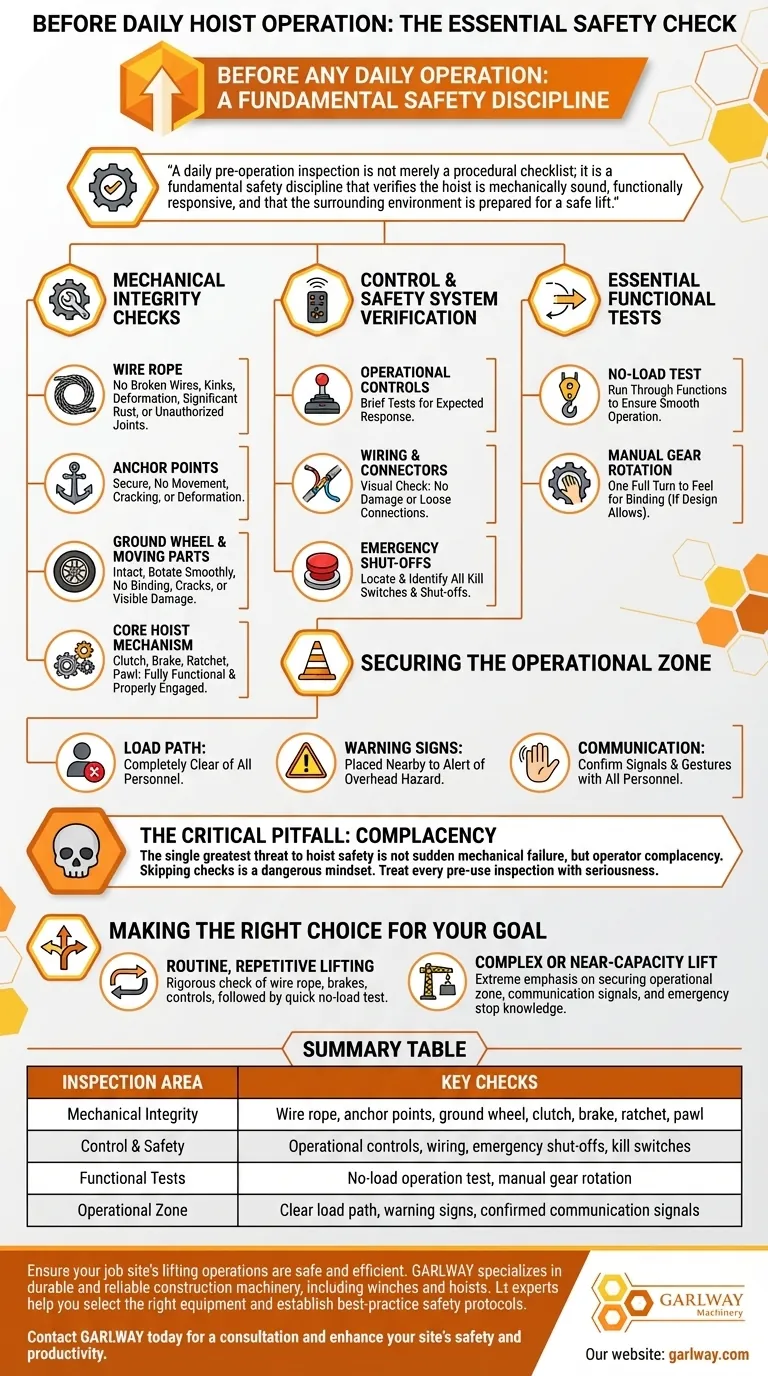
| Inspection Area | Key Checks |
|---|---|
| Mechanical Integrity | Wire rope, anchor points, ground wheel, clutch, brake, ratchet, and pawl |
| Control & Safety | Operational controls, wiring, emergency shut-offs, and kill switches |
| Functional Tests | No-load operation test and manual gear rotation |
| Operational Zone | Clear load path, warning signs, and confirmed communication signals |
Ensure your job site's lifting operations are safe and efficient.
Daily hoist inspections are critical for preventing accidents and downtime. GARLWAY specializes in providing durable and reliable construction machinery, including winches and hoists, designed for the rigorous demands of construction companies and contractors globally.
Let our experts help you select the right equipment and establish best-practice safety protocols. Contact GARLWAY today for a consultation and enhance your site's safety and productivity.
Visual Guide
Related Products
- Electric Hoist Winch Boat Anchor Windlass for Marine Applications
- Electric and Hydraulic Winch for Heavy Duty Applications
- Hydraulic Winding Engine Harbor Freight Winch
- Portable Cement Mixer with Lift Concrete Machine
- 12000 lb Electric Boat Trailer Winch with Windlass Anchor Warn
People Also Ask
- How does an electric anchor winch work? Power, Safety, and Reliable Operation Explained
- What are the advantages of installing an electric anchor winch on a boat? Boost Safety & Ease for Boaters
- What are the operational differences between electric hoists and winches? A Guide to Safe Lifting vs. Pulling
- What are the main benefits of a boat anchor winch? Boost Safety & Efficiency for Your Vessel
- How does a boat anchor winch work? A Guide to Reliable Anchor Handling