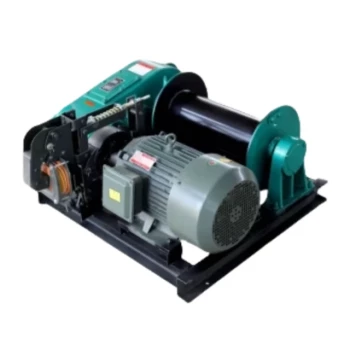
At its core, a modern winch control box integrates several critical safety features designed to prevent accidental operation and mechanical failure. Key among these are Safe Torque Off (STO) capabilities, electrical interlocking that prevents simultaneous rewind and unwind signals, and a reed safety contact that deactivates the motor when a manual crank is engaged.
A winch control box is more than a simple on/off switch; it is an intelligent safety system. Its primary function is to prevent the most common and dangerous failure modes by ensuring the winch only operates when explicitly commanded and never in a conflicting or unsafe state.
The Core Principle: Preventing Unintended Operation
The most catastrophic winch failures occur when the machine acts unexpectedly. The safety features within the control box are engineered to create a predictable and reliable system, ensuring the winch motor only receives power when the operator issues a clear, safe command.
Electrical Interlocking for Commands
The control scheme often uses a reverted connection for the rewind and unwind buttons. This is a form of electrical interlocking.
It physically prevents the circuitry from ever sending both a "forward" and "reverse" signal to the motor at the same time. This simple design feature protects the motor and drivetrain from the extreme stress of conflicting commands.
Manual Override Protection
Many winches have a manual crank for use during power failure. Engaging the motor while an operator is using the crank is extremely dangerous.
To prevent this, a reed safety contact or similar sensor is used. When the manual crank is inserted or engaged, this sensor physically opens the circuit, deactivating the entire electrical control scheme and making it impossible to start the motor.
Safe Torque Off (STO)
Safe Torque Off is a more advanced, certified safety function found in modern industrial motor drives.
STO cuts power to the motor's windings, preventing it from generating torque (rotational force). It achieves this reliably without needing to shut down the entire control box, allowing for a faster and safer restart once the situation is resolved.
Operator-Focused Safety Features
Beyond the internal circuitry, several features are built into the operator's interface to enhance control and safety during a pull.
The Emergency Stop Button
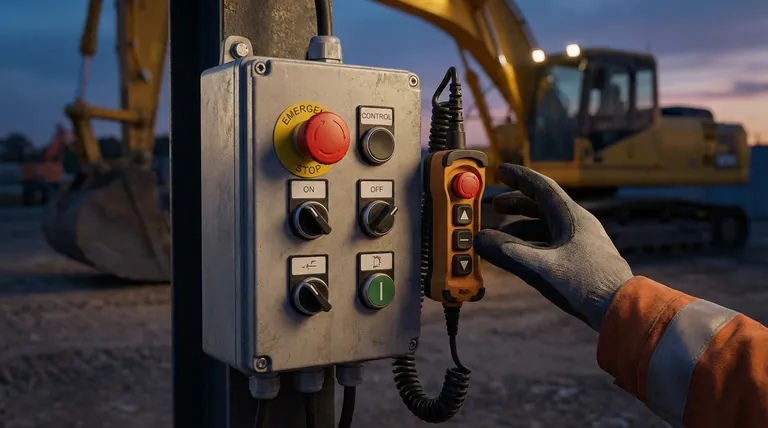
An emergency stop button is a critical, manually operated feature. When pressed, it immediately cuts power to the winch motor, halting all operations in a crisis situation.
Remote Control Operation
Using a wired or wireless remote control is a fundamental safety practice. It allows the operator to stand at a safe distance from the winch, cable, and load. This positioning is vital to avoid injury from a snapping cable or a shifting load.
Controlled Speed Operation
Features like two-speed or variable-speed control enhance safety by giving the operator more precise command over the load. The ability to perform slow, deliberate movements is crucial for positioning heavy or delicate objects without dangerous, jerky motions.
Understanding System-Level Safety
The control box is a critical component, but it works as part of a larger system. Understanding its limitations is key to safe operation.
Control Box vs. Mechanical Brakes
The control box manages the motor's operation, telling it when to start and stop.
However, a separate mechanical load-holding brake is what physically prevents the drum from reversing under load. The control system and the mechanical brake must work together to ensure the load is always secure.
The Importance of the Entire System
A safe winch system depends on more than just the controls. The choice between a synthetic rope and a steel cable, the winch's structural integrity, and proper rigging techniques are all equally important parts of the overall safety equation. The control box cannot compensate for a frayed cable or an improper anchor point.
Making the Right Choice for Your Application
To evaluate a winch's safety, consider how its features align with your specific needs.
- If your primary focus is industrial compliance or high-risk environments: Prioritize winches with certified safety functions like Safe Torque Off (STO) and professionally integrated emergency stop circuits.
- If your primary focus is vehicle recovery or intermittent use: Ensure the control system has a reliable remote, clear protection against conflicting commands, and robust mechanical braking.
- If your primary focus is any application with a manual override: Confirm there is a dedicated safety mechanism, like a reed switch, that absolutely prevents motor activation when the crank is in use.
Ultimately, understanding these safety features empowers you to select the right equipment and operate it with the confidence that comes from control.
Summary Table:
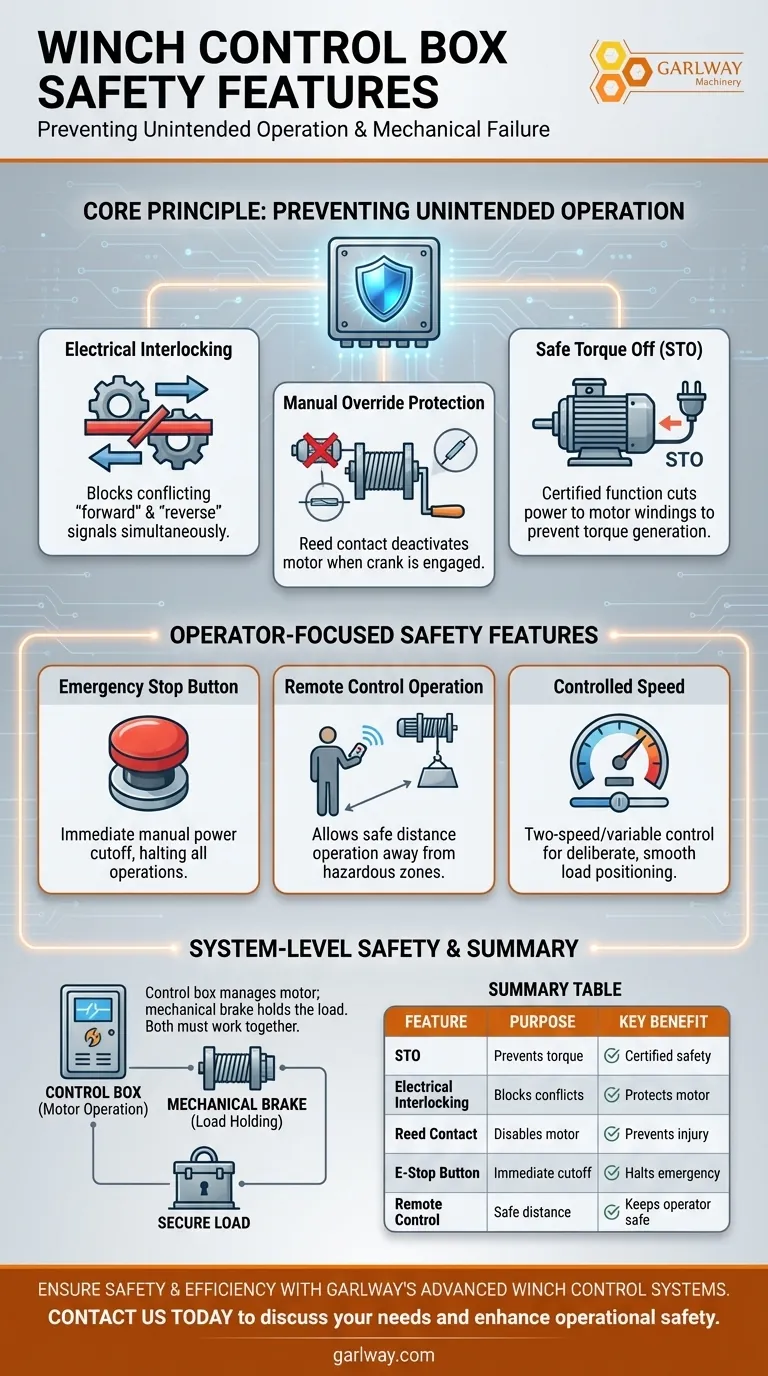
| Safety Feature | Purpose | Key Benefit |
|---|---|---|
| Safe Torque Off (STO) | Prevents motor torque generation | Certified safety, prevents unintended movement |
| Electrical Interlocking | Blocks conflicting commands | Protects motor from stress and damage |
| Reed Safety Contact | Disables motor during manual cranking | Prevents operator injury during override |
| Emergency Stop Button | Immediate power cutoff | Halts operations in an emergency |
| Remote Control Operation | Allows operation from a safe distance | Keeps operator away from hazardous loads |
Ensure your project's safety and efficiency with GARLWAY's advanced winch control systems.
GARLWAY specializes in construction machinery, offering robust winches, concrete mixers, and batching plants for construction companies and contractors globally. Our winch control boxes are engineered with industry-leading safety features to protect your team and equipment, ensuring reliable performance in demanding environments.
Contact us today to discuss your specific needs and discover how GARLWAY's solutions can enhance your operational safety and productivity.
Visual Guide
Related Products
- Small Electric Winch 120V and 240V for Compact Applications
- Portable Small Trailer Winch
- Electric and Hydraulic Winch for Heavy Duty Applications
- Quick Windlass Portable Winch for Truck and Boat Best Boat Winch
- Electric Hoist Winch Boat Anchor Windlass for Marine Applications
People Also Ask
- What makes electric winches suitable for off-road use? Key Features for Reliable Vehicle Recovery
- What are the common applications of electric winches? Power Your Lifting & Pulling Tasks
- What are the common uses of an electric winch? A Guide to Safe and Efficient Heavy Lifting
- What are the uses of electric winches in mining and tunneling? Enhance Safety and Efficiency Underground
- How do electric winches contribute to energy savings? Maximize Efficiency and Lower Costs