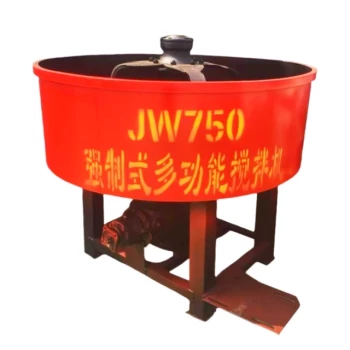
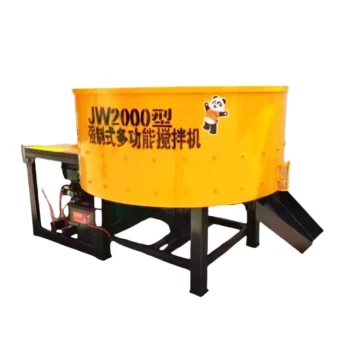
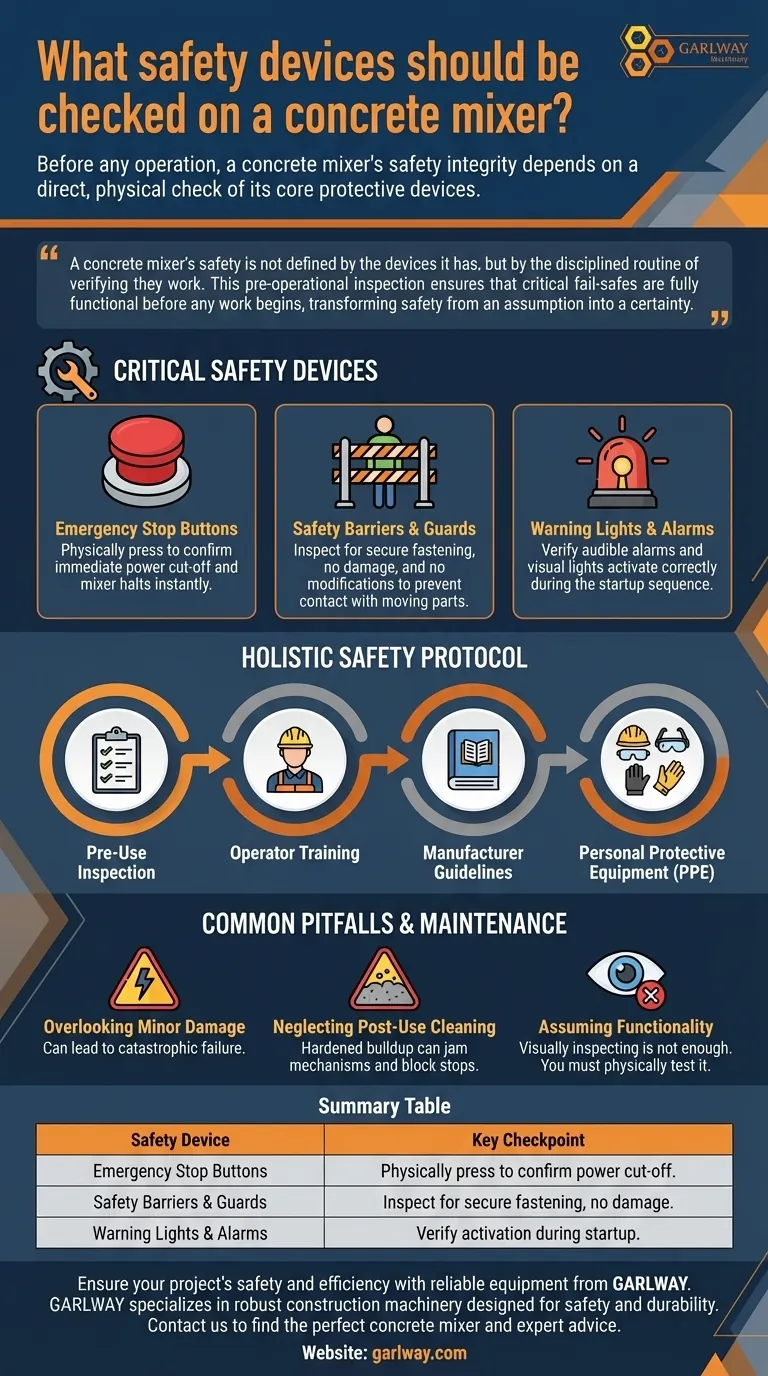
Before any operation, a concrete mixer's safety integrity depends on a direct, physical check of its core protective devices. The most critical components to verify are the emergency stop buttons, all safety barriers or guards, and any installed warning lights and alarms.
A concrete mixer's safety is not defined by the devices it has, but by the disciplined routine of verifying they work. This pre-operational inspection ensures that critical fail-safes are fully functional before any work begins, transforming safety from an assumption into a certainty.
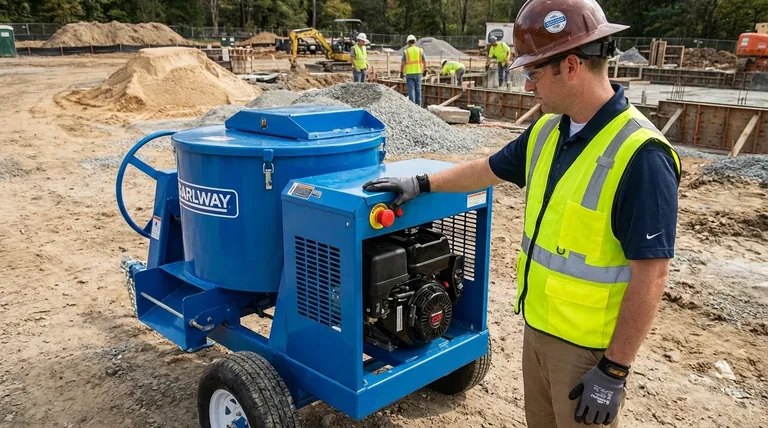
A Breakdown of Critical Safety Devices
To conduct a meaningful check, you must understand the specific function of each safety component and what constitutes a "pass" or "fail."
Emergency Stop Buttons
These buttons are designed to immediately halt all mixer functions in an emergency. The check is simple but non-negotiable: physically press the button to confirm it cuts power and that the mixer stops instantly.
Safety Barriers and Guards
Guards, grates, and barriers physically prevent operators from coming into contact with moving parts, such as the rotating drum, gears, or engine components. Inspect them to ensure they are securely fastened, undamaged, and have not been modified or removed.
Warning Lights and Alarms
Audible alarms and visual lights signal that the mixer is in operation, reversing, or has a fault. Before starting the engine, confirm that these systems activate correctly during the startup sequence.
Beyond Devices: A Holistic Safety Protocol
Functional devices are only one part of a comprehensive safety strategy. The operational environment and user knowledge are equally important.
The Foundation of Pre-Use Inspection
Conducting a safety check before every use is the single most effective way to prevent accidents. This routine identifies potential failures before they can cause harm and reinforces a culture of safety consciousness.
The Role of Operator Training
A safety device is only effective if the operator understands its purpose and how to use it. Proper training, based on the manufacturer's instructions, is essential for safe operation and for knowing how to react in an emergency.
Following Manufacturer Guidelines
Safe operation extends to how the machine is used. Adhering to the manufacturer's instructions for loading materials, respecting capacity limits to avoid overfilling, and proper post-use cleaning are all crucial aspects of operational safety.
Personal Protective Equipment (PPE)
The operator is the final layer of defense. Always wear appropriate safety gear, including eye protection to guard against splashes and durable gloves to protect hands.
Common Pitfalls and Maintenance Habits
Complacency is the greatest risk in routine operations. Certain oversights can completely undermine the effectiveness of a mixer's safety features.
Overlooking Minor Damage
A small crack in a safety guard or a loose mounting bolt can seem insignificant. However, under the stress and vibration of operation, these minor issues can lead to catastrophic failure.
Neglecting Post-Use Cleaning
Hardened concrete buildup can jam mechanisms, block emergency stop buttons, or hide developing cracks in components. Thorough cleaning after every use is a critical maintenance and safety task.
Assuming Functionality
Visually inspecting a safety button is not enough. You must physically test it. Similarly, looking at a safety guard doesn't confirm it's secure. Always physically verify that safety components are tight and in their proper place.
Implementing a Reliable Safety Check
To integrate these checks effectively, tailor your approach to your operational needs.
- If your primary focus is daily operational safety: Create a simple, mandatory pre-start checklist that every operator must complete and sign before using the mixer.
- If your primary focus is long-term equipment reliability: Schedule and document regular, in-depth maintenance that includes inspecting the structural integrity of all guards and the wiring for all safety circuits.
- If your primary focus is building a team-wide safety culture: Implement a clear and immediate protocol for reporting any safety concern or device malfunction, ensuring no operator feels pressured to use compromised equipment.
A consistent and thorough safety check is the foundation of a productive and accident-free worksite.
Summary Table:
| Safety Device | Key Checkpoint |
|---|---|
| Emergency Stop Buttons | Physically press to confirm immediate power cut-off. |
| Safety Barriers & Guards | Inspect for secure fastening, no damage, and no modifications. |
| Warning Lights & Alarms | Verify they activate correctly during the startup sequence. |
Ensure your project's safety and efficiency with reliable equipment from GARLWAY.
GARLWAY specializes in providing robust construction machinery, including concrete mixers, winches, and batching plants, designed with safety and durability for construction companies and contractors globally. Our machines are built to meet rigorous standards, helping you maintain a safe worksite and avoid costly downtime.
Contact us today to find the perfect concrete mixer for your needs and get expert advice on safe operation and maintenance.
Visual Guide
Related Products
- Portable Concrete Mixer Machine Equipment for Mixing Concrete
- Construction Products Concrete Plant Machine Mixing Concrete Mixer
- Portable Electric Concrete Mixer Machine for Cement Mixing
- JZC400 Mobile Small Concrete Mixer Cement Mixer Machine
- Hydraulic Concrete Mixer Machine Cement Mixing Equipment for Mixture Concrete
People Also Ask
- Why is it necessary to use a portable concrete mixer? Gain Total Control & Efficiency
- How much concrete can you pour with a portable mixer? Find the Perfect Fit for Your Project
- What types of projects are portable concrete mixers suitable for? Ideal for DIY & Small-Scale Construction
- How much does a portable concrete mixer hold? A Guide to Choosing the Right Capacity
- What types of portable concrete mixers exist? Find the Perfect Mixer for Your Project