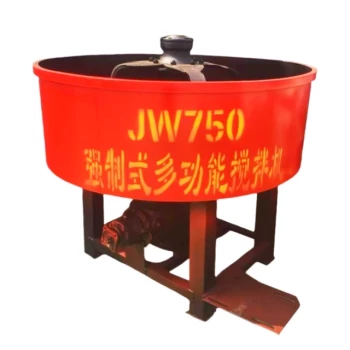
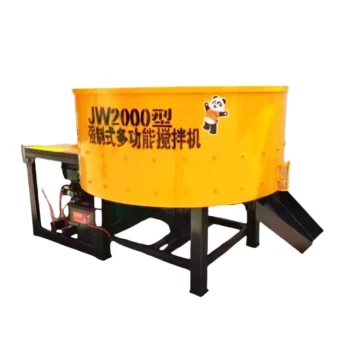
At its core, a pan mixer's efficiency stems from its forced-action mixing mechanism. Unlike mixers that rely on gravity, a pan mixer uses a system of rotating blades, or a rotating pan, to shear, fold, and force materials together. This high-energy process guarantees a fast, consistent, and exceptionally homogeneous mix that is difficult to achieve with other batch mixer designs.
The true efficiency of a pan mixer isn't just about speed; it's about the superior quality and consistency of the final product. Its design is engineered to eliminate weak spots and ensure every particle is evenly coated, which is critical for high-performance applications.
The Mechanics of Forced-Action Mixing
To understand a pan mixer's efficiency, you must first understand that it operates on a completely different principle than more common drum mixers.
A Deliberate Action, Not a Tumble
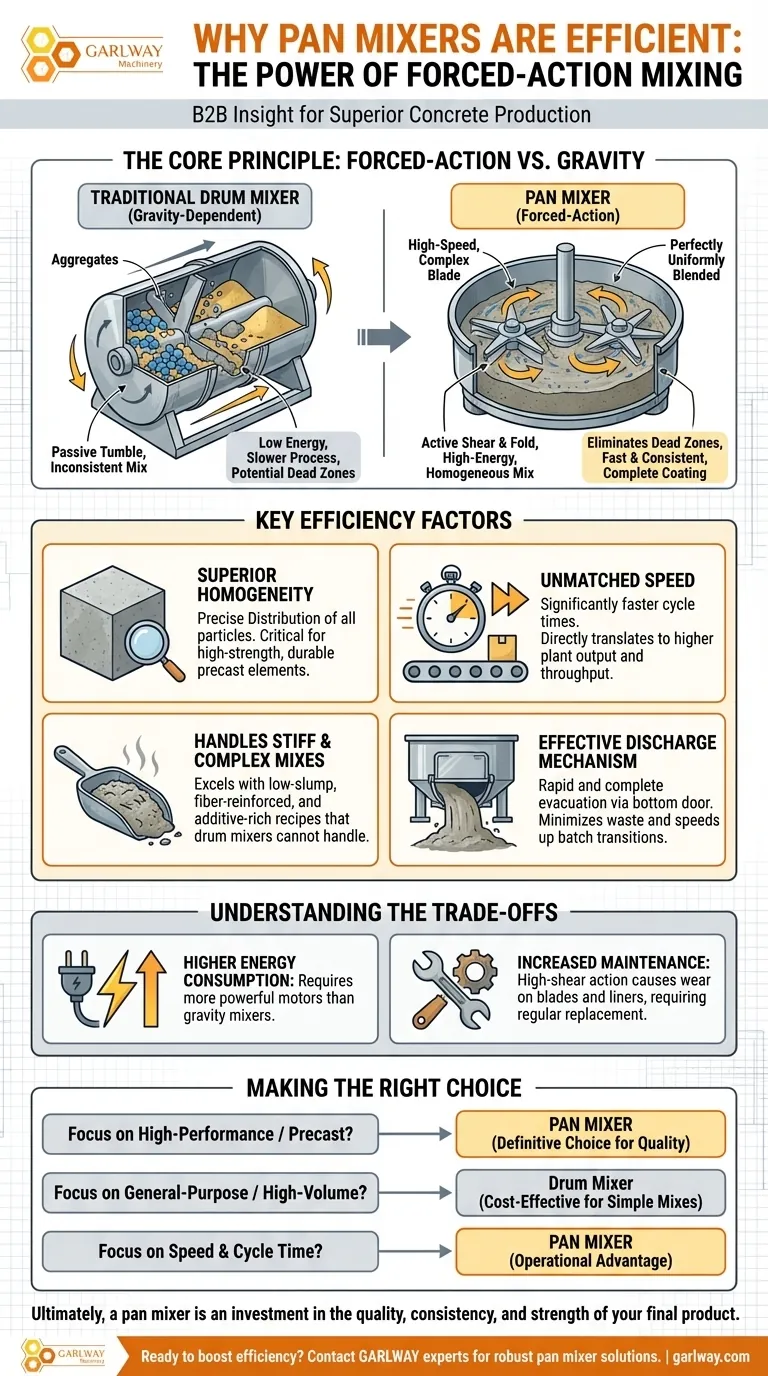
A traditional drum mixer tumbles material, relying on gravity and random chance for particles to combine. This is a relatively low-energy, passive process.
A pan mixer, however, employs a forced-action method. It actively forces the materials to interact through a high-speed, high-shear process, ensuring nothing is left to chance.
The Role of Star-Shaped Blades
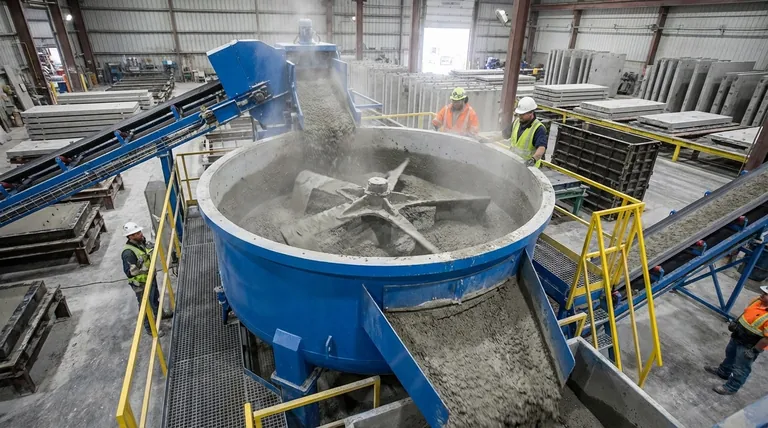
The mixing is typically performed by star-shaped blade assemblies that rotate inside a stationary cylindrical pan.
These blades are precisely engineered to cover the entire floor and walls of the pan, scraping and moving material from the edges to the center. This systematic coverage eliminates "dead zones" where unmixed material could hide.
Two Core Configurations
While the most common design features a static pan and rotating blades, another configuration exists where the pan itself rotates against stationary blades.
Both designs achieve the same goal: ensuring every particle within the batch is constantly in motion and interacting with the others.
What "Efficiency" Means in This Context
The term efficiency extends beyond simple speed. For a pan mixer, it encompasses the quality of the mix, its versatility, and the effectiveness of its operation from start to finish.
Superior Homogeneity
The primary benefit of forced-action mixing is a highly homogeneous end product. This means the cement paste, aggregates, and any additives are perfectly and evenly distributed.
This level of consistency is critical for producing high-strength, durable concrete, especially for precast elements where quality control is paramount.
Unmatched Speed for Batch Production
The intense mixing action dramatically reduces the time required to achieve a complete and uniform mix.
For production environments like precast concrete plants, these faster cycle times translate directly into higher output and greater operational efficiency.
Handling Stiff and Complex Mixes
Pan mixers excel where drum mixers struggle. Their powerful action can easily handle stiff, low-slump concrete mixtures or complex recipes containing fibers and special admixtures.
The force generated is sufficient to break down clumps and ensure even distribution in materials that would simply not mix properly by tumbling alone.
Effective Discharge Mechanism
Efficiency also includes getting the material out of the mixer. Pan mixers typically feature a large discharge door on the bottom of the pan.
This allows for a rapid and complete evacuation of the mixed batch, minimizing waste and speeding up the transition to the next cycle.
Understanding the Trade-offs
No single design is perfect for every situation. The high performance of a pan mixer comes with specific considerations.
Higher Energy Consumption
Forced-action mixing is an energy-intensive process. It requires a more powerful motor than a comparable-sized drum mixer that uses gravity to assist its work.
Increased Maintenance and Wear
The high-shear action and direct contact between the blades and the aggregate cause significant wear over time.
Mixer blades and pan floor/wall liners are considered consumable parts that require regular inspection and replacement to maintain performance.
Making the Right Choice for Your Application
Selecting the right mixer depends entirely on the requirements of your final product and your operational priorities.
- If your primary focus is high-performance or precast concrete: The superior homogeneity and ability to handle stiff mixes make the pan mixer the definitive choice.
- If your primary focus is general-purpose, high-volume concrete: A simpler drum mixer may offer a more cost-effective solution, provided the mix designs are not overly complex.
- If your primary focus is production speed and cycle time: The fast mixing and discharge capabilities of a pan mixer are a significant operational advantage.
Ultimately, choosing a pan mixer is an investment in the quality, consistency, and strength of your final product.
Summary Table:
| Key Efficiency Factor | Description |
|---|---|
| Mixing Mechanism | Forced-action with rotating blades for high-shear, uniform mixing. |
| Mix Quality | Superior homogeneity, essential for high-strength and precast concrete. |
| Speed | Faster cycle times compared to gravity-dependent drum mixers. |
| Versatility | Effectively handles stiff mixes and complex recipes with fibers/admixtures. |
| Discharge | Rapid and complete batch evacuation via a bottom discharge door. |
Ready to boost your project's efficiency and concrete quality?
GARLWAY specializes in providing robust construction machinery, including high-performance pan mixers, for construction companies and contractors globally. Our mixers are engineered to deliver the consistent, high-quality results your demanding projects require.
Contact our experts today to find the perfect mixer solution for your specific needs!
Visual Guide
Related Products
- HZS25 Best Cement Mixer for Quick Mix Concrete at Bunnings
- Portable Concrete Mixer Machine Equipment for Mixing Concrete
- Harbor Freight JS1500 On Site Concrete Mixing Volumetric Cement Mixer
- Concrete Cement Mixer Machine Drum Mixer for Construction
- JDC350 Small Cement Concrete Mortar Mixer
People Also Ask
- How do cement mixers enhance safety on construction sites? Reduce Strain, Hazards, and Accidents
- What are the main components of a cement mixer? A Guide to Core Parts & Functions
- What are some tips for using a cement mixer effectively? Maximize Your Mixer's Performance & Concrete Quality
- How does cleaning a cement mixer after use benefit its performance? Maximize Lifespan and Mix Quality
- Why is it important to clean the cement mixer after use? Prevent Costly Damage and Ensure Quality Concrete