In essence, a self-loading mixer thrives in mountainous regions because it combines the capabilities of a wheel loader, a concrete mixer, and a transport truck into a single, compact, all-terrain machine. Its four-wheel drive, high ground clearance, and operational independence make it uniquely suited for the logistical challenges posed by steep, remote, and undeveloped sites.
A self-loading mixer is not just a piece of equipment; it's a complete, mobile concrete production solution. Its value in mountainous terrain comes from its ability to overcome the fundamental obstacles of accessibility, space, and infrastructure that render traditional methods impractical.
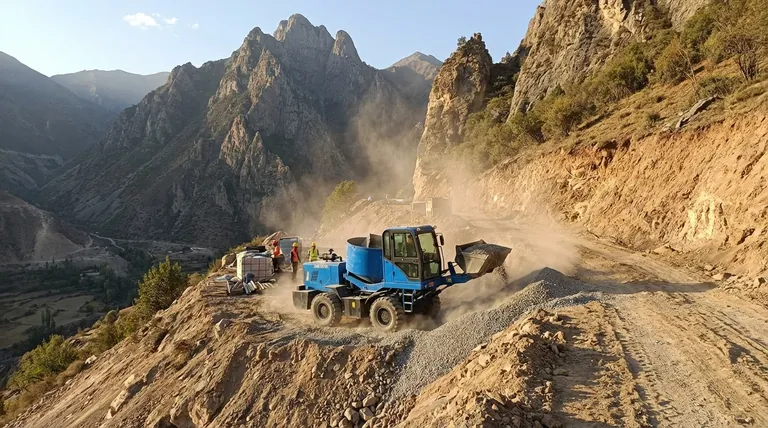
The Core Challenge: Concrete in Remote Terrain
Producing and delivering concrete to a standard construction site is a streamlined, predictable process. Mountainous regions, however, introduce a unique set of variables that break this conventional workflow.
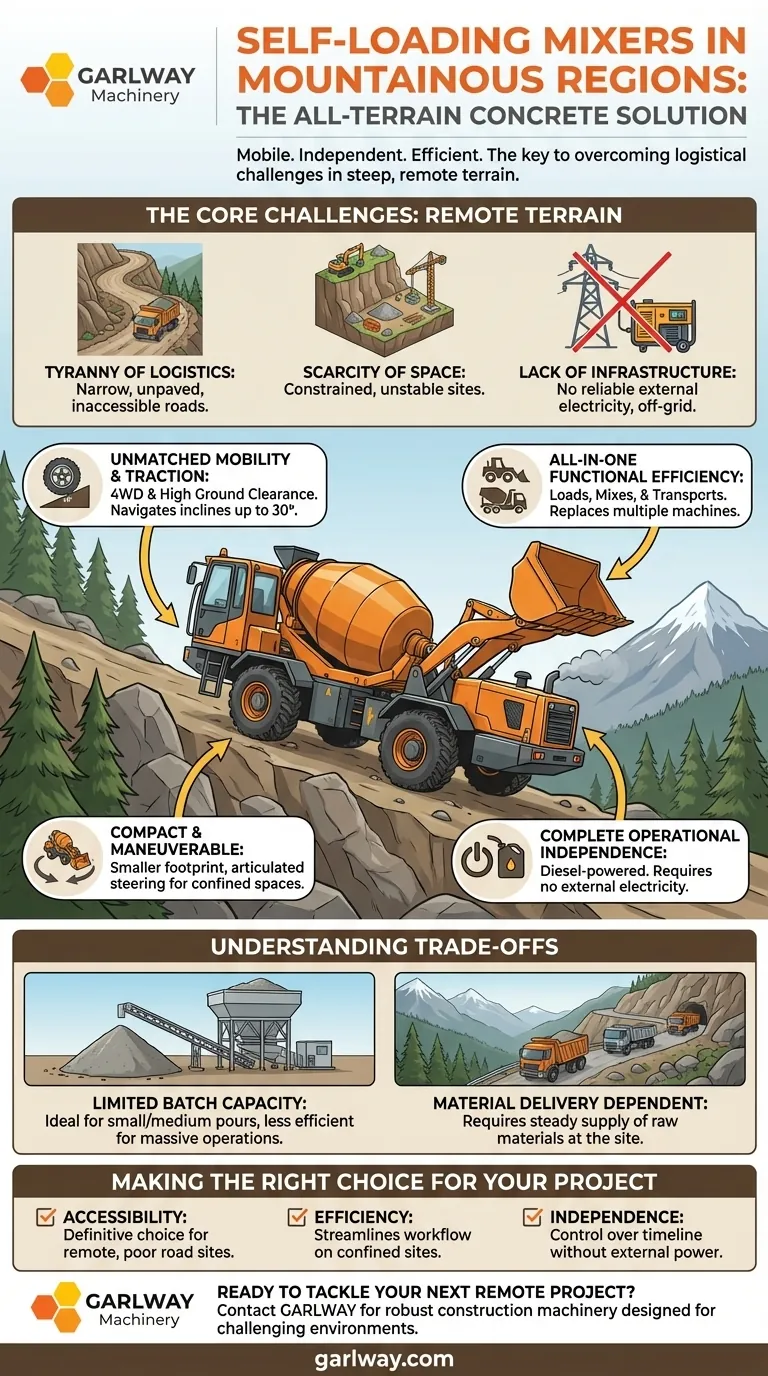
The Tyranny of Logistics
Mountain roads are often narrow, winding, and unpaved. This makes it difficult, if not impossible, for large, heavy vehicles like traditional concrete transit trucks and separate wheel loaders to access the site.
The Scarcity of Space
Construction sites in hilly areas are frequently constrained. There is often not enough flat, stable ground to set up a conventional batching plant, store materials, and maneuver multiple large machines.
The Lack of Infrastructure
Remote mountain locations typically lack reliable access to the electrical grid. Equipment that requires an external power source is often a non-starter, forcing crews to rely on less efficient, generator-powered solutions.
Key Capabilities for Mountain Operations
A self-loading mixer is engineered to directly solve these problems. Its design is a masterclass in efficiency and all-terrain performance, built around four critical features.
Unmatched Mobility and Traction
The most crucial feature is its four-wheel drive system, often coupled with high ground clearance. This allows the machine to confidently navigate rough, uneven ground and steep inclines, with some models capable of operating on slopes up to 30 degrees.
This all-terrain capability ensures the mixer can reach job sites that are completely inaccessible to standard road-based vehicles.
All-in-One Functional Efficiency
The machine integrates a self-loading bucket, a mixing drum, and the vehicle chassis. This single unit performs the work of a wheel loader (loading aggregates), a mixer (producing concrete), and a dumper (transporting and placing the concrete).
This consolidation is a massive logistical advantage, eliminating the need to transport, fuel, and operate three separate pieces of equipment.
Compact and Maneuverable Design
By design, self-loading mixers are more compact than the combination of equipment they replace. Their smaller footprint and articulated steering allow them to operate effectively in the confined spaces typical of mountain construction.
Complete Operational Independence
These mixers are powered by their own diesel engines, meaning they require no external electricity to operate. This self-sufficiency is vital for off-grid projects, allowing for consistent concrete production anywhere the machine can physically reach.
Understanding the Trade-offs
While highly effective, self-loading mixers are not a universal solution. Understanding their limitations is key to using them correctly.
Limited Batch Capacity
Compared to a dedicated batching plant, a self-loading mixer has a smaller per-batch output. It is ideal for small to medium-sized pours, foundational work, or repair jobs, but may be inefficient for massive, continuous pouring operations.
Dependence on Material Delivery
The mixer itself is self-sufficient, but it still requires a steady supply of raw materials (cement, sand, aggregate, water) at the site. The logistics of getting these base materials to a remote mountain location remain a primary planning challenge.
Making the Right Choice for Your Project
Choosing a self-loading mixer depends entirely on the constraints and goals of your specific project.
- If your primary focus is accessibility: The mixer's 4WD and compact size make it the definitive choice for projects on remote sites with poor or non-existent roads.
- If your primary focus is efficiency on a confined site: The all-in-one functionality is invaluable, reducing machine clutter and streamlining the entire concrete production workflow.
- If your primary focus is project independence: The ability to produce concrete without relying on external power or a distant batching plant gives you ultimate control over your timeline and quality.
Ultimately, a self-loading mixer transforms the challenge of remote construction from a logistical nightmare into a manageable, self-contained operation.
Summary Table:
| Feature | Benefit for Mountainous Regions |
|---|---|
| 4WD & High Ground Clearance | Navigates steep inclines (up to 30°) and rough, unpaved roads inaccessible to standard trucks. |
| All-in-One Design | Combines loading, mixing, and transport into one machine, eliminating the need for multiple vehicles. |
| Compact & Maneuverable | Operates effectively in confined, unstable sites where space is limited. |
| Operational Independence | Diesel-powered; requires no external electricity, ideal for off-grid locations. |
Ready to tackle your next remote or mountainous construction project with confidence?
At GARLWAY, we specialize in robust construction machinery designed for challenging environments. Our range of self-loading mixers, along with winches, concrete mixers, and batching plants, provides the reliability and efficiency that construction companies and contractors need to succeed globally.
Let us help you streamline your operations and overcome logistical hurdles. Contact our experts today for a personalized consultation and discover the right equipment for your specific terrain and project requirements.
Visual Guide
Related Products
- Skid Steer Self Loading Concrete Mixers for Construction
- Belle Mixer Drum Self Loading Mortar Mixers JS3000
- Portable Cement Mixer with Lift Concrete Machine
- Portable Concrete Mixer Machine Equipment for Mixing Concrete
- JW1000 Mobile Cement Mixer Concrete Mixer Truck and Batching Plant
People Also Ask
- How does the control system improve production efficiency in a self loading concrete mixer? Automate Mixing for Speed & Quality
- What is the purpose of keeping the drum rotating during transportation in a self loading concrete mixer? Ensure Quality & Consistency
- How does the weighing process work in a self loading concrete mixer? Achieve Precise, On-Site Concrete Batching
- What components are involved in the loading process of a self loading concrete mixer? A Guide to the Key Systems
- How should materials be loaded into a self-loading concrete mixer? Master the Step-by-Step Process