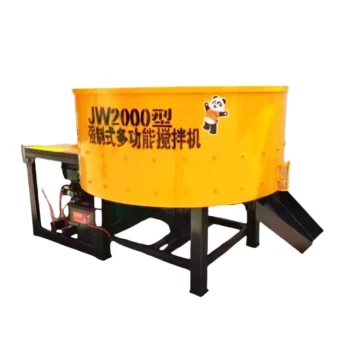
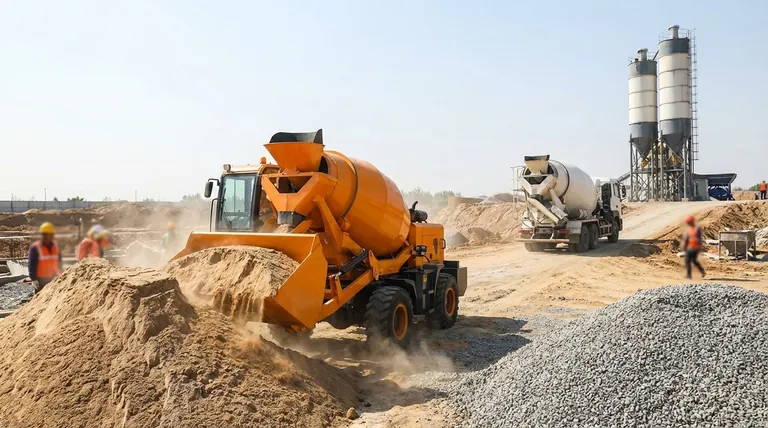
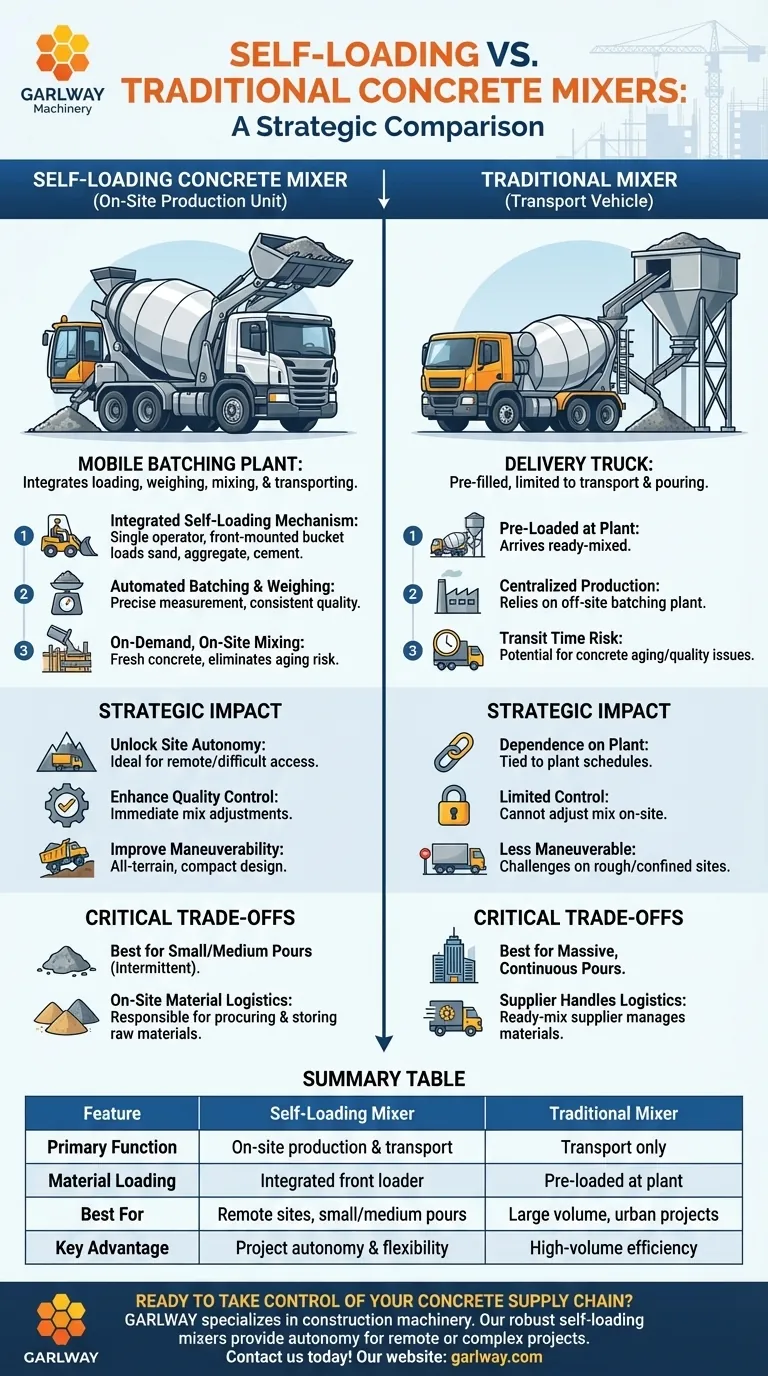
At its core, a self-loading concrete mixer is a mobile batching plant, while a traditional mixer is simply a transport vehicle. The self-loading mixer integrates the functions of loading raw materials, weighing, mixing, and transporting into a single, automated machine. This fundamentally changes its role on a construction site from a delivery truck to an on-demand production unit.
The essential difference isn't just about loading; it's a strategic shift from a centralized production model (a batching plant supplying multiple trucks) to a decentralized, on-site production model where concrete is created exactly when and where it's needed.
From Transportation to All-in-One Production
The most significant distinction lies in the scope of their function. A traditional mixer truck arrives pre-filled with ready-mix concrete from a central plant, limiting its role to transportation and pouring. A self-loading mixer handles the entire process from start to finish.
The Self-Loading Mechanism
A self-loading mixer is equipped with a front-mounted articulated bucket. This mechanism allows a single operator to load the necessary raw materials—sand, aggregate, and cement—directly into the mixing drum without requiring a separate loader or manual labor.
Integrated Batching and Weighing
These machines feature sophisticated, automated weighing systems. The operator sets the required mix design, and the machine precisely measures each component as it's loaded, ensuring consistent quality and minimizing material waste.
On-Demand, On-Site Mixing
Because it carries raw materials, a self-loading mixer produces fresh concrete on-site. This eliminates the risk of the concrete aging during long transit times from a central plant, which can be a critical factor for quality and workability.
The Strategic Impact on Project Workflow
This all-in-one capability creates several operational advantages that can dramatically alter how a project is managed, particularly in challenging environments.
Unlocking Site Autonomy
By producing concrete on-site, these mixers eliminate dependence on a central batching plant. This is a game-changer for remote projects, sites with difficult access, or jobs that require concrete outside a plant's normal operating hours.
Enhancing Quality Control
The ability to make immediate adjustments to the mix design provides superior control. If site conditions change or a specific batch requires a different consistency, the operator can modify the recipe instantly, ensuring optimal performance.
Improving Maneuverability
Self-loading mixers are often designed with all-terrain capabilities and compact chassis. Their enhanced maneuverability allows them to navigate rough or confined construction sites where a larger, traditional mixer truck might struggle.
Understanding the Critical Trade-offs
While powerful, the self-loading mixer is not a universal solution. Its advantages come with trade-offs that must be considered for proper application.
Volume vs. Versatility
A self-loading mixer is ideal for small-to-medium volume pours or projects requiring intermittent batches. For massive, continuous pours like a large building foundation, the output of a dedicated batching plant supplying a fleet of traditional trucks is far more efficient.
Operational Responsibility
While the machine itself may only need one operator, the overall process shifts the burden of raw material logistics to the job site. You become responsible for procuring, storing, and managing sand, aggregate, cement, and water, which a ready-mix supplier would normally handle.
The Potential for Error
The promise of consistent quality hinges on proper machine calibration and skilled operation. Unlike a certified batching plant with rigorous quality checks, an improperly used or poorly maintained self-loading mixer can produce inconsistent or poor-quality concrete. The precision is a feature of the machine, not an automatic guarantee.
Making the Right Choice for Your Project
Choosing between these two systems depends entirely on your project's specific constraints and goals.
- If your primary focus is massive, continuous volume in an accessible urban area: A traditional ready-mix supplier provides the most efficient and cost-effective solution.
- If your primary focus is a remote site or one with difficult terrain: A self-loading mixer provides unparalleled autonomy and access, eliminating long transit times.
- If your primary focus is on projects with multiple small, custom, or intermittent pours: The on-demand production of a self-loading mixer minimizes waste and ensures fresh concrete for each task.
- If your primary focus is budget control on smaller projects: A self-loading mixer can reduce labor costs and eliminate the premium prices associated with small-batch deliveries from a central plant.
Ultimately, understanding this equipment means seeing it not just as a mixer, but as a strategic tool for controlling your project's concrete supply chain.
Summary Table:
| Feature | Self-Loading Mixer | Traditional Mixer |
|---|---|---|
| Primary Function | On-site production & transport | Transport only |
| Material Loading | Integrated front loader | Pre-loaded at plant |
| Best For | Remote sites, small/medium pours | Large volume, urban projects |
| Key Advantage | Project autonomy & flexibility | High-volume efficiency |
Ready to take control of your concrete supply chain? GARLWAY specializes in construction machinery, offering robust self-loading concrete mixers for construction companies and contractors globally. Our machines provide the autonomy and on-site production capabilities you need for remote or complex projects. Contact our experts today to find the perfect solution for your specific needs and enhance your project's efficiency!
Visual Guide
Related Products
- Skid Steer Self Loading Concrete Mixers for Construction
- Belle Mixer Drum Self Loading Mortar Mixers JS3000
- Portable Cement Mixer with Lift Concrete Machine
- Portable Concrete Mixer Machine Equipment for Mixing Concrete
- Portable Ready Mix Concrete Mixer Equipment
People Also Ask
- How does the control system improve production efficiency in a self loading concrete mixer? Automate Mixing for Speed & Quality
- What is the purpose of keeping the drum rotating during transportation in a self loading concrete mixer? Ensure Quality & Consistency
- How does the weighing process work in a self loading concrete mixer? Achieve Precise, On-Site Concrete Batching
- What components are involved in the loading process of a self loading concrete mixer? A Guide to the Key Systems
- How should materials be loaded into a self-loading concrete mixer? Master the Step-by-Step Process