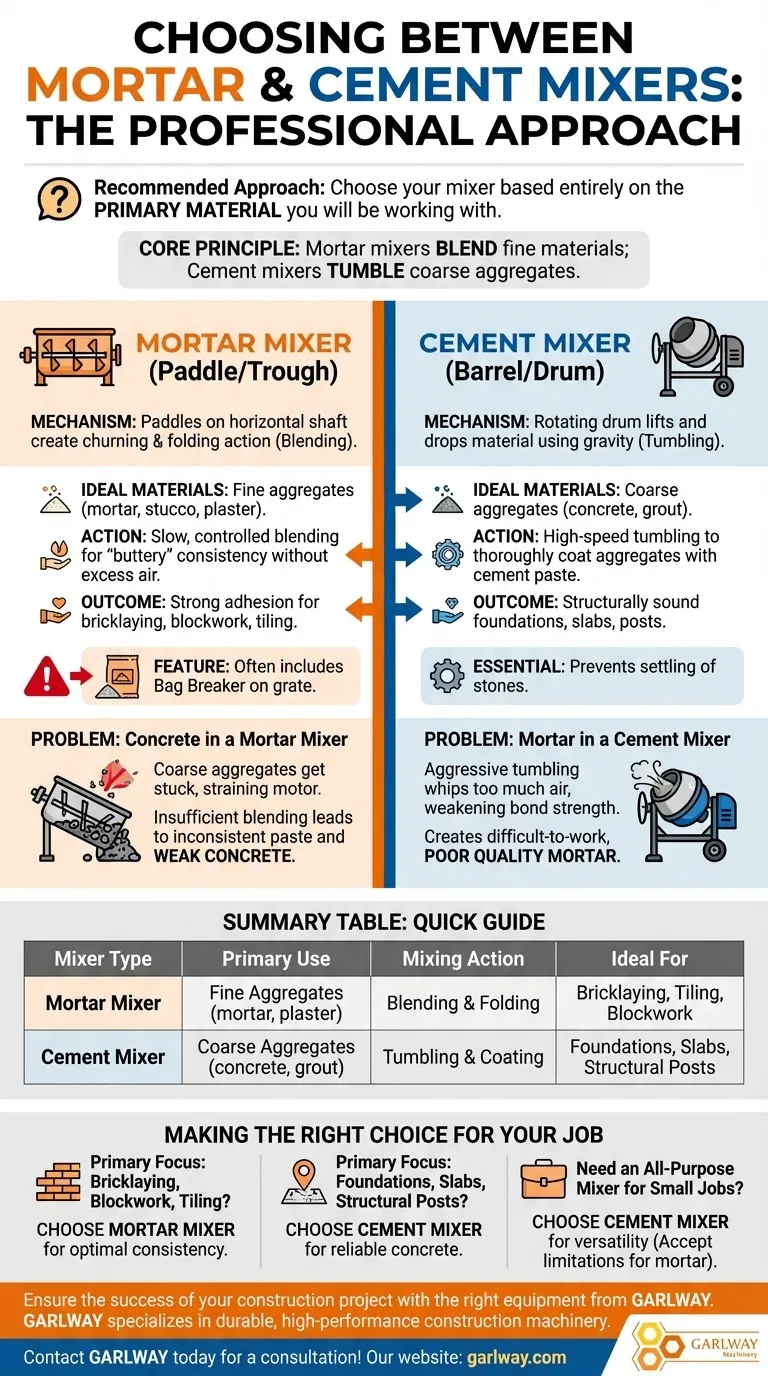
The recommended approach is to choose your mixer based entirely on the primary material you will be working with. For materials with fine aggregates like mortar, stucco, or plaster, a mortar mixer is the correct tool. For materials with coarse aggregates like concrete or grout, a cement mixer is the required choice.
The core principle is simple: mortar mixers are designed to blend fine materials into a smooth, consistent paste, while cement mixers are built to tumble coarse aggregates to ensure every stone is coated in cement. Using the wrong tool compromises the quality and structural integrity of your mix.

The Core Difference: Blending vs. Tumbling
The choice between these mixers comes down to their fundamentally different mechanical actions. Each is purpose-built to handle a specific type of aggregate and deliver a specific consistency.
How a Mortar Mixer Works
A mortar mixer, often called a "paddle" or "trough" mixer, uses paddles rotating on a horizontal shaft inside a stationary tub. This design creates a churning and folding action.
The slow, controlled blending is ideal for mortar. It works the sand, lime, and cement together into a "buttery" consistency without introducing excess air, which is critical for strong adhesion between bricks or blocks.
Many models also feature a grate with a "bag breaker," allowing you to efficiently open bags of material directly over the tub.
How a Cement Mixer Works
A cement mixer, also known as a "barrel" or "drum" mixer, uses a rotating drum to lift and drop the material. The mixing action is based on tumbling and gravity.
This high-speed tumbling is essential for making concrete. It ensures that coarse aggregates, like gravel and crushed stone, are thoroughly coated with the cement paste (cement, sand, and water).
Without this action, the aggregates would settle, resulting in a weak and inconsistent final product unfit for structural use.
Why Using the Wrong Mixer is a Problem
Choosing incorrectly isn't just inefficient; it can lead to material failure. The wrong mixing action actively damages the properties of the material you are trying to create.
Mortar in a Cement Mixer
The tumbling action of a cement mixer is too aggressive for mortar. It whips too much air into the mix, which weakens the final bond strength and makes the mortar difficult to work with.
You will struggle to achieve the smooth, sticky consistency required for masonry work, leading to a poor-quality, less durable result.
Concrete in a Mortar Mixer
The paddles in a mortar mixer are not designed to handle coarse aggregates like gravel. The stones can get stuck, straining or even burning out the motor.
More importantly, the blending action is insufficient to properly coat the aggregates. This results in pockets of uncoated stone and inconsistent paste, creating weak concrete that is unsafe for any structural application.
Understanding the Trade-offs
While each mixer has a specific purpose, project constraints sometimes force a compromise. Understanding the limitations is key.
The Case for a Dedicated Mortar Mixer
For any professional masonry job—bricklaying, blockwork, or tiling—a mortar mixer is non-negotiable. It produces a superior quality mortar with the exact consistency needed for high bond strength and workability.
The efficiency and quality it provides for its intended material far surpass any attempt to mix mortar in a barrel mixer.
The Versatility of a Cement (Barrel) Mixer
If you can only justify purchasing one mixer for a variety of small, non-critical jobs, a cement mixer is the more flexible option. It is the only tool that can correctly mix concrete and grout.
While not ideal, it can be used to mix mortar for small patches or non-structural applications. However, you must accept that the quality of the mortar will be inferior to what a proper paddle mixer can produce.
Making the Right Choice for Your Job
Your decision should be guided by the demands of your project and your commitment to quality.
- If your primary focus is bricklaying, blockwork, or tiling: A mortar mixer is the correct professional tool to ensure optimal consistency and bond strength.
- If your primary focus is foundations, slabs, or structural posts: A cement (barrel) mixer is the only acceptable choice for properly mixing strong, reliable concrete.
- If you need a single, all-purpose mixer for various small jobs: A cement mixer offers the most versatility, but you must be aware of its limitations when mixing mortar.
Choosing the right mixer is the first step to ensuring the structural integrity and quality of your work.
Summary Table:
| Mixer Type | Primary Use | Mixing Action | Ideal For |
|---|---|---|---|
| Mortar Mixer | Fine aggregates (mortar, plaster) | Blending & Folding | Bricklaying, tiling, blockwork |
| Cement Mixer | Coarse aggregates (concrete, grout) | Tumbling & Coating | Foundations, slabs, structural posts |
Ensure the success of your construction project with the right equipment from GARLWAY.
Choosing the wrong mixer can compromise material strength and lead to costly rework. GARLWAY specializes in durable, high-performance construction machinery, including mortar mixers and cement mixers, designed for the specific demands of contractors and construction companies.
Let our experts help you select the perfect mixer for your job, ensuring optimal consistency, efficiency, and structural integrity.
Contact GARLWAY today for a consultation and get a quote tailored to your project needs!
Visual Guide
Related Products
- JDY350 Electric Hydraulic Mortar Mud Concrete Mixer
- JDC350 Small Cement Concrete Mortar Mixer
- Mini Cement Mortar Mixer Truck for Construction
- Belle Mixer Drum Self Loading Mortar Mixers JS3000
- JS1000 Volumetric Concrete Mortar Mixer for Sale Skid Steer Cement Mixer
People Also Ask
- When are electric mortar mixers typically used? Find the Perfect Tool for Small to Medium-Sized Jobs
- What are hydraulic concrete mixers used for? Powering Large-Scale Construction Projects
- How are mortar mixers utilized in concrete and grout projects? Maximize Your Mixing Efficiency
- What are the benefits of electric concrete mixers? Quiet, Clean, and Low-Maintenance Mixing
- What is a mortar mixer and what is its primary use? Master Masonry with the Right Equipment