
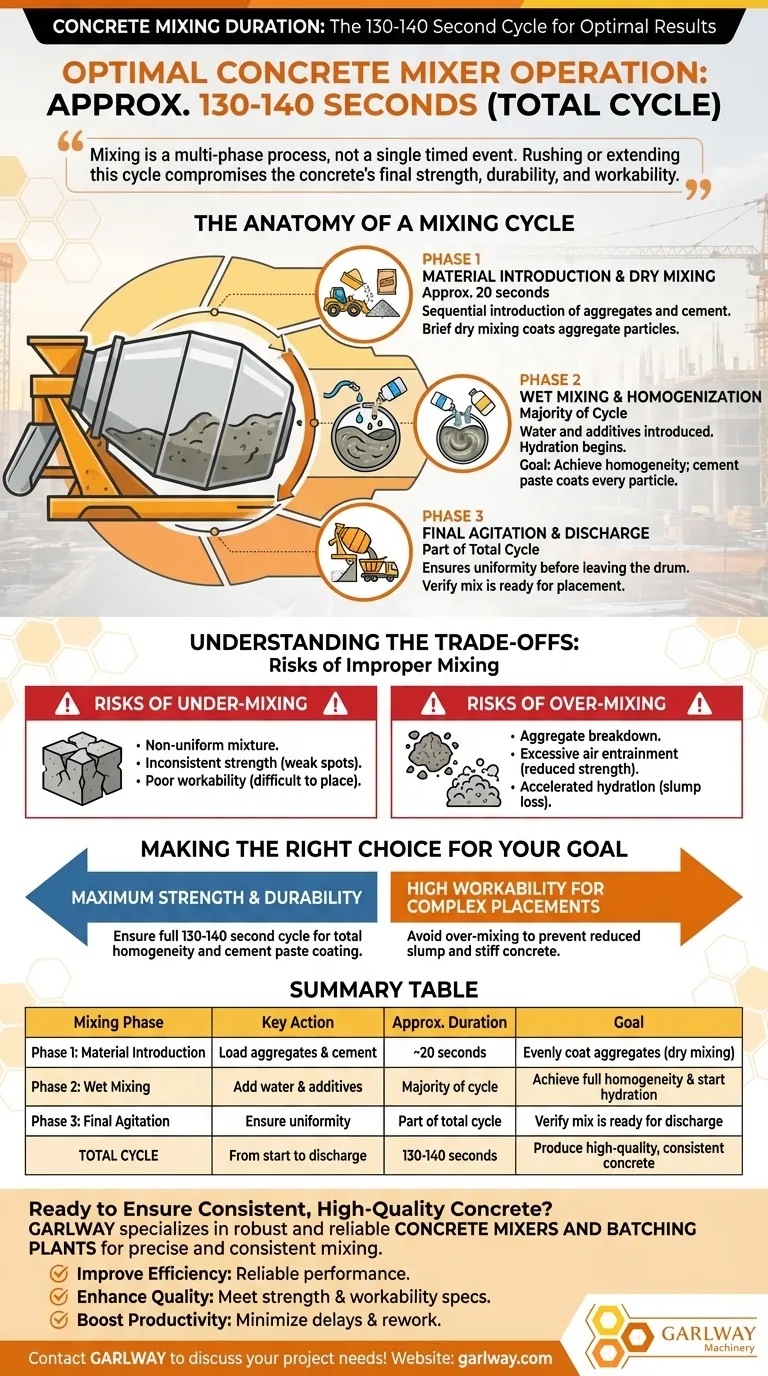
For optimal results, a concrete mixer should operate for a total of approximately 130-140 seconds before discharge. This total time accounts for the entire cycle, from introducing the first materials to achieving a fully homogeneous mix ready for placement.
The specific number is less important than the principle: mixing is a multi-phase process, not a single timed event. Rushing or extending this cycle compromises the concrete's final strength, durability, and workability.
The Anatomy of a Mixing Cycle
Achieving high-quality concrete depends on a structured mixing sequence. Each phase has a specific purpose that contributes to the final properties of the mix.
Phase 1: Material Introduction & Dry Mixing
The first stage involves loading the raw materials, which should be completed rapidly, often within the first 20 seconds.
This includes the sequential introduction of aggregates (sand and stone) and cement. A brief period of dry mixing allows the cement powder to evenly coat the aggregate particles, which is critical for a strong bond.
Phase 2: Wet Mixing & Homogenization
Following the dry mix, water and any chemical additives are introduced. This begins the crucial wet mixing phase, where the chemical reaction of hydration starts.
The majority of the mixing energy and time is spent here. The goal is to achieve homogeneity, ensuring every particle of aggregate is coated in cement paste and that water is distributed evenly throughout the batch.
Phase 3: Final Agitation & Discharge
The final part of the cycle ensures the mix is uniform before it leaves the drum. While some sources mention a short 25-35 second period, this may refer to a minimum final agitation time or the duration of the discharge itself, not the entire process.
The full 130-140 second cycle ensures all components are fully integrated and the mix has reached its target consistency.
Understanding the Trade-offs: The Risks of Improper Mixing
The duration of the mixing cycle is a critical quality control point. Deviating from the optimal time introduces significant risks to the structural integrity of the concrete.
The Problem with Under-mixing
Insufficient mixing time is a common failure point. It results in a non-uniform mixture where water, cement, and aggregates are not evenly distributed.
This leads directly to inconsistent strength, creating weak spots within the final structure. It also causes poor workability, making the concrete difficult to place, compact, and finish properly.
The Danger of Over-mixing
While less common, mixing for too long can also be detrimental. Excessive agitation can begin to break down aggregates, altering the carefully designed particle size distribution.
Over-mixing can also entrain too much air into the concrete, reducing its final compressive strength. It may also accelerate hydration, causing a loss of slump (workability) before the concrete can be placed.
Making the Right Choice for Your Goal
Adhering to the correct mixing time is essential for producing concrete that meets project specifications. Your primary objective should guide your focus during the quality control process.
- If your primary focus is maximum strength and durability: Ensure the full 130-140 second cycle is completed to achieve total homogeneity and proper cement paste coating.
- If your primary focus is high workability for complex placements: Avoid over-mixing, as this can reduce slump and make the concrete stiff and difficult to manage.
Ultimately, consistent and controlled mixing time is the foundation of predictable, high-performance concrete.
Summary Table:
| Mixing Phase | Key Action | Approx. Duration | Goal |
|---|---|---|---|
| Phase 1: Material Introduction | Load aggregates & cement | ~20 seconds | Evenly coat aggregates with cement (dry mixing) |
| Phase 2: Wet Mixing | Add water & additives | Majority of cycle | Achieve full homogeneity and start hydration |
| Phase 3: Final Agitation | Ensure uniformity | Part of total cycle | Verify mix is ready for discharge |
| Total Cycle | From start to discharge | 130-140 seconds | Produce high-quality, consistent concrete |
Ready to Ensure Consistent, High-Quality Concrete on Every Project?
Proper mixing is the foundation of durable concrete structures. GARLWAY specializes in providing robust and reliable construction machinery, including concrete mixers and batching plants, designed to deliver precise and consistent mixing cycles for contractors and construction companies worldwide.
Let us help you achieve optimal results:
- Improve Efficiency: Our equipment is engineered for reliable performance, batch after batch.
- Enhance Quality: Ensure your concrete meets strength and workability specifications every time.
- Boost Productivity: Minimize delays and rework with machinery you can count on.
Contact GARLWAY today to discuss your project needs and find the perfect concrete mixing solution for your business!
Visual Guide
Related Products
- Portable Concrete Mixer Machine Equipment for Mixing Concrete
- Construction Products Concrete Plant Machine Mixing Concrete Mixer
- Portable Electric Concrete Mixer Machine for Cement Mixing
- JZC400 Mobile Small Concrete Mixer Cement Mixer Machine
- Hydraulic Concrete Mixer Machine Cement Mixing Equipment for Mixture Concrete
People Also Ask
- Why is it necessary to use a portable concrete mixer? Gain Total Control & Efficiency
- How much concrete can you pour with a portable mixer? Find the Perfect Fit for Your Project
- What types of projects are portable concrete mixers suitable for? Ideal for DIY & Small-Scale Construction
- How much does a portable concrete mixer hold? A Guide to Choosing the Right Capacity
- What types of portable concrete mixers exist? Find the Perfect Mixer for Your Project






