
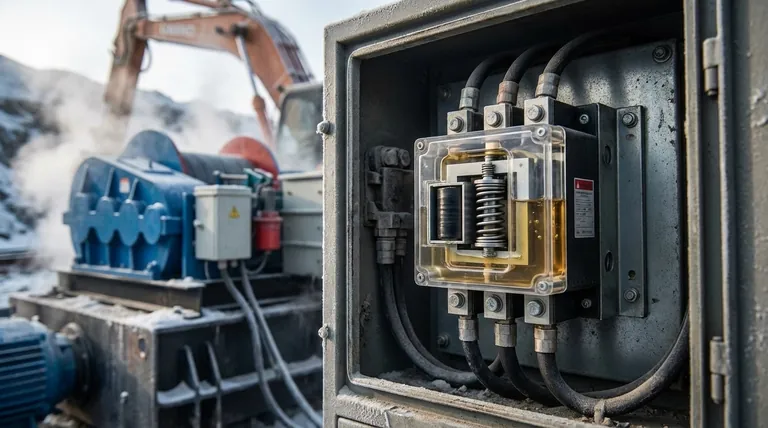
At its core, a Quick hydraulic magnetic circuit breaker is a high-precision safety device. Its purpose is to protect DC electrical equipment from damage by automatically disconnecting power during an overcurrent or short-circuit event. Unlike common thermal breakers, its performance is unaffected by changes in ambient temperature, ensuring exceptional reliability.
The critical advantage of a hydraulic magnetic circuit breaker is its consistency. It trips based purely on the magnetic force of the current, not on heat, which prevents false trips in hot environments and ensures it always protects your equipment as intended, regardless of the surrounding temperature.
How a Hydraulic Magnetic Breaker Achieves Precision
To understand the purpose of this device, you must first understand its unique internal mechanism, which combines magnetism with fluid dynamics.
The Core Components
A hydraulic magnetic breaker contains a solenoid coil (a wire wrapped around a tube). Inside this sealed tube is a spring-loaded iron core and a viscous silicone fluid. This combination is the key to its operation.
Responding to Overcurrents
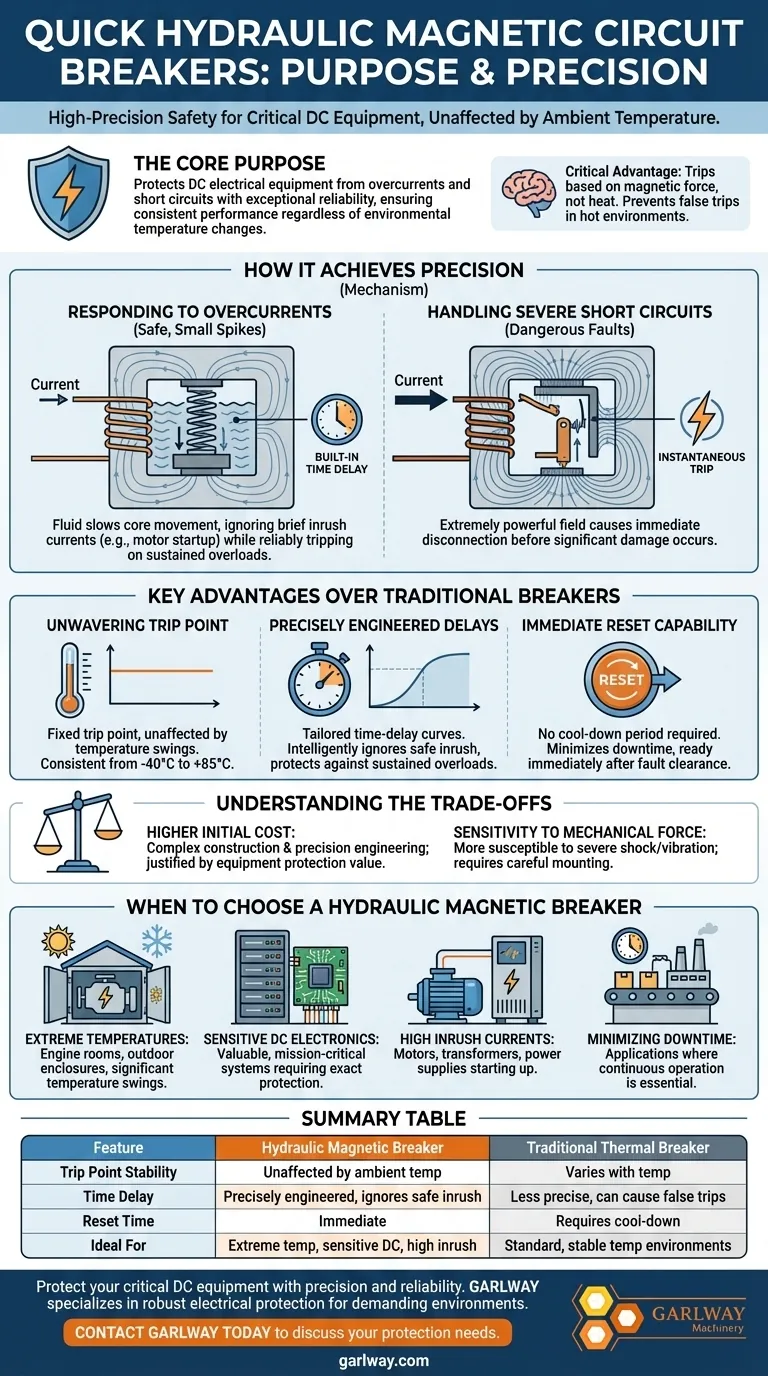
When current flows through the coil, it generates a magnetic field. During a safe, small overcurrent, this magnetic field begins pulling the iron core through the thick fluid. The fluid slows the core's movement, creating a built-in time delay that prevents tripping from brief, harmless current spikes, like a motor starting up.
Handling Severe Short Circuits
If a dangerous short circuit occurs, the current skyrockets instantly. This creates an extremely powerful magnetic field that attracts the armature immediately, bypassing the fluid-damped core. The result is an instantaneous trip that disconnects the circuit before significant damage can occur.
Key Advantages Over Traditional Breakers
The "why" behind choosing this technology becomes clear when you compare it to more common thermal or thermal-magnetic breakers that rely on a heat-sensitive metal strip.
Unwavering Trip Point
The primary benefit is temperature stability. A thermal breaker's trip point changes with ambient temperature—it might trip too soon when hot or too late when cold. A hydraulic magnetic breaker's trip point is fixed, providing consistent protection from -40°C to +85°C.
Precisely Engineered Delays
The viscosity of the internal fluid can be precisely engineered. This allows for specific time-delay curves tailored to the equipment being protected, intelligently ignoring safe inrush currents while reliably tripping on sustained overloads.
Immediate Reset Capability
Because it does not rely on a heated element that needs to cool down, a hydraulic magnetic breaker can be reset immediately after the fault condition is cleared. This minimizes downtime in critical systems.
Understanding the Trade-offs
While highly effective, this technology is not the default choice for every application. Objectivity requires acknowledging its specific considerations.
Higher Initial Cost
The complex mechanical construction and precision engineering make hydraulic magnetic breakers more expensive than standard thermal-magnetic units. Their cost is justified by the value of the equipment they protect or the environment they operate in.
Sensitivity to Mechanical Force
Due to the internal moving parts, these breakers can be more susceptible to nuisance tripping from severe mechanical shock or vibration compared to solid-state protection devices. Careful mounting and placement are important.
When to Choose a Hydraulic Magnetic Breaker
Your decision should be driven by the demands of the application and the environment.
- If your primary focus is reliability in extreme temperatures: This is the ideal choice for equipment in engine rooms, outdoor enclosures, or any environment with significant temperature swings.
- If your primary focus is protecting sensitive DC electronics: The precise trip characteristics offer exact, repeatable protection for valuable or mission-critical systems.
- If your primary focus is handling equipment with high inrush currents: The customizable delay curves allow motors, power supplies, and transformers to start up without causing false trips.
- If your primary focus is minimizing downtime: The ability for an immediate reset after clearing a fault makes them superior for applications where continuous operation is essential.
By choosing a circuit breaker based on its operating principle, you ensure your equipment has the most reliable and appropriate protection for its specific needs.
Summary Table:
| Feature | Hydraulic Magnetic Breaker | Traditional Thermal Breaker |
|---|---|---|
| Trip Point Stability | Unaffected by ambient temperature | Varies with temperature |
| Time Delay | Precisely engineered, ignores safe inrush currents | Less precise, can cause false trips |
| Reset Time | Immediate reset after fault clearance | Requires cool-down period |
| Ideal For | Extreme temperatures, sensitive DC electronics, high inrush currents | Standard, temperature-stable environments |
Protect your critical DC equipment with precision and reliability.
GARLWAY specializes in providing robust construction machinery and components, understanding the need for dependable electrical protection in demanding environments. Our expertise extends to supporting contractors and construction companies globally with reliable solutions.
If your equipment operates in extreme temperatures or requires precise protection from dangerous overcurrents, our team can help you select the right components for maximum uptime and safety.
Contact GARLWAY today to discuss your specific protection needs and ensure your machinery is safeguarded by the best technology.
Visual Guide
Related Products
People Also Ask
- What features were incorporated into the upgraded portable winch system? Boost Your Recovery Power & Safety
- What are some uses mentioned for portable winches beyond vehicle recovery? Essential Versatility for Property & Work
- How could the twisting issue with a portable winch be mitigated? Achieve Safe, Centered Pulls with Proper Rigging
- What are the primary uses of a portable winch for a truck? Boost Your Truck's Capability and Self-Reliance
- What is the single rope traction force of the quick winch without a pulley block? 0.5 to 40 Tons Explained
