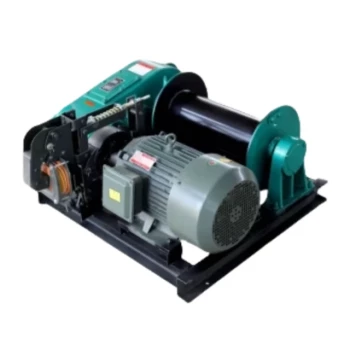
At its core, the main purpose of a winch is to pull or lift heavy objects using a simple mechanical principle: winding a cable or rope around a drum. This action creates immense tension, allowing you to move loads—most commonly a vehicle—that are stuck, on a steep incline, or otherwise unable to move under their own power.
A winch is fundamentally a force multiplier. It converts rotational motion from a motor or hand crank into a powerful linear pull, making it an essential tool for vehicle recovery, industrial hauling, and loading operations.
How a Winch Fundamentally Works
A winch's design is remarkably straightforward, which contributes to its reliability and widespread use across various industries.
The Core Mechanism: Drum and Cable
The heart of the winch is a drum (or spool) and a length of cable or synthetic rope. One end of the cable is anchored to the drum, and the other has a hook to attach to a load.
When the drum is turned, it winds the cable, shortening its effective length and creating powerful tension. This tension is what pulls the object toward the winch.
Creating Mechanical Advantage
The system of gears within the winch provides a significant mechanical advantage. This means a small amount of input power—from an electric motor or a person turning a crank—is converted into a much larger output pulling force.
Key Applications: From Off-Road to Industrial Sites
While often associated with 4x4 trucks, the winch is a versatile tool used in many different contexts.
Vehicle Self-Recovery
This is the most widely known application. A winch allows a vehicle stuck in mud, sand, or a ditch to pull itself out by anchoring the cable to a stable point like a tree or another vehicle.
Industrial Lifting and Hauling
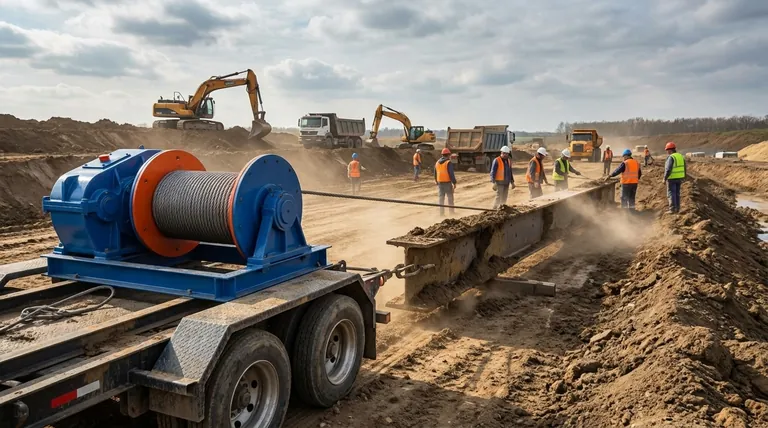
In sectors like construction, mining, and forestry, winches are critical for moving materials. They are used for dragging logs, lifting construction components, or pulling heavy equipment into position.
Loading and Unloading Operations
Trailer winches are essential for moving heavy items onto a flatbed or trailer. Their most common use is for loading and unloading boats, a process that would be nearly impossible manually due to the boat's weight and bulk.
Understanding the Key Parameters
Not all winches are created equal. Their capability is defined by a few basic parameters that determine their suitability for a task.
Rated Pulling Force
This is the most important specification. It defines the maximum load the winch can safely pull without causing damage to its motor or gears.
Working Speed
Working speed refers to how quickly the winch can spool its cable under load. There is often a trade-off between pulling power and speed; the heaviest loads are typically pulled very slowly.
Rope Capacity
This simply refers to the length of the cable or rope that the drum can hold. This parameter dictates the maximum distance from which you can pull an object.
Making the Right Choice for Your Goal
Understanding the winch's purpose helps you select the right one for your specific needs.
- If your primary focus is emergency vehicle recovery: Prioritize a winch with a rated pulling force at least 1.5 times your vehicle's gross weight.
- If your primary focus is industrial material handling: Look for durability and a suitable duty cycle (how long it can operate without overheating) in addition to raw power.
- If your primary focus is loading a boat or ATV: A smaller, simpler winch with a focus on smooth, controlled operation is often more important than maximum pulling force.
Ultimately, a winch gives you the controlled power to safely overcome immense physical obstacles.
Summary Table:
| Parameter | What It Means | Why It Matters |
|---|---|---|
| Rated Pulling Force | Maximum safe load capacity. | Determines if the winch can handle your vehicle or equipment weight. |
| Working Speed | How fast the cable spools under load. | Affects efficiency; heavier loads are pulled slower. |
| Rope Capacity | Total length of cable on the drum. | Defines the maximum distance you can pull from. |
Need a Reliable Winch for Your Project?
Whether you're a contractor on a construction site or an off-road enthusiast, having the right winch is critical for safety and efficiency. GARLWAY specializes in robust construction machinery, offering durable winches, concrete mixers, and batching plants designed for the demanding needs of construction companies and contractors globally.
Let us provide you with the controlled power to overcome your biggest challenges.
Contact GARLWAY today for a personalized solution and quote!
Visual Guide

Related Products
- Warn Winch Windlass Boat Trailer Winch
- Electric and Hydraulic Winch for Heavy Duty Applications
- Small Electric Winch 120V and 240V for Compact Applications
- 12000 lb Electric Boat Trailer Winch with Windlass Anchor Warn
- Quick Windlass Portable Winch for Truck and Boat Best Boat Winch
People Also Ask
- What are the main components of a boat trailer winch? A Guide to Safe & Efficient Boat Loading
- What factors should be considered when choosing a boat trailer winch? Ensure Safe and Effortless Boat Loading
- What is the purpose of boat trailer winches? Safely and Efficiently Load Your Boat
- What are the two main types of boat trailer winches? Manual vs. Electric Explained
- How often should a boat trailer winch be replaced? Your Guide to Safety and Longevity