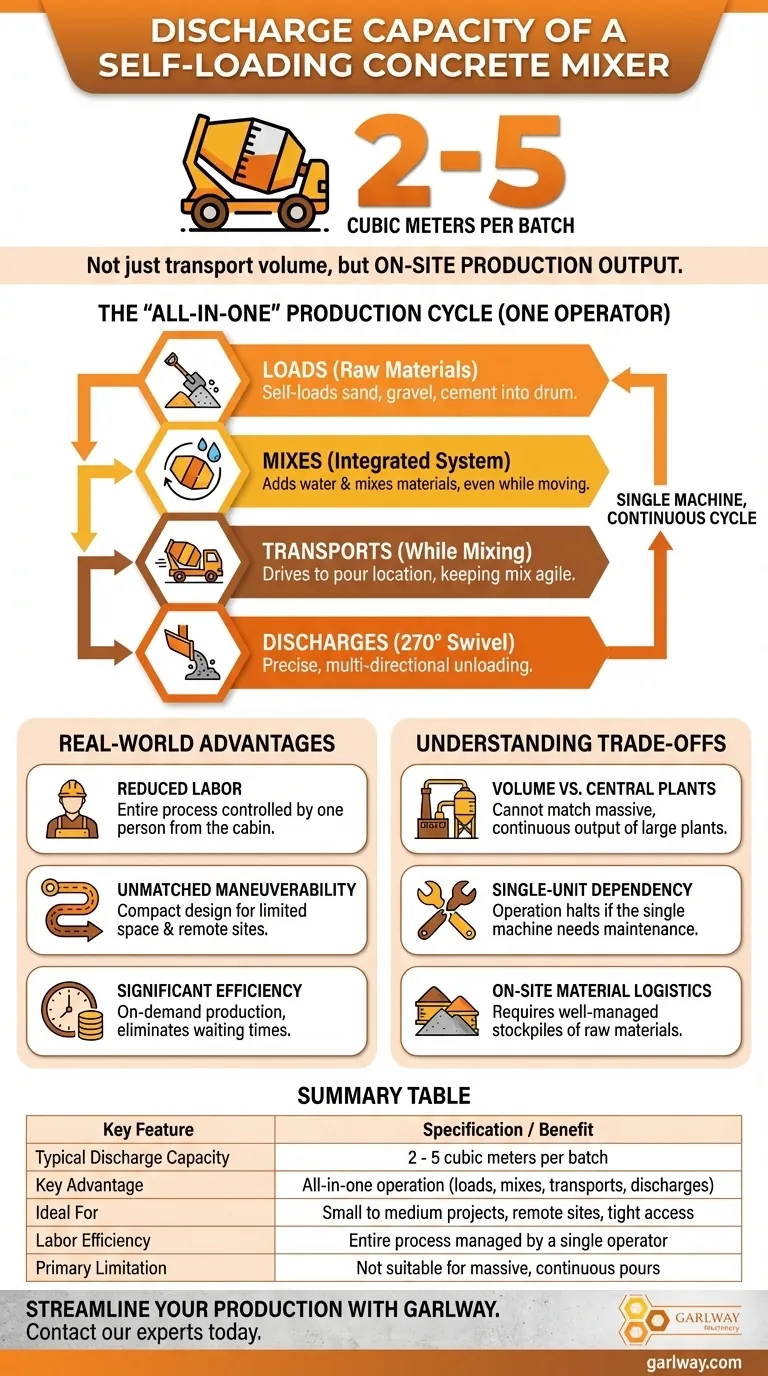
To put it directly, the discharge capacity of a typical self-loading concrete mixer ranges from two to five cubic meters per batch. This figure represents the volume of finished, mixed concrete the machine can produce and discharge in a single cycle.
While the specific capacity is a key specification, its true value lies in the machine's ability to function as an autonomous, mobile batching plant, streamlining the entire concrete production process from raw materials to final placement with a single operator.
How a Self-Loading Mixer Redefines "Capacity"
The term "discharge capacity" for a self-loading mixer is fundamentally different from that of a standard transit mixer truck. It doesn't just measure a transport volume; it represents the output of a complete, integrated production cycle.
An All-in-One Production Unit
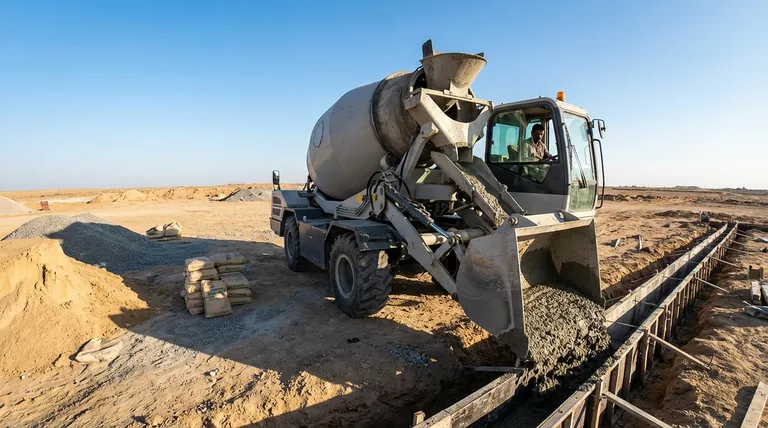
A self-loading mixer is a versatile machine that combines a wheel loader, a batching system, and a concrete mixer into one vehicle. It handles every step of the process on-site.
The Self-Loading Process
The cycle begins with loading raw materials. The machine uses its own hydraulic shovel or loading bucket to scoop sand, gravel, and cement directly into the mixing drum.
Integrated Mixing and Transport
Once loaded, an onboard system adds a precise amount of water. The drum then rotates to mix the materials into concrete, a process that can continue even while the machine is driving to the pour location.
Versatile Discharge Function
Upon arrival, the mixed concrete is discharged via an adjustable chute. Many models feature a drum that can rotate up to 270 degrees, allowing for precise, multi-directional unloading without repositioning the entire vehicle.
The Real-World Advantages of this Design
Understanding the machine's full operational cycle reveals that its benefits go far beyond its simple cubic meter capacity. The design is engineered to solve specific logistical and financial challenges on a job site.
Drastically Reduced Labor Costs
The entire process—from loading aggregates to discharging finished concrete—is controlled by a single person from the operator's cabin. This significantly reduces the need for a separate loader operator and batch plant staff.
Unmatched On-Site Maneuverability
These mixers are designed with narrow bodies, short wheelbases, and small turning radii. This makes them exceptionally well-suited for projects with limited space, remote locations, or challenging terrain where larger trucks cannot operate.
Significant Gains in Efficiency
By eliminating the wait times associated with concrete delivery from an off-site plant, projects can proceed without interruption. This on-demand production capability saves both time and money.
Understanding the Trade-offs
While highly efficient for its intended purpose, this machine is not a universal solution. An objective evaluation requires acknowledging its limitations.
Output Volume vs. Central Batching Plants
The 2-5 cubic meter batch size is perfect for many applications but cannot compete with the high-volume, continuous output of a large, stationary batching plant supplying a fleet of transit mixers for massive pours.
Dependency on a Single Unit
The all-in-one design means your entire concrete operation relies on one machine. If it requires maintenance or breaks down, production stops completely, unlike a system with multiple trucks.
On-Site Material Logistics
The machine itself is autonomous, but it still requires a well-managed supply of raw materials (sand, gravel, cement, and water) to be stockpiled and accessible on-site.
Making the Right Choice for Your Project
Selecting the appropriate concrete production method depends entirely on the scale and logistics of your construction project.
- If your primary focus is on small-to-medium projects, remote sites, or jobs with tight access: The self-loading mixer provides unparalleled efficiency and cost savings.
- If your primary focus is on large-scale industrial or infrastructure projects requiring massive, continuous concrete pours: A traditional central batching plant with a fleet of transit trucks remains the superior choice.
- If your primary focus is on maximizing labor efficiency and operational flexibility across various job sites: The single-operator, on-demand nature of a self-loading mixer is its defining advantage.
Ultimately, choosing the right tool is about matching the equipment's core strengths to the specific demands of your project.
Summary Table:
| Key Feature | Specification / Benefit |
|---|---|
| Typical Discharge Capacity | 2 - 5 cubic meters per batch |
| Key Advantage | All-in-one operation: loads, mixes, transports, and discharges |
| Ideal For | Small to medium projects, remote sites, and areas with limited access |
| Labor Efficiency | Entire process managed by a single operator |
| Primary Limitation | Not suitable for massive, continuous pours requiring high-volume output |
Ready to streamline your concrete production and cut labor costs?
GARLWAY specializes in robust construction machinery, offering self-loading concrete mixers designed for the efficiency needs of construction companies and contractors globally. Our machines empower you to handle the entire concrete process on-site with just one operator.
Contact our experts today to find the perfect self-loading mixer for your project's scale and budget.
Visual Guide
Related Products
- Skid Steer Self Loading Concrete Mixers for Construction
- Belle Mixer Drum Self Loading Mortar Mixers JS3000
- Portable Cement Mixer with Lift Concrete Machine
- Portable Concrete Mixer Machine Equipment for Mixing Concrete
- JW1000 Mobile Cement Mixer Concrete Mixer Truck and Batching Plant
People Also Ask
- How does the control system improve production efficiency in a self loading concrete mixer? Automate Mixing for Speed & Quality
- What is the purpose of keeping the drum rotating during transportation in a self loading concrete mixer? Ensure Quality & Consistency
- How does the weighing process work in a self loading concrete mixer? Achieve Precise, On-Site Concrete Batching
- What components are involved in the loading process of a self loading concrete mixer? A Guide to the Key Systems
- How should materials be loaded into a self-loading concrete mixer? Master the Step-by-Step Process