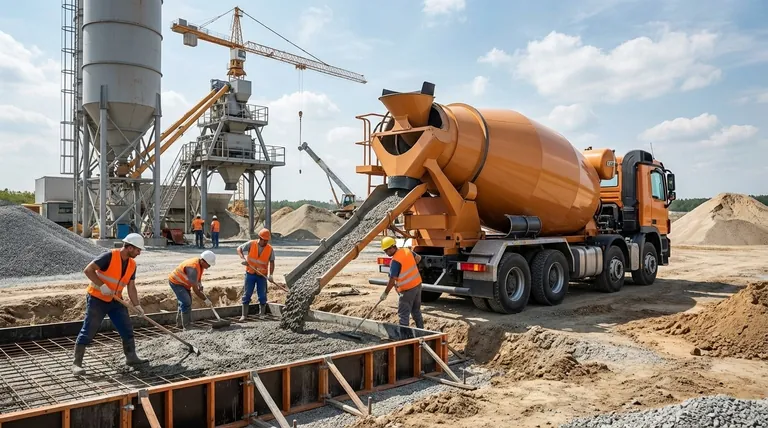
As a general rule, specialized concrete mixer drums have a capacity ranging from 8 cubic meters to 12 cubic meters. This range allows for flexibility in accommodating different project sizes, from smaller residential pours to large-scale commercial or infrastructure work.
The choice of drum capacity is a critical decision that directly impacts project logistics, on-site efficiency, and overall cost. It's less about finding the maximum volume and more about matching the equipment to the specific demands of the job.
The Significance of Drum Capacity
Understanding the implications of drum size is essential for effective project planning. The stated capacity is not just a technical specification; it's a key variable in the construction equation.
Matching Volume to Project Scale
The most obvious factor is the size of the pour. Large foundation slabs, roadways, or major structural elements benefit from the efficiency of larger 10-12 m³ mixers, which reduce the number of trips required.
Smaller projects, such as residential patios, repairs, or sites with intermittent concrete needs, are better served by smaller 8 m³ drums to avoid waste and logistical complexity.
Aligning with the Batching Plant
A mixer's capacity is only useful if it aligns with the output of the concrete batching plant. A 12 m³ mixer arriving at a plant that can only produce 6 m³ per batch creates significant inefficiency and wait times.
Optimal logistics involve synchronizing the mixer fleet's capacity with the plant's production rate to ensure a continuous, smooth flow of concrete to the site.
Understanding the Trade-offs
Choosing a drum size involves balancing the benefits of volume against practical on-the-ground limitations. A larger drum is not always the superior choice.
The Efficiency of Larger Drums (10-12 m³)
The primary advantage of a larger capacity is a lower cost per cubic meter transported. Fewer trips from the plant to the site mean reduced fuel consumption and labor hours for a given volume of concrete.
This makes them the preferred choice for large, easily accessible sites where the goal is to pour a massive amount of concrete as quickly as possible.
The Flexibility of Smaller Drums (8 m³)
Smaller capacity mixers are mounted on more compact, maneuverable trucks. This is a critical advantage for urban construction, residential neighborhoods, or any site with tight access roads, sharp turns, or limited space.
Their ability to navigate congested areas often makes them the only viable option, regardless of the potential efficiency gains from a larger drum.
The Factor of Weight and Regulations
A fully loaded 12 m³ concrete mixer is an extremely heavy vehicle. This can be a significant issue for roads with weight restrictions or for sites with soft ground conditions.
The lighter footprint of an 8 m³ mixer can be a decisive advantage when navigating bridges or local roads with strict weight limits.
Making the Right Choice for Your Goal
Selecting the correct drum capacity requires a clear understanding of your project's primary constraints and objectives.
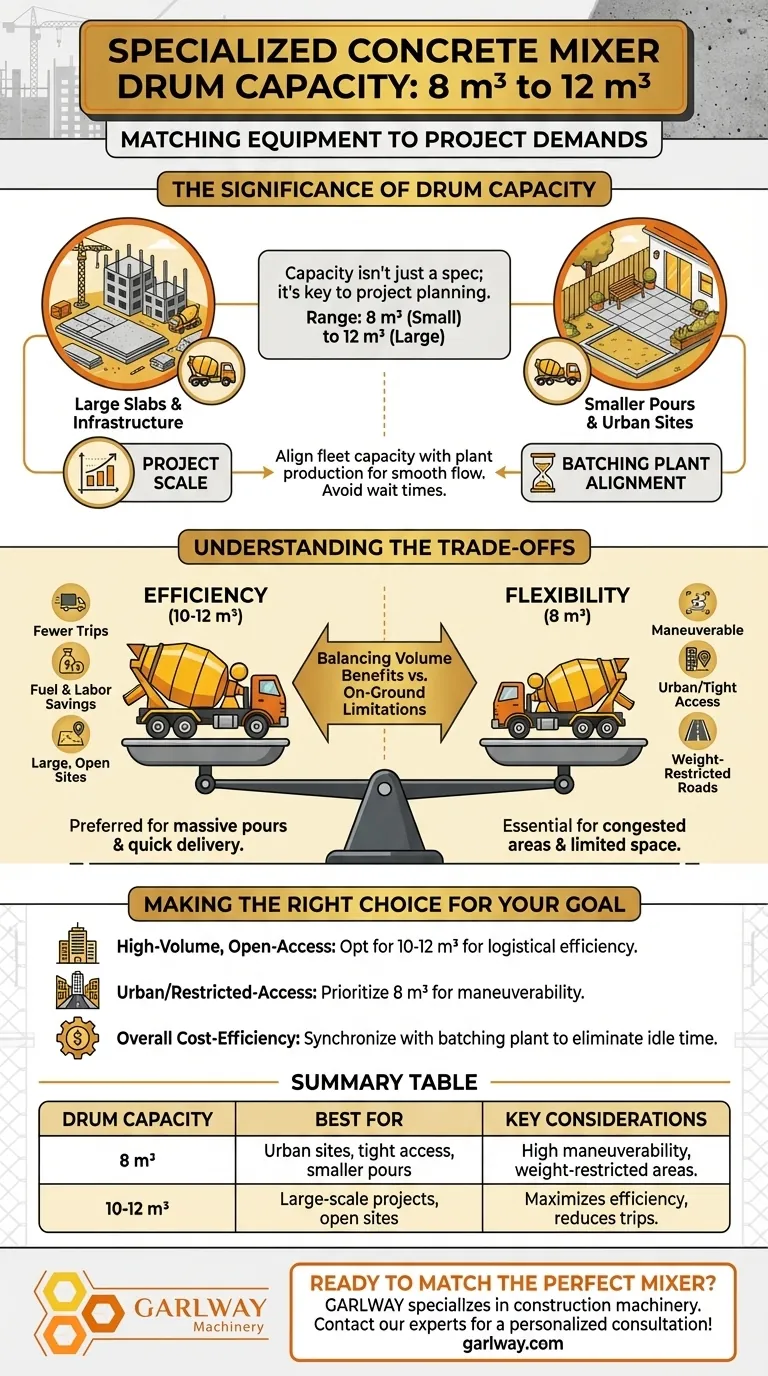
- If your primary focus is high-volume, open-access projects: Opt for the largest capacity drums (10-12 m³) to maximize logistical efficiency and reduce the number of required trips.
- If your primary focus is urban, residential, or restricted-access sites: Prioritize smaller, more maneuverable mixers (8 m³) to ensure the concrete can be delivered successfully.
- If your primary focus is overall project cost-efficiency: Ensure your chosen mixer capacity is perfectly synchronized with your concrete batching plant's output to eliminate idle time.
Ultimately, choosing the right drum capacity is about aligning the equipment's potential with the practical realities of your specific job site.
Summary Table:
| Drum Capacity | Best For | Key Considerations |
|---|---|---|
| 8 m³ | Urban sites, tight access, smaller pours | High maneuverability, ideal for weight-restricted areas. |
| 10-12 m³ | Large-scale projects, open sites | Maximizes efficiency, reduces trips for high-volume pours. |
Ready to match the perfect concrete mixer to your project's needs? GARLWAY specializes in construction machinery, offering a full range of reliable concrete mixers and batching plants for contractors and construction companies globally. We'll help you select the ideal drum capacity to maximize your on-site efficiency and cost-effectiveness. Contact our experts today for a personalized consultation!
Visual Guide
Related Products
- Concrete Cement Mixer Machine Drum Mixer for Construction
- Belle Mixer Drum Self Loading Mortar Mixers JS3000
- Portable Concrete Mixer Machine Equipment for Mixing Concrete
- Construction Products Concrete Plant Machine Mixing Concrete Mixer
- JZC400 Mobile Small Concrete Mixer Cement Mixer Machine
People Also Ask
- What are the key advantages of using drum mixers in concrete mixing? Boost Volume & Efficiency on Your Site
- What are the key components that maintain concrete mix consistency in the drum? Ensure Uniform Quality from Plant to Site
- How do cement mixers enhance safety on construction sites? Reduce Strain, Hazards, and Accidents
- When was the first concrete mixer developed and by whom? Discover the 1900 Breakthrough
- What is the average lifespan of a concrete mixer? Maximize Your Equipment's Lifespan & ROI