
At its core, a reverse drum mixer is a specialized machine used for producing high-quality, single batches of material, most commonly concrete. It operates by rotating its drum in one direction to thoroughly mix ingredients and in the opposite direction to discharge the finished product through a dedicated chute.
The defining feature of a reverse drum mixer is its ability to produce a highly uniform mix without tilting. Its dual-direction rotation provides a gentle yet thorough blending action, making it ideal for applications where material consistency is critical.
How a Reverse Drum Mixer Works
A reverse drum mixer, also known as a non-tilting mixer, relies on a simple and effective mechanical principle to perform its function.
The Dual-Rotation Principle
The machine's operation is based on its ability to rotate the entire drum in two directions around its horizontal axis.
One direction (often clockwise) is used for mixing. The other direction (counter-clockwise) is used for discharging.
The Role of Internal Flights
Inside the drum, welded chutes or blades, known as flights, are crucial to the process.
During the mixing rotation, these flights lift and tumble the materials, ensuring a consistent and homogeneous blend. When the rotation is reversed, the same flights guide the mixed material out of the discharge chute.
A Non-Tilting Design
Unlike tilting mixers that pivot the drum downwards to empty, a reverse drum mixer remains stationary. Materials are loaded through a chute at one end and exit through another at the opposite end, controlled entirely by the drum's rotation.
Key Applications and Strengths
This design makes the reverse drum mixer particularly suitable for specific tasks where quality and control are paramount.
High-Quality Concrete Production
The primary use is producing highly uniform concrete for small to medium-sized projects. The thorough mixing action works equally well for both wet and dry concrete consistencies.
Gentle Blending of Other Materials
The controlled, gentle tumbling makes these mixers ideal for free-flowing materials beyond concrete. They are commonly used in the food and pharmaceutical industries for blending powders and granules without damaging the product.
Ease of Maintenance
The design often allows for straightforward cleaning and maintenance, which is a significant advantage for operations that require frequent batch changes or high levels of cleanliness.
Understanding the Trade-offs
While effective, the reverse drum mixer is not the universal solution for every mixing task. Understanding its limitations is key to using it correctly.
Cost vs. Performance
These mixers tend to have a higher initial cost compared to simpler tilting models. This investment is justified by the superior mix quality and homogeneity they produce.
Batch Production vs. Continuous Output
The reverse drum mixer is fundamentally a single-batch machine. It is not designed for the massive, continuous output required for large-scale engineering projects, where a continuous or large tilting mixer would be more efficient.
Discharge Speed
While the reverse-action discharge is controlled and precise, it is generally slower than the rapid gravity-assisted discharge of a tilting drum mixer. This can impact cycle times on time-sensitive jobs.
Making the Right Choice for Your Goal
To determine if this is the correct tool, evaluate your project's primary goal.
- If your primary focus is mix quality and uniformity: This mixer excels at creating a highly homogeneous product, making it ideal for projects where consistency is non-negotiable.
- If your primary focus is large-scale, rapid production: The single-batch nature may be a bottleneck; a tilting or continuous mixer is likely a better fit for high-volume projects.
- If your primary focus is handling sensitive or varied materials: Its gentle mixing action and ability to handle both wet and dry ingredients make it a versatile choice for applications beyond just concrete.
Choosing the right mixer is about matching the machine's core function to your project's specific demands.
Summary Table:
| Feature | Description |
|---|---|
| Primary Use | Producing high-quality, uniform single batches of material (e.g., concrete). |
| Key Strength | Gentle, thorough mixing action ensuring excellent consistency. |
| Ideal For | Small to medium projects, and blending sensitive materials like powders. |
| Main Limitation | Slower discharge and batch-only production, not for high-volume continuous output. |
Need a reliable mixer for high-quality results?
GARLWAY specializes in construction machinery, offering robust and efficient reverse drum mixers, concrete batching plants, and winches for construction companies and contractors globally. Our equipment is designed to deliver the consistent, homogeneous mix your projects demand.
Contact GARLWAY today to find the perfect mixing solution for your specific needs and enhance your project's quality and efficiency!
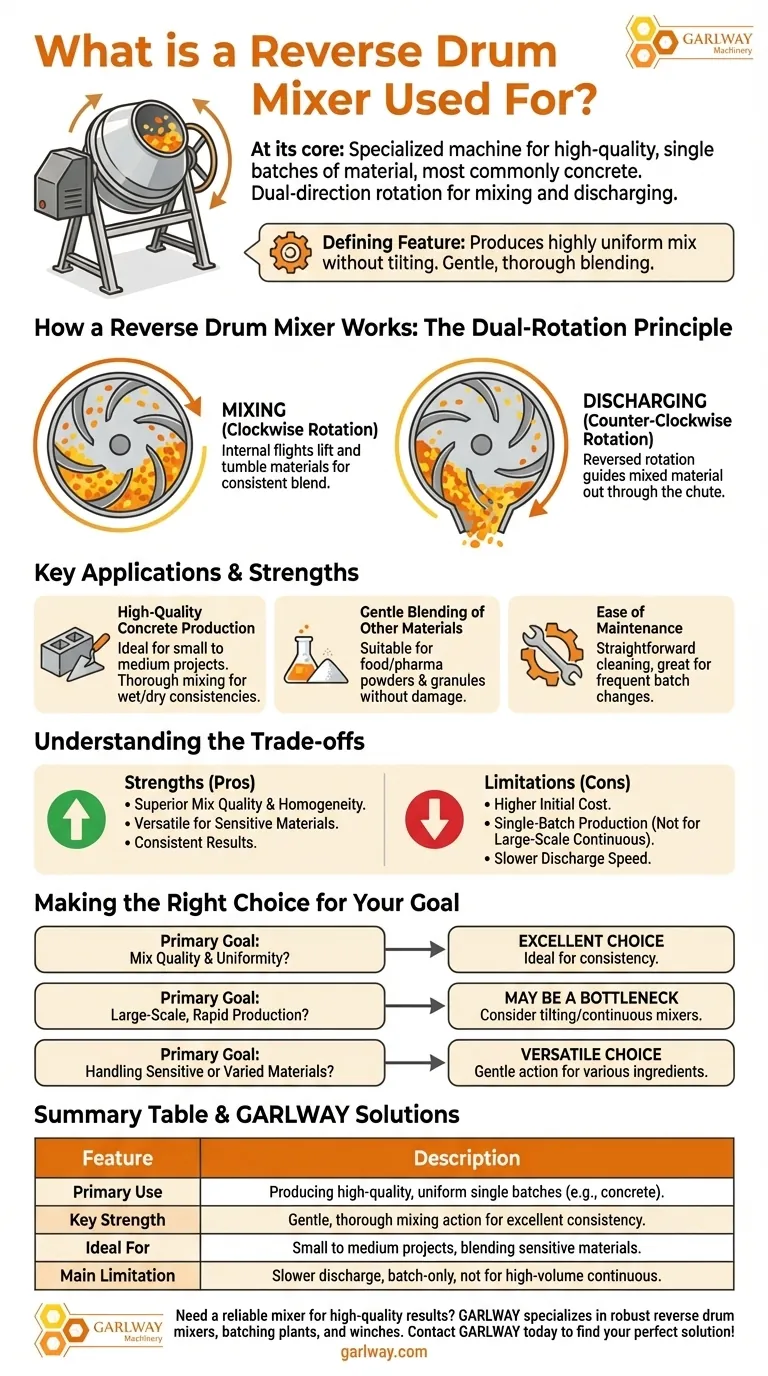
Visual Guide
Related Products
- Belle Mixer Drum Self Loading Mortar Mixers JS3000
- Concrete Cement Mixer Machine Drum Mixer for Construction
People Also Ask
- What are the features of mobile transporting in a self loading mixer? Boost On-Site Efficiency
- Why is timely cleaning important for a self loading mixer? Prevent Costly Downtime and Mix Failure
- How is discharging accomplished in a self loading mixer? Master Precise Concrete Placement
- What is the purpose of keeping the drum rotating during transportation in a self loading concrete mixer? Ensure Quality & Consistency
- What components are involved in the loading process of a self loading concrete mixer? A Guide to the Key Systems

