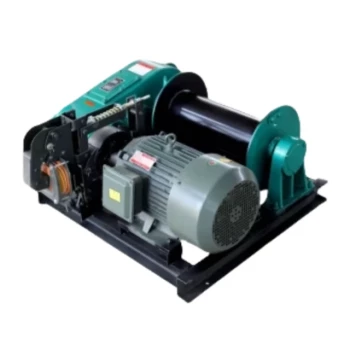
At its core, a manual winch is a hand-powered mechanical device used on yachts to manage ropes under high tension. It acts as a force multiplier, allowing a sailor to use minimal physical effort to pull in or let out ropes—known as sheets and halyards—that control the immense power of the sails.
A winch is the essential tool that translates a sailor's strength into precise control over the wind. Without it, harnessing the power captured by modern sails would be physically impossible for a human crew.

The Core Principle: Mechanical Advantage
A manual winch is a simple yet brilliant application of physics, designed to make an impossible task manageable. It allows a sailor to control loads that are hundreds or even thousands of pounds.
From Human Effort to Powerful Control
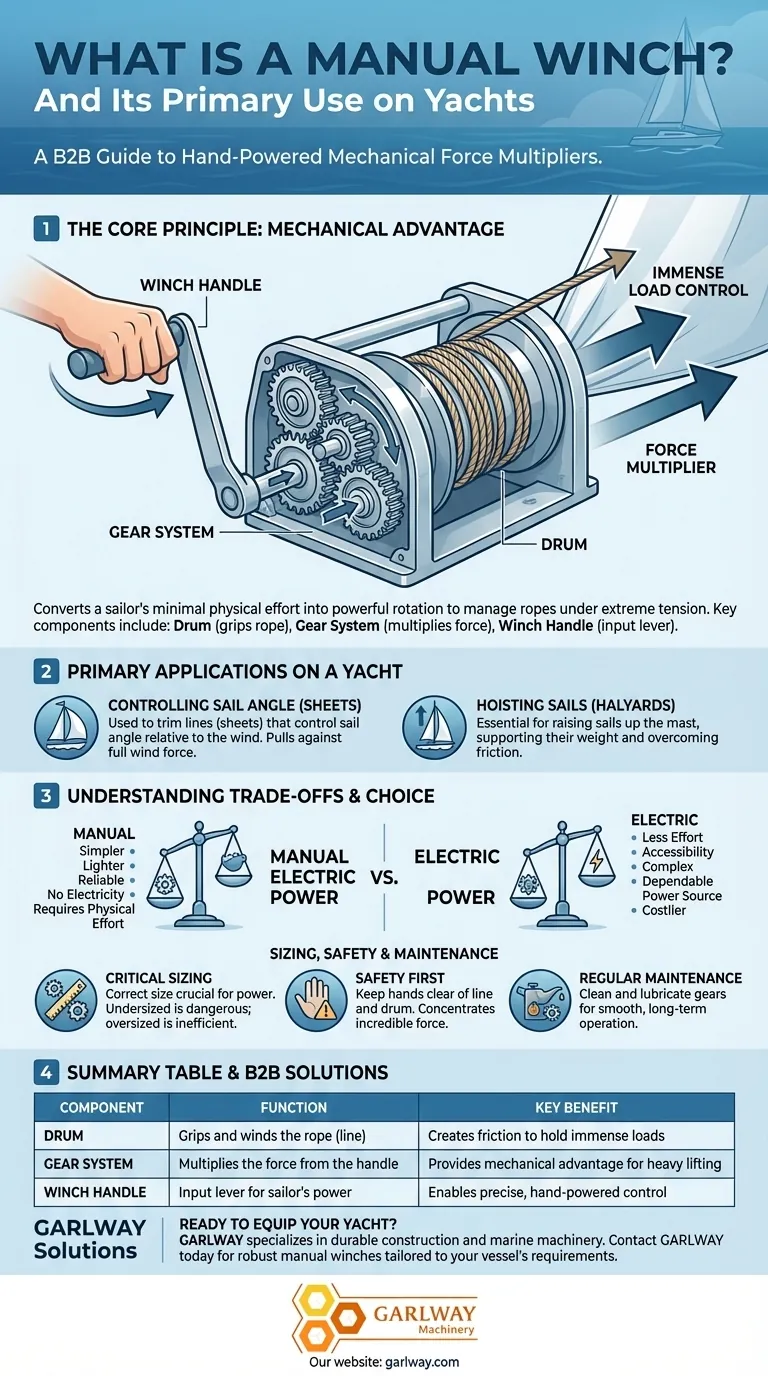
The winch uses an internal system of gears to multiply force. When a sailor turns the winch handle, that rotational force is transferred through gears that spin the central drum. Each turn of the handle results in a much slower, but vastly more powerful, rotation of the drum, easily pulling in a rope that is under extreme load.
The Key Components
Every manual winch consists of a few critical parts:
- The Drum: This is the vertical cylinder that the rope, or line, is wrapped around. The friction between the line and the drum is what allows the winch to grip and pull.
- The Gear System: Housed within the base, these gears determine the winch's power ratio—how much it multiplies the force applied to the handle. Many winches have two speeds for both fast, low-load trimming and slow, high-load grinding.
- The Winch Handle: This removable lever is what the sailor inserts into the top of the winch to provide the input power.
Primary Applications on a Yacht
While simple in design, the winch is one of the most frequently used pieces of equipment on any sailboat, critical for both performance and safety.
Controlling Sail Angle (Sheets)
The most common use for a winch is to trim the sheets. These are the lines that control the angle of the sails (like the jib or genoa) relative to the wind. Adjusting the sheets requires pulling against the full force of the wind in the sail, a task managed by wrapping the sheet around a winch and cranking the handle.
Hoisting Sails (Halyards)
Winches are also essential for raising the sails up the mast. The ropes used for this, called halyards, must support the entire weight of the sail while overcoming friction. A winch provides the mechanical advantage needed to hoist a heavy mainsail or genoa smoothly into place.
Understanding the Trade-offs
While indispensable, the choice and use of a manual winch involve important considerations. It is a powerful tool that demands respect and proper maintenance.
Manual vs. Electric Power
The primary trade-off is between manual and electric winches. Manual winches are mechanically simpler, lighter, and exceptionally reliable, as they do not depend on the boat's electrical system. However, they require significant physical effort, which can be taxing on long voyages or for less physically able crew.
The Critical Role of Sizing
A winch must be correctly sized for the boat and the sail it is intended to control. An undersized winch will not provide enough power, making sail trim difficult and potentially dangerous. An oversized winch adds unnecessary weight and cost. The correct size is determined by the boat's length and sail area.
Safety and Maintenance
A winch concentrates incredible force. It is critical to keep hands and fingers clear of the line and drum during operation to avoid serious injury. Regular maintenance, including cleaning and lubricating the internal gears, is essential for ensuring the winch operates smoothly and reliably for years.
Making the Right Choice for Your Goal
Your approach to winches should align directly with your type of sailing.
- If your primary focus is reliability for coastal cruising: Standard, appropriately sized manual winches are your best choice, offering simplicity and dependability.
- If your primary focus is racing or performance: Multi-speed winches are a necessity for making rapid and precise adjustments to sail trim under pressure.
- If your primary focus is accessibility or short-handed sailing: Upgrading key winches, like those for the primary sheets or main halyard, to electric power can dramatically reduce fatigue and make sailing more manageable.
Ultimately, the manual winch is the quiet workhorse of the sailboat, the crucial link that empowers the sailor to command the wind.
Summary Table:
| Component | Function | Key Benefit |
|---|---|---|
| Drum | Grips and winds the rope (line) | Creates friction to hold immense loads |
| Gear System | Multiplies the force from the handle | Provides mechanical advantage for heavy lifting |
| Winch Handle | Input lever for sailor's power | Enables precise, hand-powered control |
Ready to equip your yacht with reliable, high-performance winches?
GARLWAY specializes in durable construction and marine machinery, including robust manual winches perfect for the demanding environment of sailing. Whether you're a boat builder, a marine contractor, or a serious sailor, our winches deliver the precise control and unwavering reliability you need.
Contact GARLWAY today to discuss the perfect winch solution for your vessel's specific requirements and harness the wind with confidence.
Visual Guide
Related Products
- Quick Windlass Portable Winch for Truck and Boat Best Boat Winch
- Portable Small Trailer Winch
- Electric and Hydraulic Winch for Heavy Duty Applications
- Small Electric Winch 120V and 240V for Compact Applications
- Hydraulic Winding Engine Harbor Freight Winch
People Also Ask
- What features were incorporated into the upgraded portable winch system? Boost Your Recovery Power & Safety
- What are some uses mentioned for portable winches beyond vehicle recovery? Essential Versatility for Property & Work
- How could the twisting issue with a portable winch be mitigated? Achieve Safe, Centered Pulls with Proper Rigging
- What are the primary uses of a portable winch for a truck? Boost Your Truck's Capability and Self-Reliance
- What is the single rope traction force of the quick winch without a pulley block? 0.5 to 40 Tons Explained