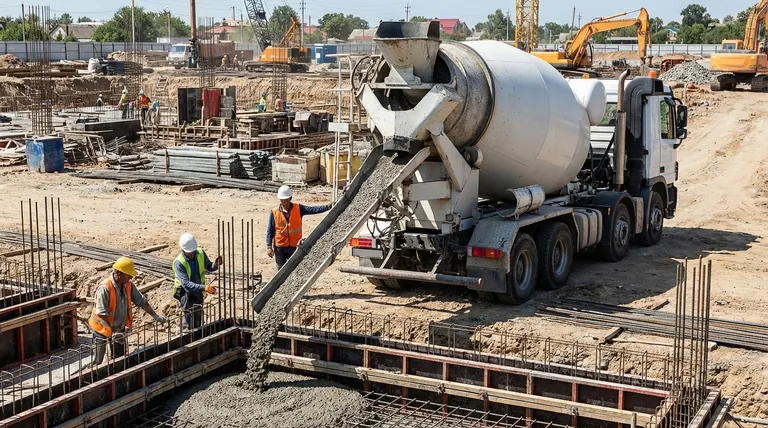
A concrete mixer truck is a specialized vehicle designed to both mix its core ingredients—cement, sand, gravel, and water—and transport the resulting concrete to a construction site. Its primary purpose is to deliver a perfectly blended, ready-to-use concrete mixture, ensuring it remains viable and does not harden prematurely during transit.
The true value of a concrete mixer truck isn't just transport; it's a mobile batching plant. Its constantly rotating drum ensures the concrete remains in an ideal, unhardened state from the moment it leaves the plant until it's poured on-site.
The Anatomy of a Mobile Mixing Plant
To understand its purpose, you must first understand its core components. Each part is engineered to solve a specific challenge related to the perishable nature of concrete.
The Revolving Drum
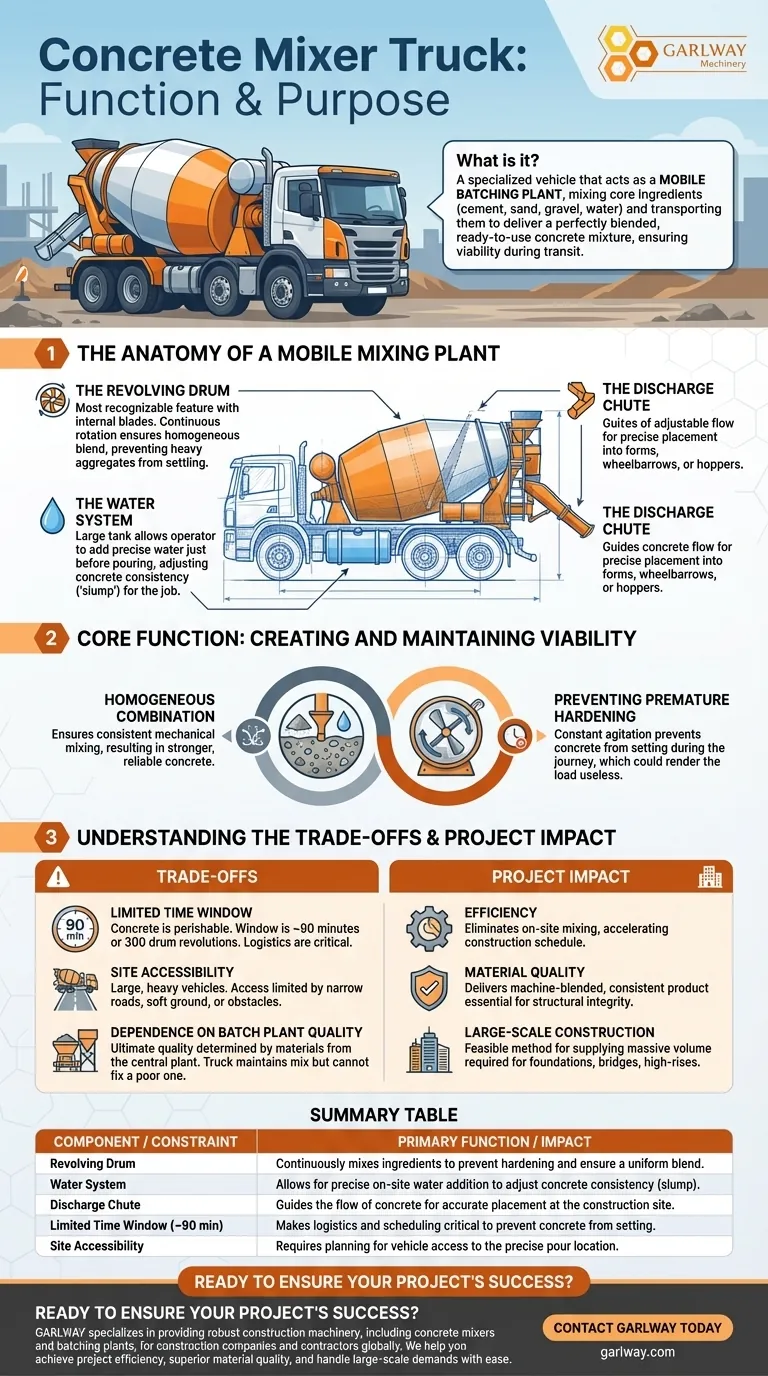
The most recognizable feature is the large, rotating drum. This drum is equipped with internal blades or fins. As it spins, these blades continuously lift and fold the mixture over itself, guaranteeing a homogeneous blend and preventing the heavy aggregates from settling.
The Water System
A large water tank is mounted on the truck. This allows the operator to add a precise amount of water to the mix just before pouring, adjusting the concrete's consistency (known as "slump") to meet the exact specifications of the job site.
The Discharge Chute
At the rear of the truck is a series of articulated chutes. These guide the flow of concrete out of the drum, allowing for precise placement directly into forms, wheelbarrows, or concrete pump hoppers.
The Core Function: Creating and Maintaining Viability
The truck performs two jobs that are fundamentally intertwined: mixing and transporting. The design solves the problem that once water is added to cement and aggregates, the chemical hardening process begins immediately.
Homogeneous Combination
The truck ensures that cement, aggregates, and water are combined uniformly. This mechanical mixing is far more thorough and consistent than what could be achieved by hand, resulting in stronger, more reliable concrete.
Preventing Premature Hardening
The constant agitation inside the drum is critical. This movement prevents the concrete from setting and hardening during the journey from the batch plant to the construction site, which could otherwise render the entire load useless.
Understanding the Trade-offs
While indispensable, the use of concrete mixer trucks comes with inherent operational constraints that must be managed.
The Limited Time Window
Concrete is a perishable product. A truck typically has a very limited window, often around 90 minutes or 300 drum revolutions, to discharge its load before the concrete begins to harden beyond a usable state. This makes logistics and scheduling absolutely critical.
Site Accessibility
These are large, heavy vehicles. Their ability to deliver concrete is limited by the accessibility of the construction site. Narrow roads, soft ground, or overhead obstacles can prevent the truck from reaching the precise pour location.
Dependence on Batch Plant Quality
The mixer truck can only work with the materials it's given. The ultimate quality and strength of the concrete are determined by the precise measurements and quality of the cement, sand, gravel, and water loaded at the central batch plant. The truck maintains the mix, but cannot fix a poor one.
How This Impacts Your Construction Project
Understanding the role of the mixer truck helps in planning for a successful concrete pour.
- If your primary focus is project efficiency: A concrete mixer truck eliminates the labor, space, and time required for on-site mixing, dramatically accelerating the construction schedule.
- If your primary focus is material quality: The truck delivers a machine-blended, consistent product that adheres to engineering specifications, which is essential for structural integrity.
- If your primary focus is large-scale construction: For projects like foundations, bridges, or high-rises, mixer trucks are the only feasible method for supplying the massive volume of concrete required.
Ultimately, the concrete mixer truck is the critical link that transforms raw materials into the structural foundations of modern construction.
Summary Table:
| Component | Primary Function |
|---|---|
| Revolving Drum | Continuously mixes ingredients to prevent hardening and ensure a uniform blend. |
| Water System | Allows for precise on-site water addition to adjust concrete consistency (slump). |
| Discharge Chute | Guides the flow of concrete for accurate placement at the construction site. |
| Key Constraint | Impact on Project |
| Limited Time Window (~90 min) | Makes logistics and scheduling critical to prevent concrete from setting. |
| Site Accessibility | Requires planning for vehicle access to the precise pour location. |
Ready to ensure your project's success with reliable, high-quality concrete delivery?
GARLWAY specializes in providing robust construction machinery, including concrete mixers and batching plants, for construction companies and contractors globally. We help you achieve project efficiency, superior material quality, and handle large-scale demands with ease.
Contact GARLWAY today to discuss your specific needs and get a tailored solution!
Visual Guide
Related Products
- Ready Mixer Machine for Construction Ready Mix Machinery
- JW1000 Mobile Cement Mixer Concrete Mixer Truck and Batching Plant
- Mini Cement Mortar Mixer Truck for Construction
- Harbor Freight JS1500 On Site Concrete Mixing Volumetric Cement Mixer
- Portable Concrete Mixer Machine Equipment for Mixing Concrete
People Also Ask
- What are the purposes of low-speed agitation in truck mixers? Preserve Concrete Quality During Transit
- How is ready-mixed concrete transported from a commercial concrete batching plant? Ensuring Quality & Timely Delivery
- What are the main ingredients mixed in a concrete mixer truck? Master the Formula for Strong Concrete
- In what ways does a mobile concrete mixer improve quality control and consistency? Achieve Superior On-Site Concrete Quality
- What types of construction projects typically use concrete mixer trucks? From Highways to Home Foundations