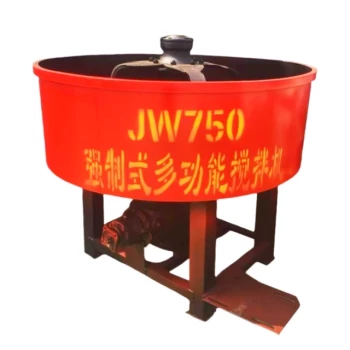
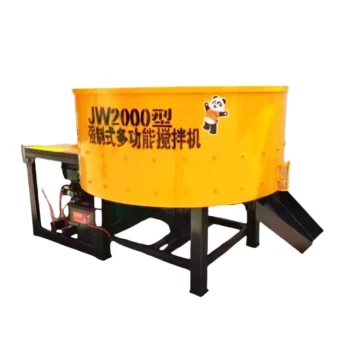
The machine used to make concrete is most commonly called a concrete mixer. While it is also frequently referred to as a cement mixer, its primary function is to homogeneously combine cement, aggregates (like sand or gravel), and water to create the final product: concrete.
The term "concrete mixer" is technically more accurate than "cement mixer." This is because cement is just one ingredient, the binding agent, while the machine's purpose is to produce the final composite material—concrete.
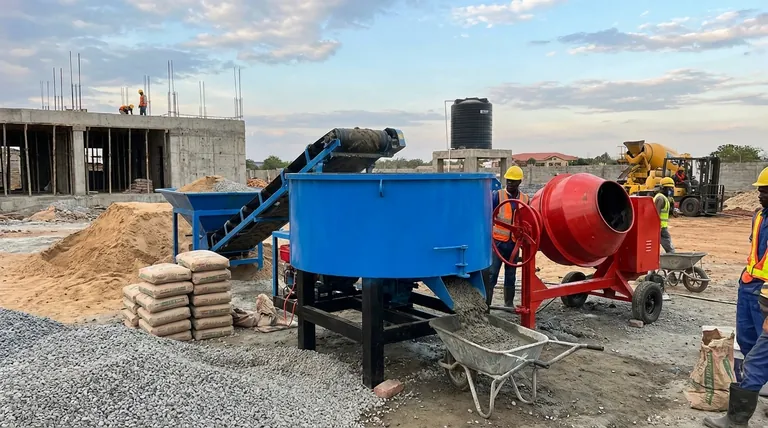
How a Concrete Mixer Works
A concrete mixer is designed for one primary purpose: to ensure every particle of cement, sand, and gravel is thoroughly coated with water. This process, called homogenization, is critical for creating strong, durable concrete.
The Core Components
The most recognizable type of mixer uses a simple and effective design. It consists of a revolving drum mounted on a frame or chassis, powered by a motor.
The Mixing Process
Inside the drum, there are fixed blades or fins. As the drum rotates, these fins continuously lift and tumble the materials over one another, preventing any single component from settling and ensuring a perfectly even consistency.
Cement vs. Concrete: A Critical Distinction
To understand the equipment, it's essential to understand the materials. Cement is the fine, dry powder that acts as a binder. When mixed with water, sand, and gravel (aggregates), the resulting wet mixture is concrete, which then hardens into a durable composite material.
Common Types of Mixers
While the revolving drum is the classic image, mixers come in various sizes and types, suited for different scales of work.
Drum Mixers
This is the most common type, ideal for small to medium-sized projects. The revolving drum is simple, reliable, and easy to clean. They are a form of batch mixer, meaning they mix one batch of concrete at a time.
Pan Mixers
Often used in precast concrete plants, pan mixers feature a stationary circular pan with rotating paddles inside. This design provides a more forceful, shearing action, which is excellent for producing high-strength, uniform concrete.
Continuous Mixers
For massive industrial projects like dams or highways, continuous mixers are used. Instead of mixing one batch at a time, raw materials are continuously fed into the machine, mixed, and then discharged without interruption, allowing for immense production volume.
Common Pitfalls to Avoid
The mixer is a powerful tool, but the quality of the final product depends on more than just the machine.
The Wrong Terminology
In professional or technical settings, referring to the machine as a "concrete mixer" demonstrates a correct understanding of the construction process. While "cement mixer" is common, it can be seen as imprecise.
Ignoring the Mix Ratio
A mixer only combines what you put into it. The ultimate strength of the concrete is determined by the precise ratio of water, cement, and aggregates. An incorrect ratio will result in weak concrete, regardless of how well it's mixed.
Overloading the Drum
Filling a drum mixer beyond its rated capacity is a frequent mistake. Overloading prevents the materials from tumbling freely, leading to an inconsistent mix with dry clumps and weak spots.
Making the Right Choice for Your Goal
Understanding the terminology and the process is key to successful project outcomes.
- If your primary focus is casual conversation: Using "cement mixer" is perfectly acceptable and will be understood by almost everyone.
- If your primary focus is technical accuracy or a professional setting: Always refer to the equipment as a "concrete mixer" to accurately describe its function.
- If you are planning a project: Remember that the mixer is just the tool; your primary concern should be achieving the correct mix design for your specific application.
Knowing the difference between cement and concrete, and the proper name for the machine that combines them, is foundational to any successful construction work.
Summary Table:
| Machine Type | Best For | Key Feature |
|---|---|---|
| Drum Mixer | Small to medium projects | Revolving drum for simple, batch mixing |
| Pan Mixer | Precast concrete production | Stationary pan with paddles for high-strength mix |
| Continuous Mixer | Large industrial projects | Non-stop mixing for high-volume output |
Ready to find the perfect concrete mixer for your project?
GARLWAY specializes in providing robust construction machinery, including concrete mixers, winches, and batching plants, to help construction companies and contractors worldwide achieve efficient, high-quality results.
Contact our experts today to discuss your specific needs and get a tailored solution!
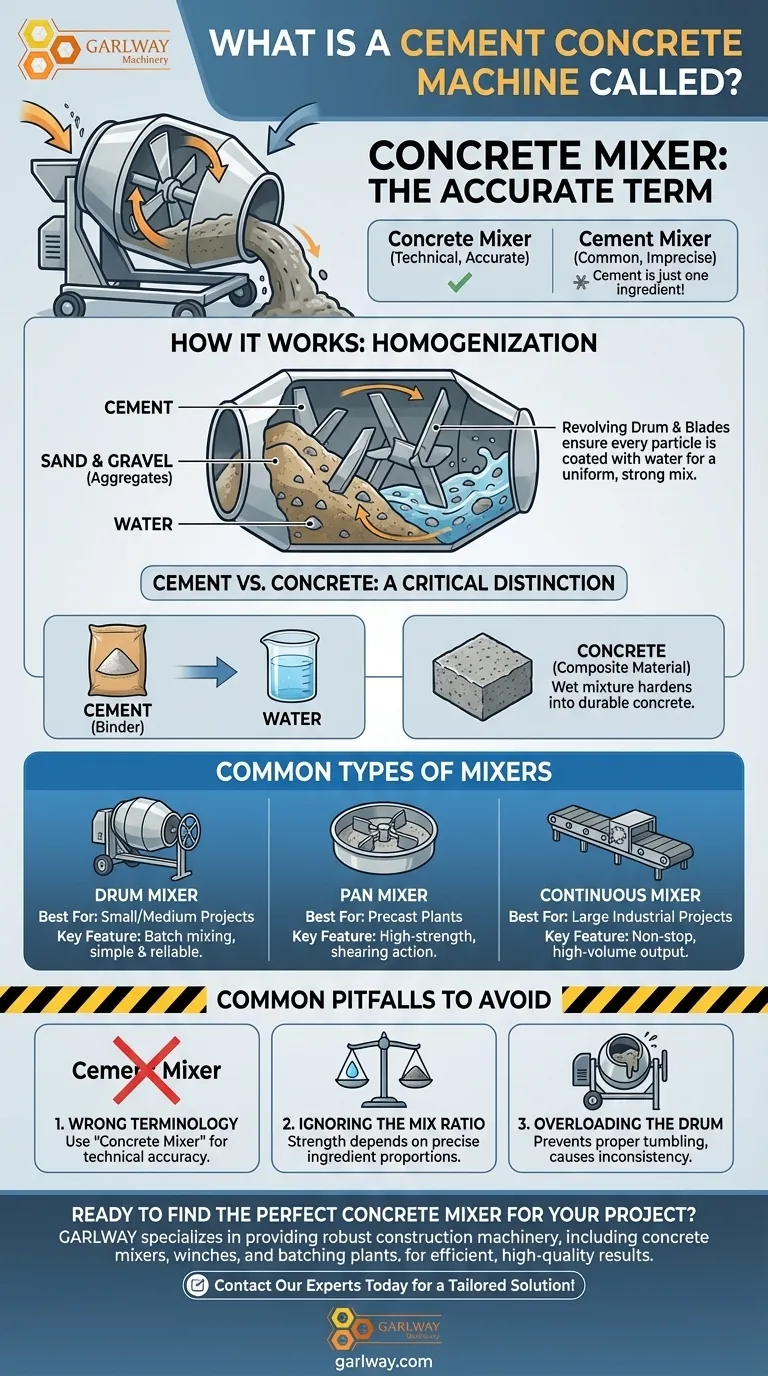
Visual Guide
Related Products
- Portable Electric Small Cement Mixer Concrete Machine
- Portable Concrete Mixer Machine Equipment for Mixing Concrete
- Hydraulic Concrete Mixer Machine Cement Mixing Equipment for Mixture Concrete
- JZC400 Mobile Small Concrete Mixer Cement Mixer Machine
- Construction Products Concrete Plant Machine Mixing Concrete Mixer
People Also Ask
- What is a portable cement mixer? Achieve Consistent, On-Demand Concrete Mixing
- What are the power sources for portable cement mixers? Choose the Right Power for Your Job Site
- What are the size and portability options for portable cement mixers? Find Your Perfect Match for Any Job
- What was the first recorded version of the portable concrete mixer and who invented it? Discover the 1904 Horse-Drawn Innovation
- How does a portable concrete mixer benefit construction projects? Boost Efficiency & Cut Costs On-Site