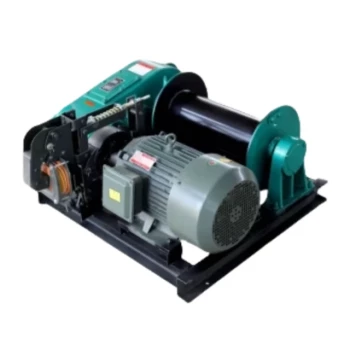
At its core, the electric winch is a foundational tool used across nearly every major industrial sector. Its applications span from construction, manufacturing, and mining to marine, forestry, automotive, and defense industries for essential tasks involving lifting, pulling, and precise material handling.
The widespread adoption of electric winches is not due to a single feature, but to their unique combination of controlled power, operational efficiency, and versatility, making them indispensable for maneuvering heavy loads in environments ranging from factory floors to remote field sites.
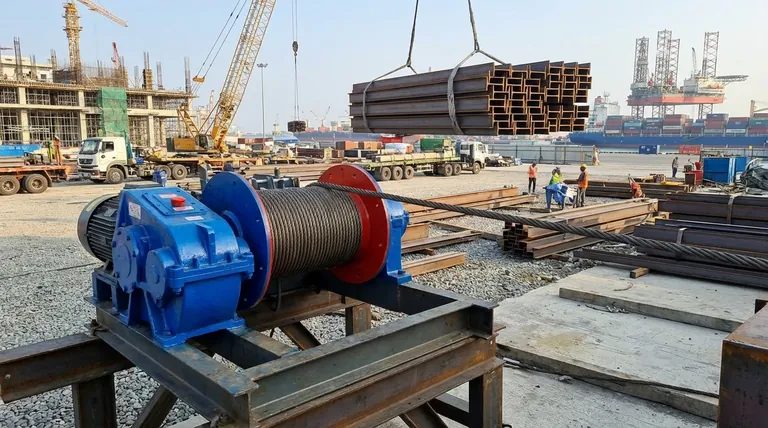
The Fundamental Role of an Electric Winch
An electric winch is a mechanical device that uses an electric motor to wind a cable or rope around a drum, creating a powerful pulling or lifting force. This simple concept solves a fundamental industrial problem: moving objects that are too heavy or cumbersome for manual labor.
The Core Mechanism
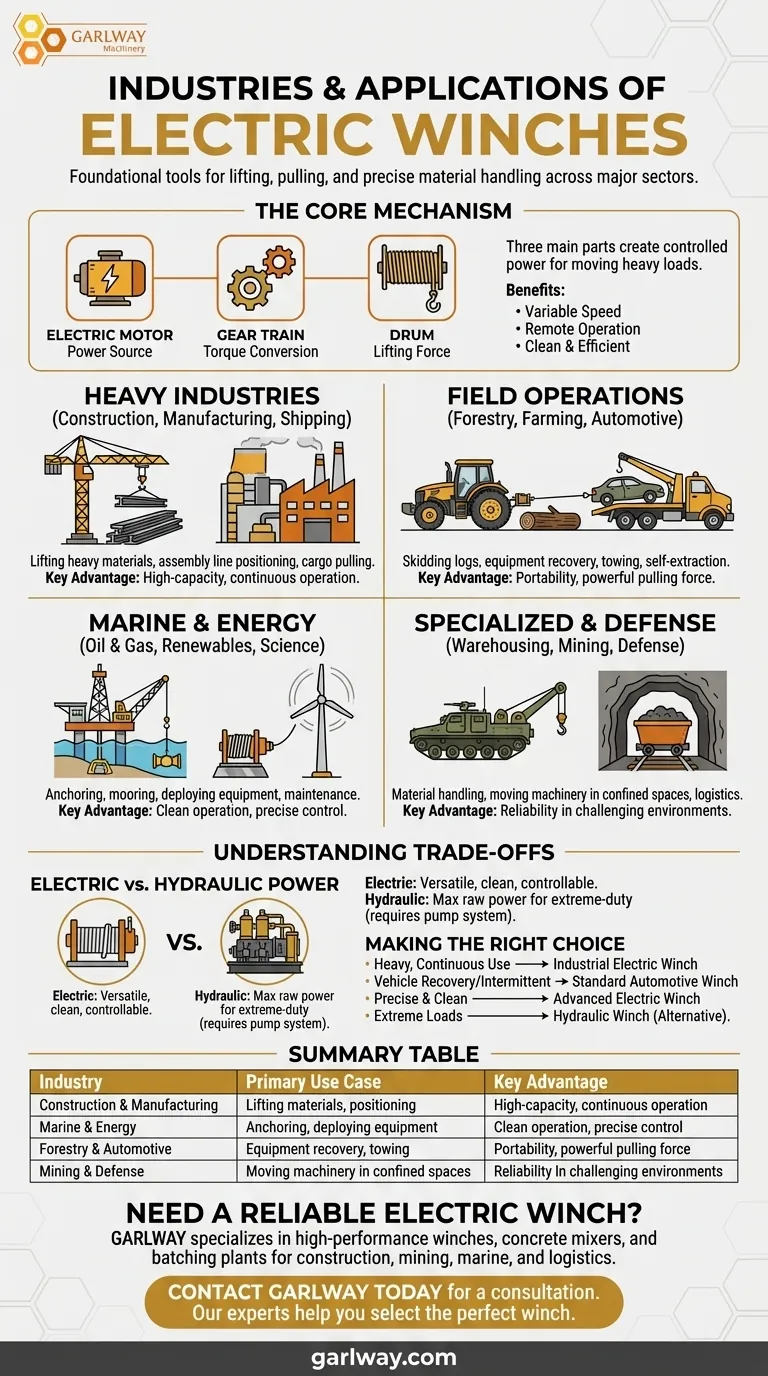
The system consists of three main parts: an electric motor that provides the power, a gear train that converts motor speed into torque, and a drum that holds the wire rope or synthetic cable. This combination allows for the controlled exertion of substantial force.
Why Electric Power is a Key Advantage
Electric power provides significant benefits over other methods. It offers variable speed control, remote operation capabilities, and is generally cleaner and more efficient for continuous use compared to fuel-powered alternatives. This makes it ideal for both indoor and outdoor applications.
A Breakdown of Key Industrial Applications
The versatility of the electric winch is best understood by looking at its specific uses across different sectors. Each industry leverages the winch's core capabilities to solve unique challenges.
Heavy Industries: Construction, Manufacturing, and Shipping
In construction sites, manufacturing facilities, and shipping yards, industrial electric winches are workhorses. They are used for lifting heavy building materials, positioning large components on an assembly line, and pulling cargo. Their high-capacity pull power and ability to operate continuously are critical in these demanding environments.
Field Operations: Forestry, Farming, and Automotive
Forestry and farming operations rely on electric winches for tasks like skidding logs, recovering stuck equipment, and tensioning lines. In the automotive world, they are a standard for tow trucks and off-road vehicles, providing essential recovery power for towing and self-extraction.
Marine and Energy Sectors: Oil & Gas, Renewables, and Science
The marine industry uses electric winches for anchoring, mooring, and deploying equipment. In the oil and gas sector, they are crucial for maintenance and inspection projects. Their cleaner operation also makes them a preferred choice in renewable energy and for deploying sensitive survey equipment in marine science.
Specialized and Defense Applications
Warehousing and logistics use winches for material handling and positioning heavy stock. In mining and tunneling, they are essential for moving materials and machinery in confined spaces. Defense forces also utilize them for vehicle recovery and material logistics in challenging terrains.
Understanding the Trade-offs
While incredibly versatile, the electric winch is not the only solution. Understanding its limitations is key to using it effectively.
Electric vs. Hydraulic Power
The primary alternative for extreme-duty tasks is the hydraulic winch. Hydraulic systems can generate more raw pulling power, making them the choice for the heaviest applications in construction and mining. However, they require a hydraulic pump system and professional installation, adding complexity.
Matching the Winch to the Load
Electric winches come in a vast range of sizes, from mini winches designed for pulling loads under a ton to massive industrial units. Selecting an undersized winch is a common mistake that leads to equipment failure and safety risks. The application must dictate the winch's capacity.
Making the Right Choice for Your Application
Choosing the correct winch requires a clear understanding of your primary goal.
- If your primary focus is heavy, continuous use in a factory or construction site: An industrial-grade electric winch with a high duty cycle is necessary.
- If your primary focus is vehicle recovery or intermittent field work: A standard automotive or utility electric winch will provide the necessary power and portability.
- If your primary focus is precise control and clean operation: An advanced electric winch is superior, especially for sensitive scientific or indoor applications.
- If your primary focus is maximum raw power for the most extreme loads: A hydraulic winch may be a more suitable, albeit more complex, solution.
Ultimately, the electric winch's role as a powerful and adaptable tool ensures its place as a cornerstone of modern industrial operations.
Summary Table:
| Industry | Primary Use Case | Key Advantage |
|---|---|---|
| Construction & Manufacturing | Lifting materials, positioning components | High-capacity, continuous operation |
| Marine & Energy | Anchoring, deploying equipment | Clean operation, precise control |
| Forestry & Automotive | Equipment recovery, towing | Portability, powerful pulling force |
| Mining & Defense | Moving machinery in confined spaces | Reliability in challenging environments |
Need a reliable electric winch for your industrial application?
GARLWAY specializes in high-performance construction machinery, including a full range of electric winches, concrete mixers, and batching plants. Whether you're a construction company, contractor, or work in mining, marine, or logistics, we provide durable, efficient solutions tailored to your heavy lifting and material handling needs.
Contact GARLWAY today for a consultation and let our experts help you select the perfect winch to power your projects.
Visual Guide
Related Products
- Electric 120V Boat Winch by Badlands
- Electric and Hydraulic Winch for Heavy Duty Applications
- Small Electric Winch 120V and 240V for Compact Applications
- 12000 lb Electric Boat Trailer Winch with Windlass Anchor Warn
- Electric Hoist Winch Boat Anchor Windlass for Marine Applications
People Also Ask
- How do electric boat winches work? Unlock Effortless Launching & Retrieval
- How much current does an electric boat winch draw? Plan Your Electrical System for Peak Performance
- Can I run a winch straight from a battery? Essential Power Setup for Safe Operation
- What are the types of electric winches available? Choose the Right Winch for Your Job
- What are the uses of electric winches in mining and tunneling? Enhance Safety and Efficiency Underground