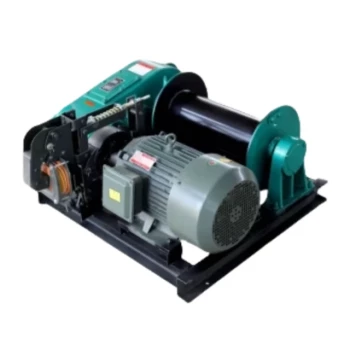
Capstan winches are specialized tools predominantly used in two key sectors: the electrical and utility industry for pulling cables and the commercial maritime industry for a wide range of rigging, anchoring, and handling tasks. Their unique design makes them ideal for applications requiring continuous, controlled pulling over very long distances.
The defining feature of a capstan winch is that it pulls without storing the line on its drum. This allows for virtually unlimited pull length, making it the superior choice for jobs like deploying long utility cables or managing extensive marine rigging, where a traditional drum winch would be limited by its capacity.
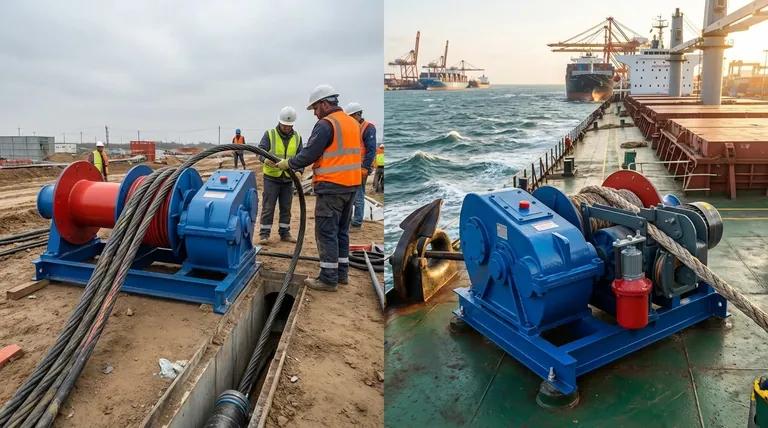
The Two Core Industries for Capstan Winches
The design of a capstan winch directly addresses the specific operational challenges found in utility and marine work.
Electrical and Utility Contracting
In this sector, the primary task is pulling electrical or fiber optic cables through long conduits, often underground or overhead.
A capstan winch excels here because it provides a smooth, continuous pulling force that won't damage the sensitive cables. Its ability to manage thousands of feet of line is a requirement that standard winches cannot meet.
Commercial Maritime Operations
The marine environment is the capstan's most traditional and diverse field of use. The need to manage long ropes and chains is constant.
Common applications include handling ship anchors, hauling in large fishing nets, managing sail rigging on larger vessels, and deploying equipment like oil spill booms. The capstan provides the mechanical advantage and control needed for these heavy-duty tasks.
Overlap with Offshore and Industrial Use
The principles that make capstans essential in maritime work also apply to related industrial fields.
Offshore oil and gas platforms use them for mooring and material handling. They are also found in some construction and manufacturing settings for specialized rigging and positioning of heavy equipment where long, continuous pulls are necessary.
Why a Capstan? The Principle of Operation
Understanding what makes a capstan different from a standard drum winch reveals why it's chosen for these specific industries.
Continuous Pulling, Not Storage
A traditional winch pulls a line and spools it directly onto its drum. The drum's size limits the total length of the line.
A capstan winch, however, uses a rotating drum (the capstan head) to create friction. The rope is wrapped around it a few times, and the operator simply pulls on the slack end to maintain tension. The line itself is coiled separately on the deck or ground.
Unmatched Rope Length Capacity
Because the capstan head doesn't store the rope, its pulling length is limited only by the length of the rope you have available. This is its single greatest advantage.
Precise Control and Variable Angles
The design allows for smooth engagement and disengagement of pulling force. This precision is critical when handling delicate cables or adjusting rigging. It can also effectively pull loads from various angles without the line-piling issues that can affect drum winches.
Understanding the Trade-offs
While powerful, the capstan winch is not a universal solution. Its design comes with specific operational considerations.
The Need for Manual Tailing
A capstan winch requires an operator to manage the "tail" or slack end of the rope, pulling it away as the winch turns. This makes it a more hands-on process compared to a "set it and forget it" drum winch.
When a Drum Winch Is Better
For applications that involve lifting rather than just pulling, or where storing the line neatly is critical, a drum winch is the better choice. Vehicle recovery is a classic example where a drum winch is standard.
Power Source Matters
Capstan winches can be powered by various sources, including electric or hydraulic systems. While electric capstans are common for utility work, heavy-duty marine or industrial applications may use hydraulic systems for their immense and consistent power output.
Making the Right Choice for Your Goal
Selecting the correct winch comes down to a clear understanding of the primary task.
- If your primary focus is pulling long distances of cable or rope: A capstan winch is purpose-built for this, offering unlimited pull length and continuous operation.
- If your primary focus is lifting heavy loads and storing the line: A traditional drum winch, potentially a hydraulic one for heavy-duty tasks, is the more appropriate tool.
- If your primary focus is versatility in marine or rigging applications: The capstan's ability to handle long ropes from various angles makes it the superior choice.
Ultimately, selecting a capstan winch is a decision for applications demanding controlled, continuous pulling power over line storage capacity.
Summary Table:
| Industry | Primary Use Case | Key Advantage |
|---|---|---|
| Electrical & Utility | Pulling long electrical/fiber optic cables | Unlimited pull length, prevents cable damage |
| Commercial Maritime | Anchoring, rigging, handling nets & equipment | Continuous, controlled pulling from various angles |
| Offshore/Industrial | Mooring, material handling, equipment positioning | Heavy-duty performance for specialized rigging |
Need a reliable winch solution for your next project?
GARLWAY specializes in construction machinery, offering robust and efficient winches, concrete mixers, and batching plants for construction companies and contractors globally. Our capstan winches provide the precise, continuous pulling power essential for utility, maritime, and industrial applications.
Contact GARLWAY today to discuss how our winches can enhance your operational efficiency and safety.
Visual Guide

Related Products
- Portable Small Trailer Winch
- Small Electric Winch 120V and 240V for Compact Applications
- Electric and Hydraulic Winch for Heavy Duty Applications
- 12000 lb Heavy Duty Electric Boat Winch
- Hydraulic Winding Engine Harbor Freight Winch
People Also Ask
- What features were incorporated into the upgraded portable winch system? Boost Your Recovery Power & Safety
- What are some uses mentioned for portable winches beyond vehicle recovery? Essential Versatility for Property & Work
- How could the twisting issue with a portable winch be mitigated? Achieve Safe, Centered Pulls with Proper Rigging
- What is the significance of trailer winches in the boating industry? Ensure Safe and Efficient Boat Recovery
- What should be considered when mounting a winch on a trailer? Ensure a Safe, Aligned Installation