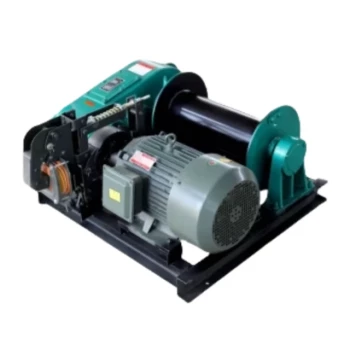
At its core, a winch is a powerful pulling device. It is most famously used for recovering a vehicle that is stuck in mud, sand, or on a steep incline, but its applications extend far beyond off-road adventures. A winch can also be a critical component in industrial machinery like cranes and hoists or a versatile tool for moving heavy objects around a property.
A winch is fundamentally a tool for creating immense mechanical advantage. While commonly associated with vehicle recovery, its true utility lies in its ability to safely and efficiently pull heavy loads in any situation where direct force is impractical or impossible.
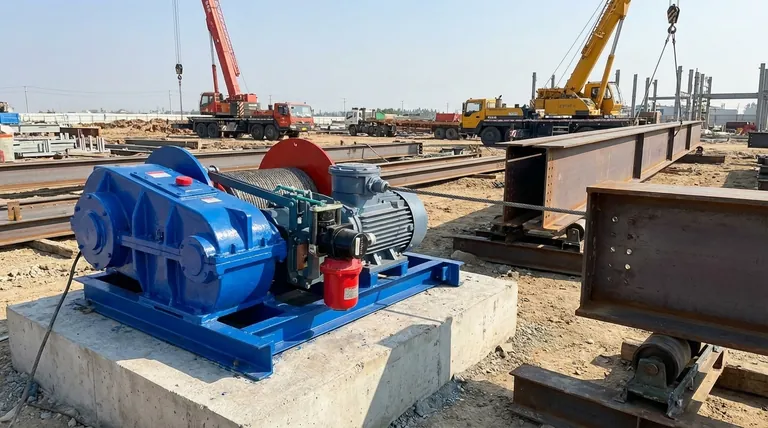
The Primary Role: Vehicle Recovery
A winch provides a safety net for navigating challenging terrain, allowing a vehicle to pull itself or another vehicle out of a difficult spot.
Self-Recovery Scenarios
The most common use for a vehicle-mounted winch is self-recovery. The operator can anchor the winch cable to a stable point like a tree or another vehicle to pull their own vehicle free.
This is essential when a vehicle is immobilized by mud, deep water, snow, or cannot overcome a steep incline under its own power.
Assisting Other Vehicles
A winch is equally valuable for rescue operations. A properly equipped vehicle can act as an anchor and use its winch to pull another disabled or stuck vehicle to safety.
Beyond the Trail: Versatile Applications
The simple and flexible structure of a winch makes it a powerful tool for a wide range of tasks beyond vehicle recovery.
Landscaping and Property Management
Winches are highly effective for moving large, heavy objects where vehicle access is limited. This includes repositioning large rocks, pulling tree stumps, or dragging logs.
Using a winch is far more efficient and controlled than attempting to move such objects with manual methods like pry bars.
Construction and Material Handling
On a job site, a winch can be used to precisely position heavy materials. By using snatch blocks and secure anchor points, a winch can pull building supplies or equipment into place with controlled force.
Industrial and Heavy Machinery
Winches are integral components in large-scale industrial equipment. They are found in cranes, road construction machinery, and specialized systems for mining and hydroelectric installations.
Specialized series of winches (JM, JMW, JT series, for example) are designed for specific industrial needs, from high-speed pulling to slow, deliberate positioning.
Understanding the Critical Safety Imperatives
While flexible and effective, the power of a winch demands a serious commitment to safety. Misuse can lead to equipment failure and severe injury.
Adhere to Load Capacities
Every winch has a maximum load capacity that must not be exceeded. Overloading the winch can snap the cable or damage the motor and gearing, creating a dangerous situation.
Secure Anchoring is Non-Negotiable
The winch itself must be securely anchored to a solid base, whether it's a vehicle frame or a dedicated industrial mount. The pulling anchor point must also be unquestionably stable.
Inspect Equipment Before Every Use
Before operation, always inspect the winch cable, hook, and remote for any signs of wear, fraying, or damage. Damaged equipment should be replaced immediately.
Maintain a Clear Operating Area
Ensure the area around the winch cable and the load is clear of all people and objects. A snapping cable releases a tremendous amount of energy and can cause serious harm.
Making the Right Choice for Your Goal
To apply a winch effectively, match its capabilities to your primary objective.
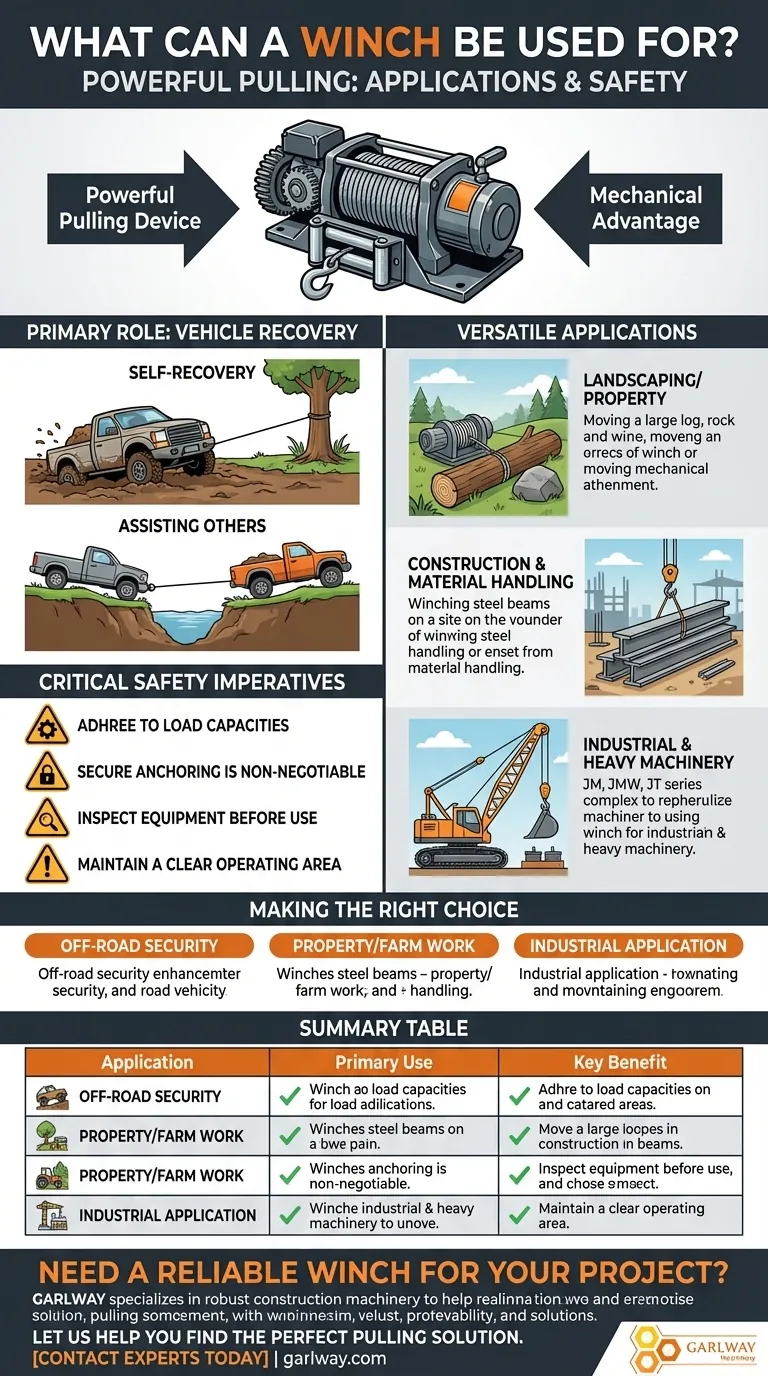
- If your primary focus is off-road security: A vehicle-mounted winch is an indispensable tool for confident self-recovery and assisting others in difficult terrain.
- If your primary focus is property or farm work: A winch provides the controlled pulling power to move heavy objects like logs, rocks, or small equipment with enhanced safety and efficiency.
- If your primary focus is an industrial application: Specialized, high-capacity winches are designed to be integrated into larger machinery for lifting, construction, and material handling.
By understanding its function as a powerful pulling tool, you can leverage a winch to make impossible tasks manageable and safe.
Summary Table:
| Application | Primary Use | Key Benefit |
|---|---|---|
| Vehicle Recovery | Self-recovery, assisting others | Safety net for off-road adventures |
| Landscaping/Property | Moving logs, rocks, stumps | Controlled, efficient heavy pulling |
| Construction | Positioning materials, equipment | Precise, powerful load handling |
| Industrial Machinery | Cranes, hoists, specialized systems | Integral component for heavy-duty tasks |
Need a reliable winch for your project?
GARLWAY specializes in providing robust construction machinery, including a wide range of winches, concrete mixers, and batching plants. Whether you're a construction company, a contractor, or manage industrial operations, our equipment is engineered for performance, safety, and durability.
Let us help you find the perfect pulling solution. Contact our experts today to discuss your specific requirements and get a quote!
Visual Guide
Related Products
- Warn Winch Windlass Boat Trailer Winch
- Electric and Hydraulic Winch for Heavy Duty Applications
- Small Electric Winch 120V and 240V for Compact Applications
- Quick Windlass Portable Winch for Truck and Boat Best Boat Winch
- Hydraulic Winding Engine Harbor Freight Winch
People Also Ask
- What are the main components of a boat trailer winch? A Guide to Safe & Efficient Boat Loading
- What factors should be considered when choosing a boat trailer winch? Ensure Safe and Effortless Boat Loading
- What is the purpose of boat trailer winches? Safely and Efficiently Load Your Boat
- What are the two main types of boat trailer winches? Manual vs. Electric Explained
- How often should a boat trailer winch be replaced? Your Guide to Safety and Longevity