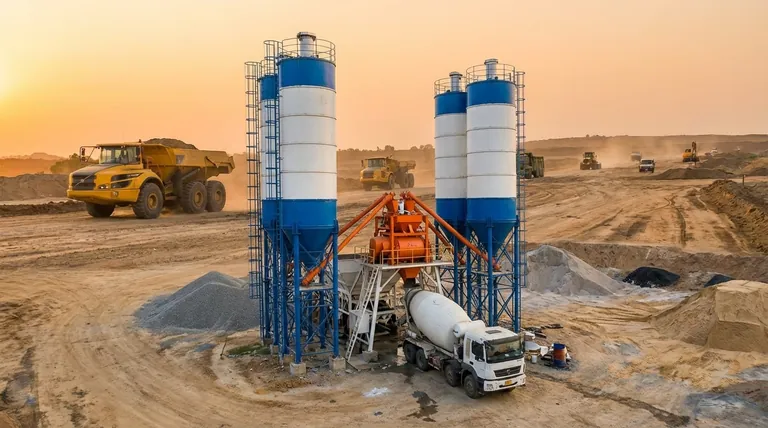
The most critical features of a mobile concrete batching plant are its portability, production efficiency, ease of operation, and adaptability to your specific project needs. These attributes determine its ability to deliver consistent, high-quality concrete exactly where and when you need it, overcoming the logistical hurdles of fixed plants.
Selecting the right mobile plant isn't about finding the one with the most features; it's about matching its core capabilities—specifically its production capacity and mobility—to the unique demands and constraints of your construction environment.
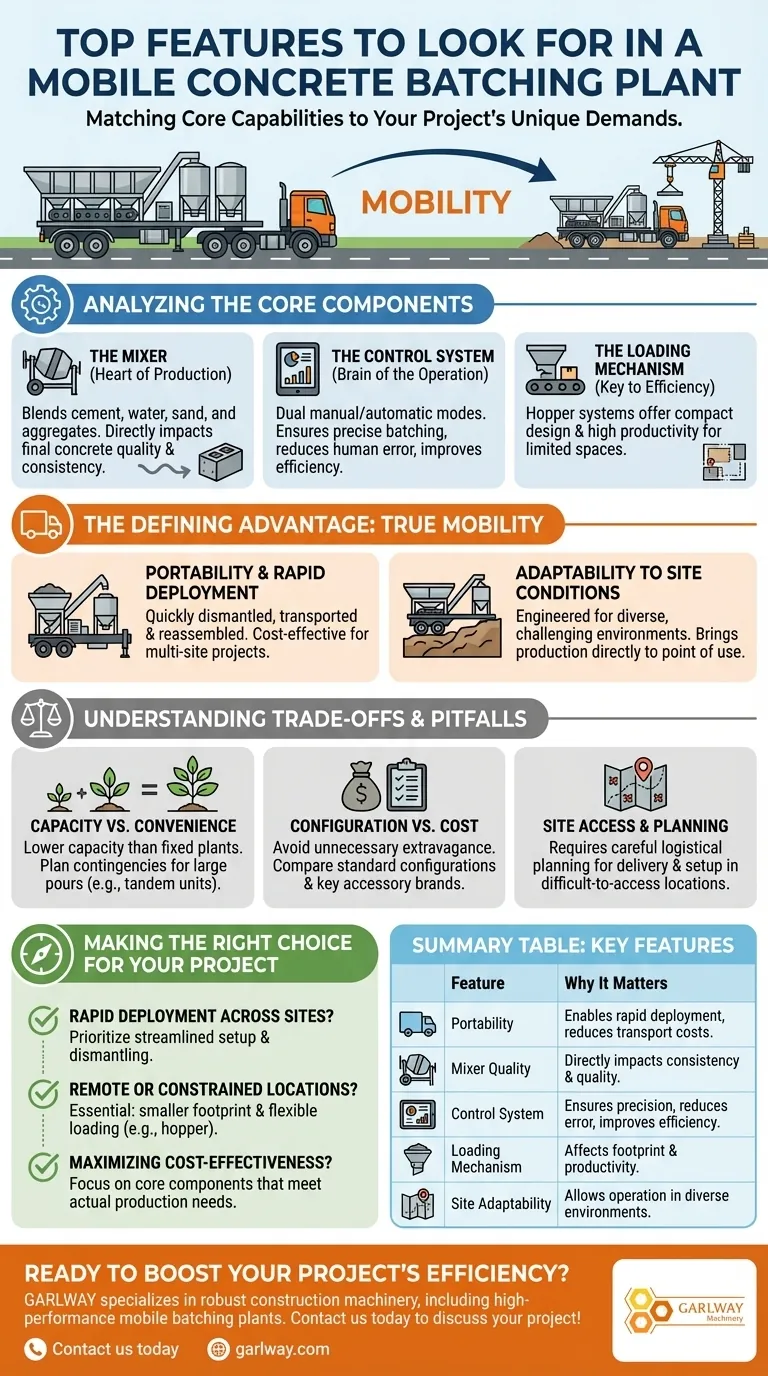
Analyzing the Core Components
Understanding the fundamental parts of a mobile batching plant helps you evaluate its overall performance and suitability for your work.
The Mixer: The Heart of Production
The mixer unit is the core of the entire operation. Its primary function is to blend cement, water, sand, and aggregates into a perfectly homogeneous mix.
The quality and consistency of your final concrete product are directly tied to the efficiency and reliability of the mixer.
The Control System: The Brain of the Operation
Modern plants often feature both fully automatic and manual control modes. This dual capability provides operational flexibility and precision.
An intuitive, reliable control system simplifies operation, ensures accurate batching, reduces the potential for human error, and improves overall efficiency.
The Loading Mechanism: The Key to Efficiency
How materials are loaded into the plant significantly impacts its footprint and productivity.
For example, plants that use a hopper system for loading can offer a compact design without sacrificing output, making them ideal for sites with limited space.
The Defining Advantage: True Mobility
The "mobile" aspect is the primary reason for choosing this type of plant. This mobility translates into two distinct strategic advantages.
Portability and Rapid Deployment
A key feature is the ability to be dismantled, transported, and reassembled at a new location with relative ease.
This makes mobile plants exceptionally convenient and cost-effective for companies managing multiple projects or needing to move operations along a large site, like a highway construction project.
Adaptability to Site Conditions
Mobile plants are engineered to operate in diverse and often challenging environments where building a permanent plant is impractical.
Their design allows them to be set up on smaller, less-prepared sites, bringing concrete production directly to the point of use and minimizing transport time and costs.
Understanding the Trade-offs and Pitfalls
An objective evaluation requires acknowledging the limitations and potential challenges associated with mobile batching plants.
Capacity vs. Convenience
Mobile plants typically have a lower production capacity than their large, static counterparts. For projects requiring a single, massive pour, you may need to create a contingency plan.
This could involve using two smaller plants in tandem or ensuring you have sufficient spare parts on-site to prevent downtime during critical operations.
Configuration vs. Cost
When evaluating options, avoid the temptation of unnecessary extravagance. The most expensive or feature-rich plant is not always the best choice.
Carefully compare the standard configuration lists from different manufacturers. Pay close attention to the brands of key accessories, as this can significantly impact long-term reliability and cost.
Site Access and Planning
While adaptable, mobile plants still require careful logistical planning. Sites that are extremely difficult to access will need thorough consideration to ensure the plant can be delivered and set up smoothly.
The most economical and effective choice is the plant that precisely fits your project requirements, not simply the one with the best specifications on paper.
Making the Right Choice for Your Project
Your decision should be guided by the specific goals and constraints of your typical projects.
- If your primary focus is rapid deployment across multiple nearby sites: Prioritize a plant with a streamlined setup and dismantling process to maximize operational uptime.
- If your primary focus is working in remote or constrained locations: A plant with a smaller footprint and flexible loading options, like a hopper system, is essential.
- If your primary focus is maximizing cost-effectiveness: Avoid over-specifying and carefully compare configuration lists, focusing on the core components that meet your actual production needs.
Ultimately, the right mobile batching plant is the one that becomes a seamless and reliable extension of your project's workflow.
Summary Table:
| Key Feature | Why It Matters |
|---|---|
| Portability | Enables rapid deployment and movement between multiple project sites, reducing transport costs. |
| Mixer Quality | Directly impacts the consistency and quality of the final concrete product. |
| Control System | Ensures precise batching, reduces human error, and improves operational efficiency. |
| Loading Mechanism | Affects the plant's footprint and productivity, crucial for space-constrained sites. |
| Site Adaptability | Allows operation in diverse environments, bringing production directly to the point of use. |
Ready to boost your project's efficiency with a mobile concrete batching plant tailored to your needs?
At GARLWAY, we specialize in providing robust construction machinery—including high-performance mobile batching plants, winches, and concrete mixers—for contractors and construction companies worldwide. Our solutions are designed to deliver reliability, flexibility, and cost-effectiveness, ensuring you get the right equipment for your specific site requirements.
📞 Contact us today via our Contact Form to discuss your project and discover how GARLWAY can help you achieve seamless, on-site concrete production!
Visual Guide
Related Products
- HZS35 Small Cement Concrete Mixing Batch Plant
- JW1000 Mobile Cement Mixer Concrete Mixer Truck and Batching Plant
- Commercial Electric Concrete Mixer Machine HZS 50 Small Batch Plant for Sale
- HZS25 Best Cement Mixer for Quick Mix Concrete at Bunnings
- Belle Cement Mixer JS2000 Volumetric Concrete Mixer for Harbor Freight
People Also Ask
- Why buy concrete batch plant parts only from the manufacturer? Protect Your Investment and Maximize Uptime
- Why is proper maintenance important for a concrete batch mix plant? Maximize Uptime & Profitability
- What is the advantage of a mobile concrete batching plant? Achieve On-Site Production & Total Control
- What are the advantages and disadvantages of concrete batching plants? Maximize Quality & Efficiency
- What are the two methods of material charging in a concrete mixing station? Single vs. Multiple Charging Explained