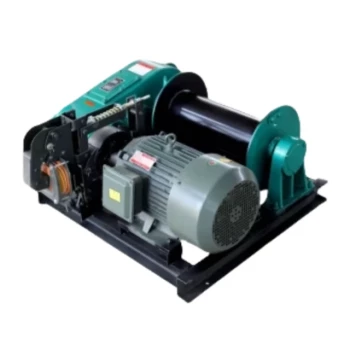
A manual trailer winch operates by using a hand crank to turn an internal gear system. This mechanism multiplies your physical effort, converting the fast, low-force rotation of the crank into the slow, high-force rotation of a central drum, which systematically winds a strap or cable to pull a heavy object.
A manual winch is fundamentally a force multiplier. It translates your physical work into powerful pulling force through gear reduction, while a ratchet acts as a safety lock to prevent the load from ever slipping backward.

The Core Components and Their Roles
To truly understand its operation, you must first understand its parts. Each component serves a distinct and critical purpose in the system.
The Crank Handle: Your Input
The crank handle is the lever where you apply force. It's the start of the entire mechanical process, capturing your physical energy.
The Gear Train: The Power Multiplier
Connected to the crank is a gear train, typically a spur gear mechanism. This is the heart of the winch. It's engineered to trade speed for power, providing the mechanical advantage necessary to move heavy loads.
The Drum: The Winding Core
The gear train rotates a central, cylindrical drum. The winch line—either a synthetic strap or a steel cable—is wound tightly and evenly onto this drum as it turns.
The Ratchet and Pawl: The Safety Lock
This is the component responsible for the distinct "clicking" sound during operation. A toothed gear (the ratchet) and a spring-loaded lever (the pawl) lock together, preventing the drum from unwinding under load if you release the handle.
How Gearing Translates Effort into Force
The magic of a winch isn't in its size, but in the simple physics of its gear system. This is what allows a person to pull thousands of pounds.
Understanding Gear Ratios
The power of a winch is expressed as a gear ratio, such as 5:1 or 10:1. A 5:1 ratio means you must turn the crank handle five full times to make the drum complete just one revolution.
The Exchange of Speed for Power
This exchange is the entire principle. You perform more rotations with the handle (speed) to generate significantly more pulling force at the drum (power). Many winches are dual-speed, allowing you to choose a ratio best suited for the load.
Understanding the Trade-offs
While effective, manual winches operate on a foundation of mechanical trade-offs that are critical to understand for safe and efficient use.
Physical Effort vs. Speed
A higher gear ratio (e.g., 10:1) provides immense pulling power but is very slow, requiring many turns of the crank. A lower ratio (e.g., 3:1) is much faster but demands far more physical effort from you.
The Critical Role of the Ratchet
Never attempt to winch a heavy load without the ratchet and pawl engaged. Disengaging it allows the drum to spin freely. Under load, this can cause the crank handle to spin backward with dangerous force, risking serious injury.
Line Management
The line must be wound evenly onto the drum. Bunching the cable or strap on one side can damage the line and put uneven stress on the winch frame itself, potentially leading to failure.
Making the Right Choice for Your Goal
Your understanding of these mechanics directly informs which winch is right for your needs.
- If your primary focus is loading a heavy boat with ease: Select a dual-speed winch or one with a high single-gear ratio (5:1 or greater) to maximize your pulling power and reduce physical strain.
- If your primary focus is quickly securing lighter watercraft or equipment: A single-speed winch with a lower gear ratio (like 3:1) will be much faster to operate.
By understanding these simple mechanical principles, you can operate your winch with greater safety, efficiency, and confidence.
Summary Table:
| Component | Function | Key Takeaway |
|---|---|---|
| Crank Handle | Applies your physical force | The starting point of the mechanical process |
| Gear Train | Multiplies force by trading speed for power | A 5:1 ratio means 5 crank turns = 1 drum turn |
| Drum | Winds the cable or strap | Line must be wound evenly to prevent damage |
| Ratchet & Pawl | Locks the drum to prevent backward movement | A critical safety feature; never disengage under load |
Ready to harness the power of a reliable manual winch for your projects?
At GARLWAY, we specialize in robust construction machinery designed for professionals. Our manual winches are engineered for maximum pulling power and safety, ideal for construction companies and contractors who demand dependable equipment.
Contact our experts today to find the perfect winch solution for your specific needs and experience the GARLWAY difference in quality and performance.
Visual Guide

Related Products
- Portable Small Trailer Winch
- Best 18000 Pound Drum Anchor Trailer Winch
- Warn Winch Windlass Boat Trailer Winch
- 12000 lb Electric Boat Trailer Winch with Windlass Anchor Warn
- Quick Windlass Portable Winch for Truck and Boat Best Boat Winch
People Also Ask
- What features were incorporated into the upgraded portable winch system? Boost Your Recovery Power & Safety
- What are some uses mentioned for portable winches beyond vehicle recovery? Essential Versatility for Property & Work
- How could the twisting issue with a portable winch be mitigated? Achieve Safe, Centered Pulls with Proper Rigging
- What is the significance of trailer winches in the boating industry? Ensure Safe and Efficient Boat Recovery
- What should be considered when mounting a winch on a trailer? Ensure a Safe, Aligned Installation