In short, hydraulic winch motors are defined by their immense power and endurance. They are engineered to deliver exceptional starting torque and sustained high performance, making them the standard for the most demanding industrial and commercial applications where failure is not an option.
While other winch types may offer convenience or precision, hydraulic systems are fundamentally about raw, reliable pulling power. Understanding this core principle is the key to choosing the right tool for your specific operational needs.
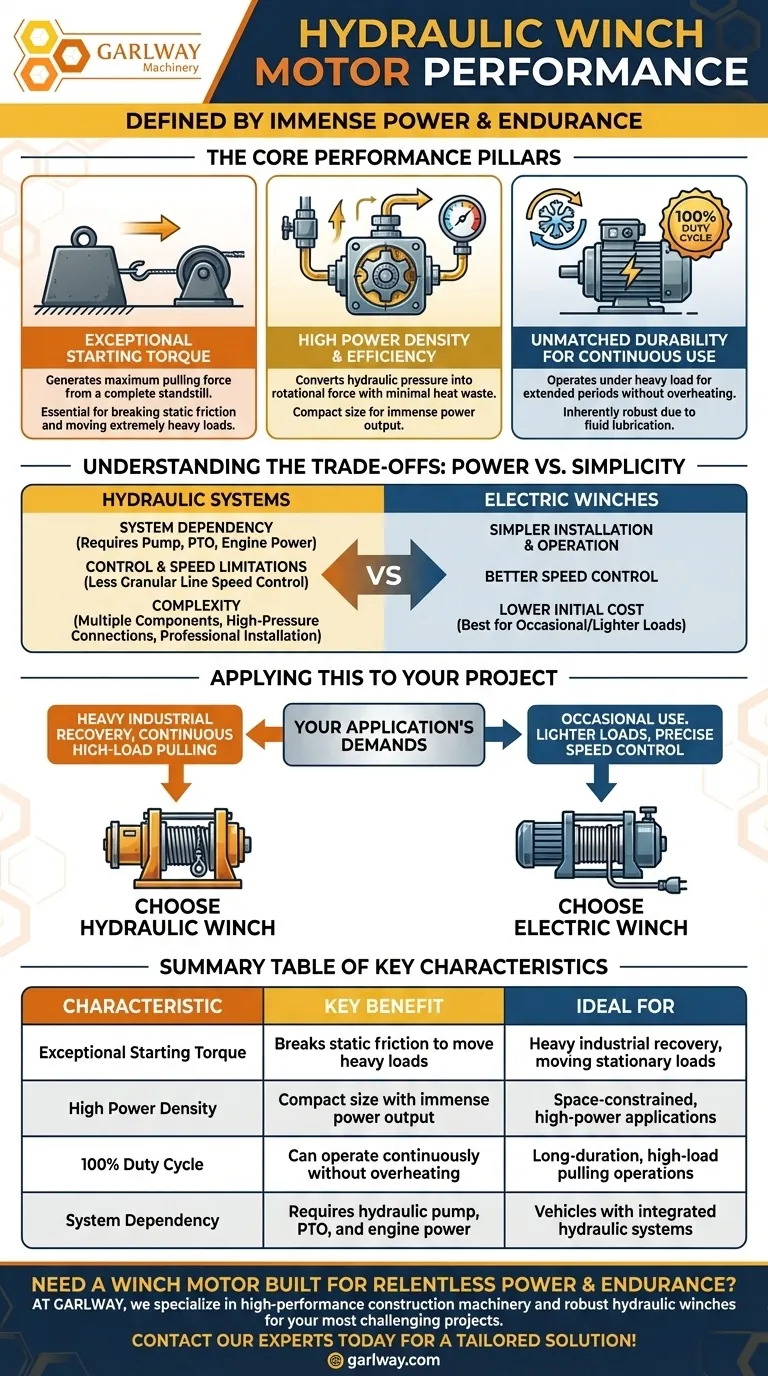
The Core Performance Pillars of Hydraulic Motors
A hydraulic winch motor's characteristics are a direct result of its design, which leverages the power of pressurized fluid to generate mechanical force. This leads to several distinct advantages in heavy-duty scenarios.
Exceptional Starting Torque
The most critical feature of a hydraulic motor is its large starting torque. This is the ability to generate maximum pulling force from a complete standstill.
This characteristic is essential for breaking static friction and moving extremely heavy, stationary loads, which is often the most demanding phase of any winching operation.
High Power Density and Efficiency
Hydraulic motors are highly efficient at converting hydraulic pressure into rotational force. They waste very little energy as heat compared to other systems.
This efficiency allows them to be relatively compact for the amount of power they produce, a quality known as high power density.
Unmatched Durability for Continuous Use
Because hydraulic fluid both powers and lubricates the motor's internal components, these systems are inherently robust.
They can operate under heavy load for extended periods—often referred to as a 100% duty cycle—without the risk of overheating that can damage or destroy electric winch motors.
Understanding the Trade-offs: Power vs. Simplicity
The immense power of a hydraulic system comes with inherent complexities and operational trade-offs. It is not a universally superior solution for every task.
The Cost of Power: System Dependency
A hydraulic motor is not a standalone component. It is part of a larger system that requires a hydraulic pump, a fluid reservoir, and high-pressure hoses.
This entire system depends on a separate power source, typically the vehicle's engine running a Power Take-Off (PTO) unit, to operate. The winch cannot run if the engine is off.
Control and Speed Limitations
While incredibly powerful, standard hydraulic winches often offer less granular control over line speed compared to modern electric winches.
The line speed is directly tied to the engine's RPM and the flow rate of the hydraulic pump. Achieving very slow, precise movements can be more challenging.
Maintenance and Installation Complexity
The multiple components and high-pressure connections in a hydraulic system create more potential points of failure, such as fluid leaks.
Installation is significantly more involved than for a self-contained electric winch, often requiring professional integration with the vehicle's powertrain.
How to Apply This to Your Project
Your choice between a hydraulic system and an alternative should be dictated entirely by your application's specific demands for power, duration, and control.
- If your primary focus is heavy industrial recovery or continuous, high-load pulling: The superior torque, power, and duty cycle of a hydraulic winch make it the only logical choice.
- If your primary focus is occasional use, lighter loads, or situations requiring precise speed control: An electric winch offers simpler installation, lower initial cost, and more straightforward operation.
Ultimately, selecting the right winch motor comes down to a clear understanding of your operational demands for power, endurance, and control.
Summary Table:
| Performance Characteristic | Key Benefit | Ideal For |
|---|---|---|
| Exceptional Starting Torque | Breaks static friction to move heavy loads | Heavy industrial recovery, moving stationary loads |
| High Power Density | Compact size with immense power output | Space-constrained, high-power applications |
| 100% Duty Cycle | Can operate continuously without overheating | Long-duration, high-load pulling operations |
| System Dependency | Requires hydraulic pump, PTO, and engine power | Vehicles with integrated hydraulic systems |
Need a winch motor built for relentless power and endurance?
At GARLWAY, we specialize in high-performance construction machinery, including robust hydraulic winches, concrete mixers, and batching plants. Our hydraulic winch motors are engineered to deliver the exceptional starting torque and continuous operation that construction companies and contractors demand for their most challenging projects.
Let us help you select the right winch for your heavy-duty applications. Contact our experts today to discuss your requirements and get a tailored solution!
Visual Guide
Related Products
- Hydraulic Winding Engine Harbor Freight Winch
- Electric and Hydraulic Winch for Heavy Duty Applications
- Small Electric Winch 120V and 240V for Compact Applications
- Electric 120V Boat Winch by Badlands
- 12000 lb Electric Boat Trailer Winch with Windlass Anchor Warn
People Also Ask
- What role does hydraulic fluid play in hydraulic winches? It's the Lifeblood of Your Heavy-Duty Pulling Power
- What vehicles commonly use hydraulic winches? For Industrial Trucks Needing Unmatched Power
- What are the features of hydraulic winches? Unmatched Power and Continuous Duty for Heavy Loads
- What preventive measures can be taken to avoid oil leakage in hydraulic winches? Ensure Long-Term Reliability
- What does 'power out' mean in a hydraulic winch? Achieve Absolute Control When Lowering Heavy Loads