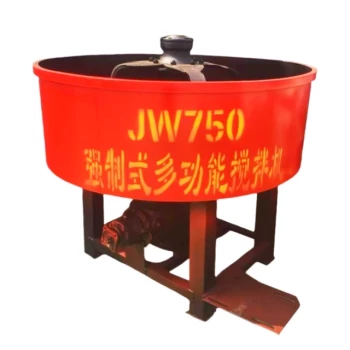
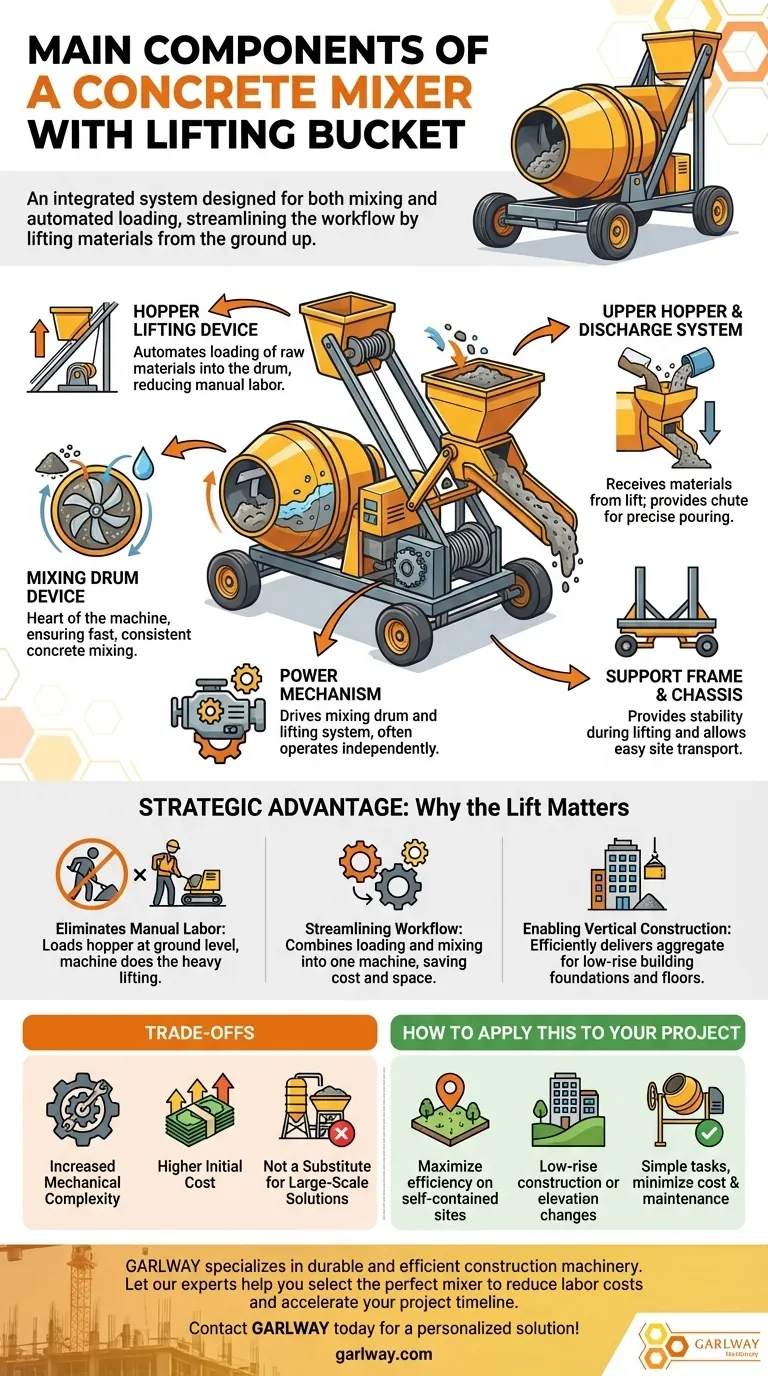
At its core, a concrete mixer with a lifting bucket is an integrated system designed for both mixing and automated loading. Its main components are the mixing drum device, a hopper lifting device, a power mechanism to drive both functions, an upper hopper for feeding the drum, and a support frame that provides stability.
This machine's primary function is not just to mix concrete, but to streamline the entire workflow by using a built-in lift to automatically transport raw materials from the ground up into the mixing drum, significantly boosting on-site efficiency.
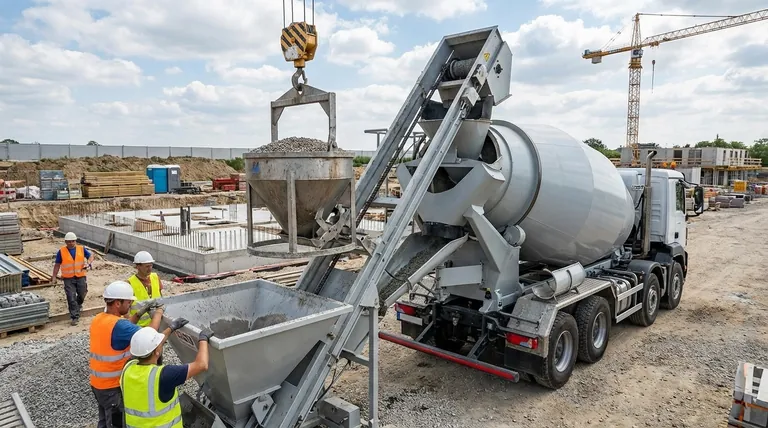
Deconstructing the Core Components
To understand how this mixer achieves its efficiency, it's essential to look at how each major component contributes to the overall process.
The Mixing Drum Device
The mixing drum is the heart of the machine, responsible for combining cement, aggregate, and water into homogenous concrete. Quality mixers feature a design that ensures fast, consistent mixing and is often mounted on a fabricated yoke for durable, long-term performance.
The Hopper Lifting Device
This is the key feature that differentiates this mixer. It consists of a bucket (hopper) that moves along a loading rack or rails, typically driven by a pulley or winch system. This device automates the physically demanding task of loading raw materials into the drum.
The Power Mechanism
This is the engine or motor that drives the entire system. It provides rotational power to the mixing drum and also powers the winch or hydraulic system for the hopper lifting device. This mechanism often allows the mixer to operate independently of an external electricity supply.
The Upper Hopper and Discharge System
When the lifting bucket reaches the top of the rack, an automatic mechanism opens a material door, allowing the aggregates to pour into the mixing drum. Once mixing is complete, a separate, easy-to-operate discharge chute is used to pour the finished concrete precisely where it's needed.
The Support Frame and Chassis
The entire assembly is mounted on a robust support frame and chassis. Key design features include a wide wheelbase to ensure stability, especially when the heavy hopper is being lifted, and a durable chassis that allows the machine to be easily transported around the job site.
The Strategic Advantage: Why the Lift Matters
The inclusion of a lifting hopper is a deliberate design choice aimed at solving specific on-site challenges and maximizing productivity.
Eliminating Manual Labor
The primary benefit is the reduction in manual labor. Instead of workers having to shovel materials directly into a high drum opening, they can load the hopper at ground level. The machine does all the heavy lifting.
Streamlining the Workflow
This design combines two jobs—loading and mixing—into one machine. This eliminates the need for a separate piece of equipment like a skid steer or front-end loader on smaller job sites, saving both cost and space.
Enabling Vertical Construction
The ability to lift materials is particularly useful for low-rise building construction. The mixer can be positioned at the base, and the hopper can efficiently deliver the aggregate mix to the drum, which then provides concrete for the next level.
Understanding the Trade-offs
While highly efficient, this design is not without its considerations. Objectivity requires acknowledging its limitations.
Increased Mechanical Complexity
The addition of a winch, pulleys, cables, and a loading rack introduces more moving parts compared to a standard drum mixer. This inherently means more components that require regular inspection and maintenance.
Higher Initial Cost
The engineering and components required for the lifting mechanism make these mixers more expensive upfront than their simpler, non-loading counterparts. The investment must be justified by the expected labor savings and efficiency gains.
Not a Substitute for Large-Scale Solutions
This type of mixer is a master of efficiency for small to medium-sized projects like foundations, driveways, or multi-story floors. However, for large-scale commercial construction, its batch capacity cannot compete with a dedicated concrete batching plant and pump truck.
How to Apply This to Your Project
Choosing the right equipment depends entirely on the scale and nature of your work.
- If your primary focus is maximum efficiency on self-contained sites: This mixer is an excellent choice, as its integrated loading and mixing capability minimizes labor and the need for other equipment.
- If your primary focus is low-rise construction or projects with elevation changes: The built-in vertical transport of materials is a significant advantage that can dramatically speed up your workflow.
- If your primary focus is minimizing equipment cost and maintenance for simple tasks: A traditional, standard concrete drum mixer without a lifting device may be the more practical and economical solution.
Ultimately, understanding these components allows you to see the machine not just as a mixer, but as a complete workflow solution for the right kind of project.
Summary Table:
| Component | Key Function |
|---|---|
| Mixing Drum | Heart of the machine, ensures fast, consistent concrete mixing. |
| Hopper Lifting Device | Automates the loading of raw materials into the drum, reducing manual labor. |
| Power Mechanism | Drives both the mixing drum and the lifting system, often operates independently. |
| Upper Hopper & Discharge | Receives materials from the lift and provides a chute for precise concrete pouring. |
| Support Frame & Chassis | Provides stability during lifting and allows for easy transport around the site. |
Ready to streamline your concrete workflow and boost on-site efficiency? The integrated design of a concrete mixer with a lifting bucket is ideal for construction companies and contractors focused on small to medium-sized projects, foundations, and low-rise buildings.
GARLWAY specializes in durable and efficient construction machinery. Let our experts help you select the perfect mixer to reduce labor costs and accelerate your project timeline.
Contact GARLWAY today to discuss your needs and get a personalized solution!
Visual Guide
Related Products
- Portable Cement Mixer with Lift Concrete Machine
- Portable Concrete Mixer Machine Equipment for Mixing Concrete
- Portable Ready Mix Concrete Mixer Equipment
- JW1000 Mobile Cement Mixer Concrete Mixer Truck and Batching Plant
- HZS25 Best Cement Mixer for Quick Mix Concrete at Bunnings
People Also Ask
- What are the size and portability options for portable cement mixers? Find Your Perfect Match for Any Job
- Why is it necessary to use a portable concrete mixer? Gain Total Control & Efficiency
- How much concrete can you pour with a portable mixer? Find the Perfect Fit for Your Project
- What is a portable cement mixer? Achieve Consistent, On-Demand Concrete Mixing
- What are the power sources for portable cement mixers? Choose the Right Power for Your Job Site