
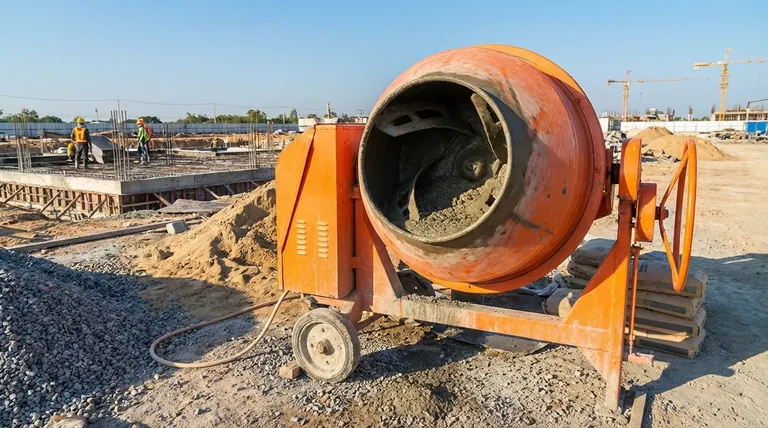
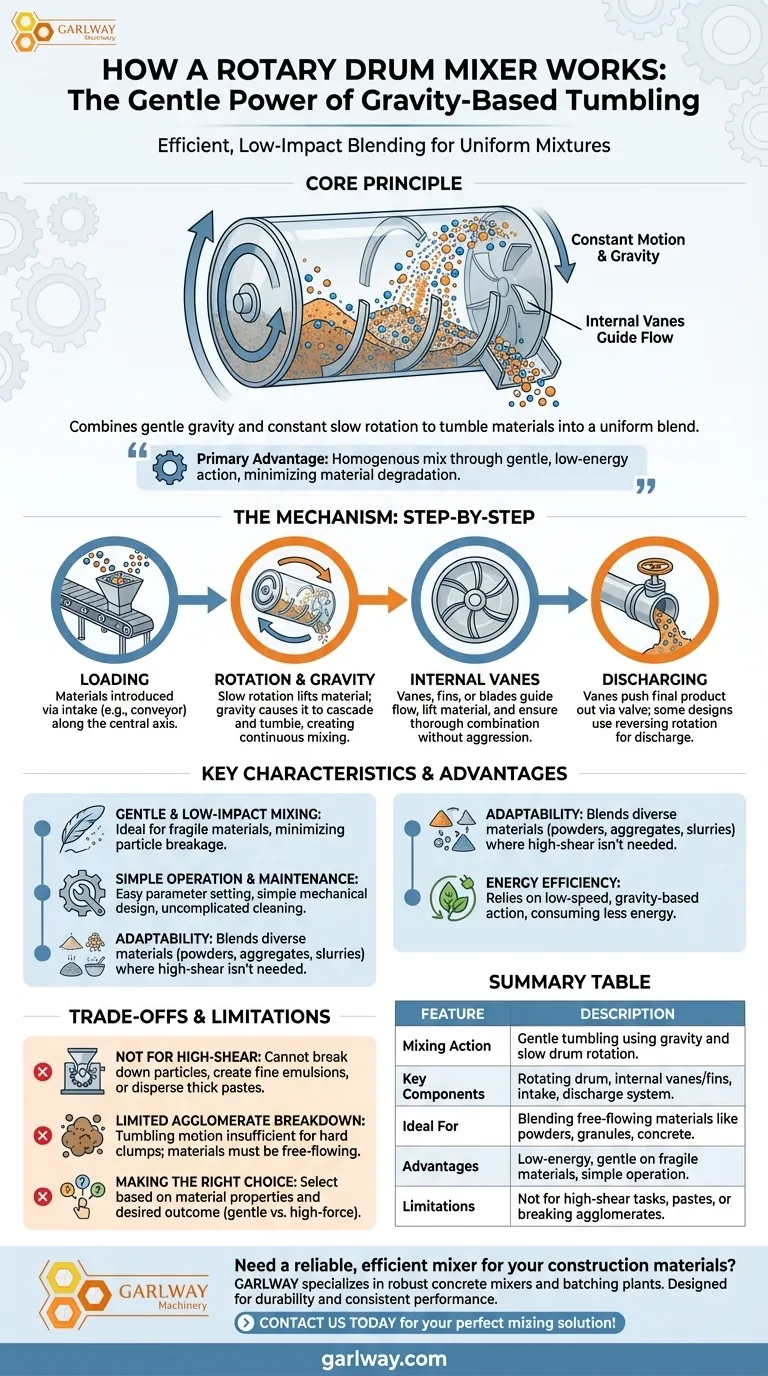
At its core, a rotary drum mixer works by using a simple, effective principle. It combines the gentle force of gravity with the constant motion of a slowly rotating drum and the guidance of internal vanes to tumble materials together until they form a uniform blend.
The primary advantage of a rotary drum mixer lies in its ability to achieve a homogenous mix through a gentle, low-energy tumbling action. This makes it exceptionally effective for blending materials without causing degradation or damage.
The Core Mechanism: A Step-by-Step Breakdown
To understand how this equipment functions, it's best to look at the process in stages, from loading the raw materials to discharging the finished product.
### Loading the Materials
Materials are introduced into the mixer through a dedicated intake. In many designs, this is located along the vessel's central axis. The loading can be done via a feeding box or a conveyor belt system.
### The Mixing Action: Rotation and Gravity
Once loaded, the drum begins to rotate at a relatively slow speed. As the drum turns, it lifts the material up its side. Gravity then causes the material to cascade or tumble back down, creating a continuous, free-flowing mixing motion.
This constant tumbling ensures that particles are randomly distributed throughout the batch.
### The Role of Internal Vanes and Blades
Inside the drum are strategically shaped and positioned vanes, fins, or blades. These are not aggressive agitators but rather guides that enhance the mixing process.
They help lift and direct the flow of material, preventing it from simply sliding along the drum's inner wall. In some cases, like concrete mixers, these blades are spiral-shaped to systematically move the material back and forth, ensuring all components (sand, cement, water) are thoroughly combined.
### Discharging the Final Product
Discharging the homogenous mixture is also straightforward. In one common design, a valve is opened, and the gentle action of the vanes pushes the product out, allowing the mixer to empty completely.
Another popular design is the reversing drum mixer. This type rotates in one direction for mixing and in the opposite direction to discharge the material out of a separate opening.
Key Characteristics and Advantages
The design of the rotary drum mixer gives it several distinct operational advantages that make it suitable for a wide range of applications.
### Gentle and Low-Impact Mixing
The tumbling action is very mild. This is a significant benefit when working with fragile materials, such as granules, food products, or certain chemical powders, as it minimizes particle breakage and degradation.
### Simplicity of Operation and Maintenance
Modern rotary drum mixers often feature automated control systems. Operators can easily set parameters like mixing time and rotation speed, and the machine completes the cycle automatically.
Their simple mechanical design also means that cleaning and maintenance are relatively uncomplicated.
### Adaptability to Different Materials
This mixing method is highly adaptable. It can effectively blend a wide variety of materials, from fine powders and aggregates to industrial slurries, as long as high-shear force is not a requirement for the process.
### Energy Efficiency
Because the mixer relies heavily on gravity and slow rotation rather than high-speed, high-torque agitation, its energy consumption is comparatively low.
Understanding the Trade-offs: When to Choose a Different Mixer
While highly effective, the rotary drum mixer is not the universal solution for every blending task. Its gentle nature creates clear limitations.
### Not Suited for High-Shear Applications
If your process requires breaking down particles, creating fine emulsions, or dispersing thick pastes, a rotary drum mixer is the wrong tool. Its low-impact action cannot generate the intense force needed for these tasks.
### Limited Ability to Break Down Agglomerates
The tumbling motion is not sufficient to break up hard clumps or agglomerates within a powder. Materials must be free-flowing before entering the drum for the best results.
Making the Right Choice for Your Goal
Selecting the correct mixer depends entirely on the properties of your materials and your desired final product.
- If your primary focus is gently blending fragile solids or powders without damage: The rotary drum mixer is an ideal choice due to its low-impact tumbling action.
- If your primary focus is creating a simple, homogenous mixture of free-flowing materials: This mixer provides an efficient, low-energy, and reliable solution.
- If your primary focus is dispersing thick pastes, reducing particle size, or creating an emulsion: You must look to high-shear mixers, as a rotary drum lacks the necessary force.
Ultimately, understanding the gentle power of gravity-based tumbling is the key to leveraging the rotary drum mixer effectively.
Summary Table:
| Feature | Description |
|---|---|
| Mixing Action | Gentle tumbling using gravity and slow drum rotation. |
| Key Components | Rotating drum, internal vanes/fins, intake, discharge system. |
| Ideal For | Blending free-flowing materials like powders, granules, concrete. |
| Advantages | Low-energy, gentle on fragile materials, simple operation. |
| Limitations | Not for high-shear tasks, pastes, or breaking agglomerates. |
Need a reliable, efficient mixer for your construction materials? GARLWAY specializes in construction machinery, offering robust concrete mixers and batching plants for contractors and construction companies globally. Our equipment is designed for durability and consistent performance. Contact us today to find the perfect mixing solution for your project!
Visual Guide
Related Products
- Belle Mixer Drum Self Loading Mortar Mixers JS3000
- Concrete Cement Mixer Machine Drum Mixer for Construction
- Harbor Freight JS1500 On Site Concrete Mixing Volumetric Cement Mixer
- JS1000 Volumetric Concrete Mortar Mixer for Sale Skid Steer Cement Mixer
- Shaft Mixer Machine for Cement and Regular Concrete Mixing
People Also Ask
- What are the features of mobile transporting in a self loading mixer? Boost On-Site Efficiency
- Why is timely cleaning important for a self loading mixer? Prevent Costly Downtime and Mix Failure
- How is discharging accomplished in a self loading mixer? Master Precise Concrete Placement
- What is the purpose of keeping the drum rotating during transportation in a self loading concrete mixer? Ensure Quality & Consistency
- What components are involved in the loading process of a self loading concrete mixer? A Guide to the Key Systems


