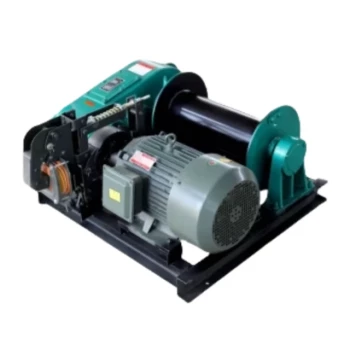
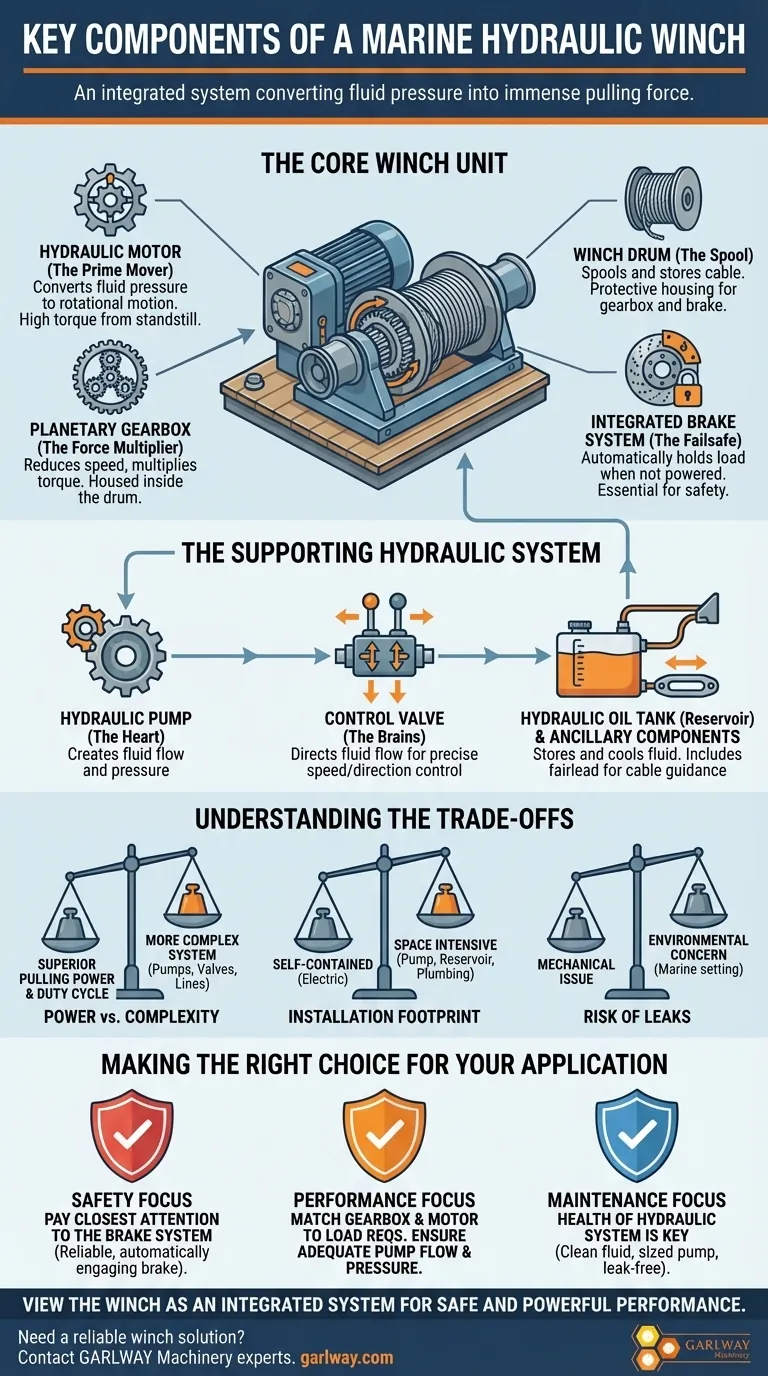
At its core, a marine hydraulic winch is an integrated system designed to convert fluid pressure into immense pulling force. The primary components of the winch unit itself are the hydraulic motor, a planetary gearbox, the main drum that spools the cable, and a critical brake system for safely holding the load.
A marine hydraulic winch is not a single part but a compact power-transmission assembly. Understanding how the motor, gearbox, and brake work together inside the drum is the key to appreciating its power, durability, and suitability for demanding marine environments.
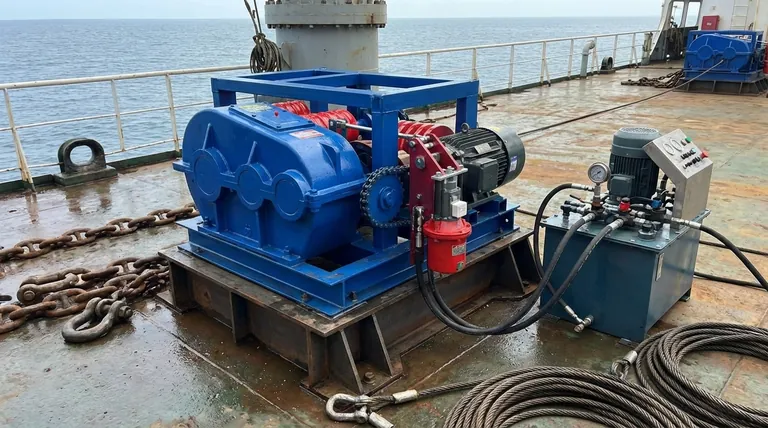
The Core Components of the Winch Unit
The winch unit is the physical assembly that mounts to the deck or vessel structure. Its internal components are designed for maximum power in a compact, weather-resistant package.
The Hydraulic Motor (The Prime Mover)
The motor is the engine of the winch. It uses pressurized hydraulic fluid to create rotational motion.
These motors are chosen for their ability to generate high torque from a standstill, a critical feature for moving heavy loads.
The Planetary Gearbox (The Force Multiplier)
The hydraulic motor’s speed is too high and its torque too low for direct pulling. The planetary gearbox solves this.
It uses a system of gears to dramatically reduce the rotational speed while multiplying the torque, creating the powerful, slow pull needed to handle heavy lines and anchors. In most modern designs, this gearbox is housed directly inside the winch drum to save space.
The Winch Drum (The Spool)
The drum is the most visible component, responsible for winding and storing the wire rope or synthetic cable.
Its design is crucial for ensuring the line spools evenly under load. The drum also serves as the protective housing for the gearbox and brake system, shielding them from the harsh marine elements.
The Integrated Brake System (The Failsafe)
The brake is arguably the most critical safety feature. It is designed to automatically engage and hold the load securely whenever hydraulic pressure is not actively driving the motor.
Most marine winches use a closed, multi-disc brake. This design prevents the load from slipping, which is essential for mooring, towing, and anchor handling operations.
The Supporting Hydraulic System
The winch unit cannot function alone. It relies on an external system to supply it with pressurized fluid.
The Hydraulic Pump (The Heart of the System)
The pump is what creates the flow and pressure of the hydraulic fluid. On a vessel, this is often driven by a Power Take-Off (PTO) from the main engine or a dedicated diesel or electric motor.
The pump's capacity must be carefully matched to the requirements of the winch's hydraulic motor to ensure proper performance.
The Control Valve (The Brains)
The control valve directs the flow of hydraulic fluid. By moving a lever or activating a switch, the operator sends fluid to one side of the motor to pull in, the other side to pay out, or blocks flow to hold the position.
This valve gives the operator precise control over the winch’s speed and direction.
The Ancillary Components (The Connective Tissue)
This category includes the hydraulic oil tank (reservoir) to store and cool the fluid, high-pressure lines to transport it, and a fairlead.
A fairlead is a separate device that guides the rope or cable neatly onto the drum, preventing tangles and reducing wear on the line.
Understanding the Trade-offs
While powerful, hydraulic systems come with specific considerations that are important to understand.
Power vs. Complexity
Hydraulic winches offer superior pulling power and duty cycle compared to most electric winches. However, the system is more complex, involving pumps, valves, and high-pressure fluid lines that require specialized knowledge for maintenance.
Installation Footprint
Unlike a self-contained electric winch, a hydraulic system requires space for a pump, a fluid reservoir, and the associated plumbing. This can make installation more involved and space-intensive.
The Risk of Leaks
Any high-pressure fluid system carries the risk of leaks. In a marine setting, a hydraulic fluid leak is not only a mechanical issue but also a potential environmental concern that must be managed carefully.
Making the Right Choice for Your Application
Understanding these components allows you to focus on what matters for your specific goal.
- If your primary focus is operational safety: Pay closest attention to the brake system. A reliable, automatically engaging brake is the most important component for preventing accidents when holding a load.
- If your primary focus is performance and power: Your decision revolves around matching the gearbox and motor to your load requirements, and ensuring the hydraulic pump can supply adequate flow and pressure.
- If your primary focus is maintenance and reliability: The health of the hydraulic system is key. Clean fluid, a properly sized pump, and leak-free connections are essential for the longevity of the entire winch assembly.
By viewing the winch as an integrated system, you can better specify, operate, and maintain it for safe and powerful performance.
Summary Table:
| Component | Primary Function | Key Characteristic |
|---|---|---|
| Hydraulic Motor | Converts fluid pressure into rotational motion | High torque from a standstill |
| Planetary Gearbox | Multiplies torque while reducing speed | Housed inside the drum for compactness |
| Winch Drum | Spools and stores the cable/wire rope | Protects internal components from elements |
| Brake System | Holds the load securely; critical safety feature | Automatically engages when not powered |
| Hydraulic Pump | Creates fluid flow and pressure for the system | Driven by PTO or dedicated motor |
| Control Valve | Directs fluid flow for precise speed/direction control | Operator interface for winch movement |
Need a powerful and reliable winch solution for your marine or construction project?
GARLWAY specializes in engineering robust construction machinery, including high-performance winches, concrete mixers, and batching plants. Our expertise ensures you get equipment perfectly matched to your power, safety, and durability requirements.
Contact our experts today to discuss your specific needs and discover how GARLWAY can power your operations.
Visual Guide
Related Products
- Hydraulic Winding Engine Harbor Freight Winch
- Electric Hoist Winch Boat Anchor Windlass for Marine Applications
- Electric and Hydraulic Winch for Heavy Duty Applications
- Heavy Duty Electric Boat Winch Windlass Anchor
- Warn Winch Windlass Boat Trailer Winch
People Also Ask
- What role does hydraulic fluid play in hydraulic winches? It's the Lifeblood of Your Heavy-Duty Pulling Power
- What vehicles commonly use hydraulic winches? For Industrial Trucks Needing Unmatched Power
- What are the features of hydraulic winches? Unmatched Power and Continuous Duty for Heavy Loads
- What preventive measures can be taken to avoid oil leakage in hydraulic winches? Ensure Long-Term Reliability
- What does 'power out' mean in a hydraulic winch? Achieve Absolute Control When Lowering Heavy Loads