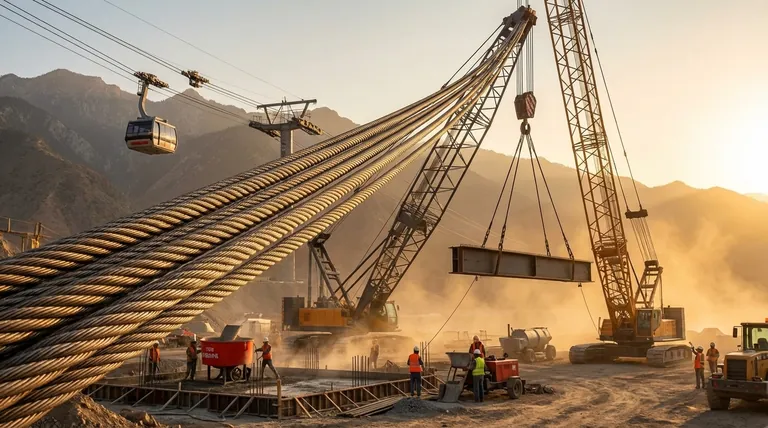
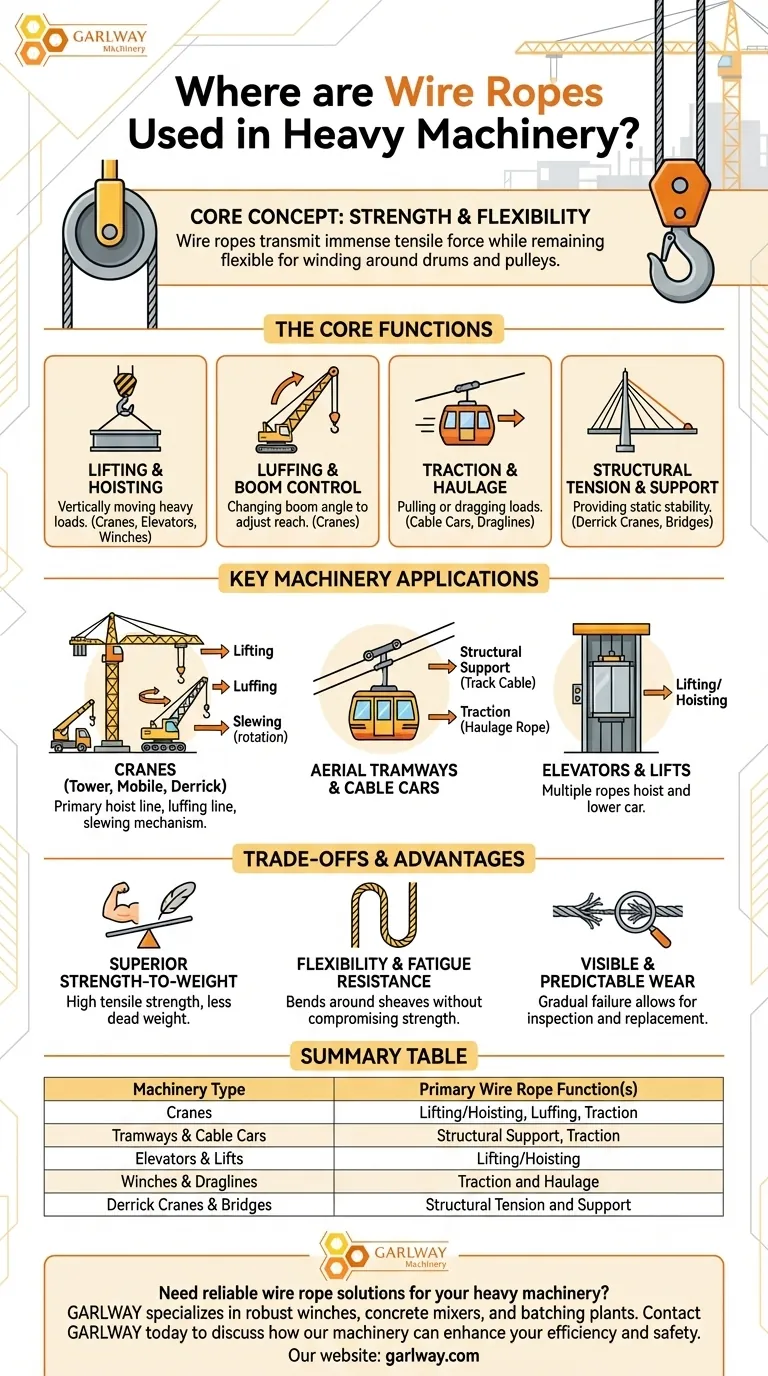
In the world of heavy machinery, wire ropes are indispensable for applications demanding immense strength combined with flexibility. They are most commonly found in the various mechanisms of cranes, such as lifting, luffing (angling the boom), and traction, as well as in aerial tramways, cable cars, and derrick cranes where they serve as tension and load-bearing cables.
The core reason wire rope is ubiquitous in heavy machinery is its unique ability to transmit enormous tensile force while remaining flexible enough to be wound around drums and pulleys. It is the fundamental component for hoisting, pulling, and anchoring across a vast range of industrial equipment.
The Core Functions of Wire Rope in Machinery
To understand where wire ropes are used, it's best to first understand the fundamental tasks they perform. Their design makes them ideal for several distinct mechanical functions.
Lifting and Hoisting
This is the most recognized application of wire rope. It is the primary component in the hoisting mechanisms of cranes, elevators, and winches, responsible for vertically moving heavy loads.
Luffing and Boom Control
In cranes, luffing refers to changing the angle of the boom to adjust the machine's reach. Wire ropes provide the precise, powerful control needed to raise and lower these massive structural arms safely.
Traction and Haulage
Wire rope is also used to pull or drag loads horizontally. This is common in the traction mechanisms of cable cars, funiculars, and dragline excavators, where the rope transmits pulling force over long distances.
Structural Tension and Support
Beyond moving parts, wire rope serves a critical static role. In derrick cranes and some bridge designs, it acts as tension ropes or stays, providing essential structural stability by anchoring and supporting major components.
A Closer Look at Key Machinery Applications
Different types of machinery leverage wire ropes to perform one or more of the core functions discussed above, often in combination.
Cranes (Tower, Mobile, and Derrick)
Cranes are the quintessential example of wire rope application. They use ropes for the main hoist line to lift loads, the luffing line to control the boom's angle, and sometimes for the slewing mechanism that rotates the crane's superstructure.
Aerial Tramways and Cable Cars
These systems demonstrate the dual capability of wire ropes. A thick, stationary track cable acts as a rail for the cabins to ride on, while a separate, moving haulage rope pulls the cabins along the track.
Elevators and Lifts
Virtually all traction elevators rely on multiple wire ropes to hoist and lower the elevator car. Their strength and reliability are paramount for vertical transportation and safety.
Understanding the Trade-offs and Inherent Advantages
Wire rope is not chosen by accident. Its selection over alternatives like chain or solid steel rods is based on a distinct set of engineering advantages that are crucial in heavy machinery.
Superior Strength-to-Weight Ratio
Wire rope provides incredible tensile strength for its relative weight, making it more efficient than solid steel bars or heavy-duty chains, which would add significant dead weight to the system.
Flexibility and Fatigue Resistance
The ability to bend around sheaves (pulleys) and drums without compromising strength is the rope's defining feature. This flexibility is something a solid rod cannot offer and is superior to chain in high-cycle, high-load applications.
Visible and Predictable Wear
A key safety advantage is that wire ropes fail gradually. They exhibit clear signs of wear, such as broken wires (fraying) and stretching, long before a catastrophic failure. This allows for routine inspection and timely replacement, which is a critical aspect of machinery maintenance.
Making the Right Choice for the Application
The specific demands of the mechanism dictate the type of wire rope used. By understanding the primary goal, you can appreciate why specific rope properties are prioritized.
- If your primary focus is vertical lifting: You need a rope engineered for high tensile strength and resistance to bending fatigue, as seen in crane hoists.
- If your primary focus is traction or pulling: You require a rope with excellent abrasion resistance for systems like cable cars or haulage winches that drag along surfaces.
- If your primary focus is static support: Your priority is a rope with high tensile strength and minimal stretch, such as the guy wires or stay ropes on a derrick crane.
Ultimately, understanding these core functions and trade-offs reveals why wire rope remains a foundational and trusted component in the world of heavy machinery.
Summary Table:
| Machinery Type | Primary Wire Rope Function(s) |
|---|---|
| Cranes (Tower, Mobile, Derrick) | Lifting/Hoisting, Boom Control (Luffing), Traction |
| Aerial Tramways & Cable Cars | Structural Support (Track Cable), Traction (Haulage Rope) |
| Elevators & Lifts | Lifting/Hoisting |
| Winches & Draglines | Traction and Haulage |
| Derrick Cranes & Bridges | Structural Tension and Support (Stays/Guy Wires) |
Need reliable wire rope solutions for your heavy machinery?
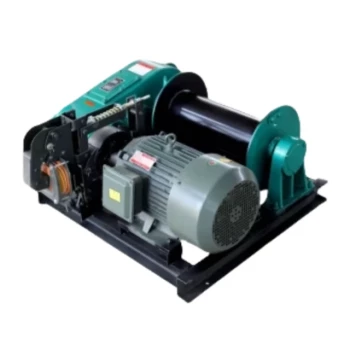
GARLWAY specializes in construction machinery, offering robust winches, concrete mixers, and concrete batching plants for construction companies and contractors globally. Our equipment is engineered for the demanding applications where wire rope excels—ensuring safety, durability, and peak performance on your job site.
Contact GARLWAY today to discuss how our machinery can enhance your operational efficiency and safety.
Visual Guide
Related Products
- Electric Hoist Winch Boat Anchor Windlass for Marine Applications
- Warn Winch Windlass Boat Trailer Winch
- Quick Windlass Portable Winch for Truck and Boat Best Boat Winch
- Small Electric Winch 120V and 240V for Compact Applications
- 12000 lb Electric Boat Trailer Winch with Windlass Anchor Warn
People Also Ask
- How does an electric anchor winch work? Power, Safety, and Reliable Operation Explained
- What are the advantages of installing an electric anchor winch on a boat? Boost Safety & Ease for Boaters
- What are the operational differences between electric hoists and winches? A Guide to Safe Lifting vs. Pulling
- What are the main benefits of a boat anchor winch? Boost Safety & Efficiency for Your Vessel
- How does a boat anchor winch work? A Guide to Reliable Anchor Handling