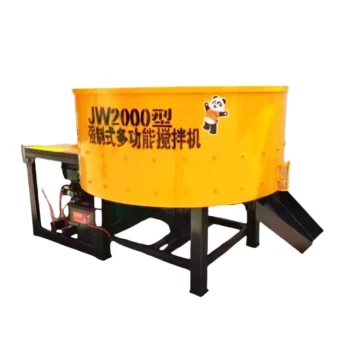
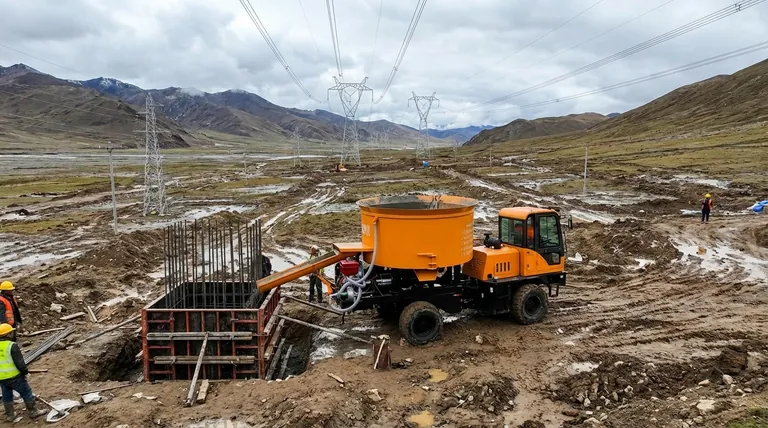
The key benefits of a self-loading concrete mixer for transmission line projects are its exceptional mobility and all-in-one functionality. This single unit combines a loader, weigher, mixer, and transporter, making it a self-sufficient mobile batching plant perfectly suited for the remote, rugged, and logistically challenging environments typical of power line construction.
Transmission line projects create a unique logistical problem: the need for many small, high-quality concrete pours across vast, often inaccessible terrain. The self-loading mixer solves this by eliminating reliance on fixed batching plants and complex supply chains, bringing the entire production process directly to the point of use.
The Failure of Traditional Concrete in Remote Projects
Traditional concrete methods, involving central batching plants and transit mixer trucks, are highly efficient for large, centralized construction. However, this model breaks down when applied to the distributed nature of transmission line projects.
The Logistical Nightmare of Remote Sites
A central batching plant requires a significant investment, a large footprint, and substantial setup and relocation efforts. Transporting wet concrete over long distances to remote tower locations is often impractical, risking premature setting and requiring extensive road infrastructure that may not exist.
The Inefficiency of Small, Distributed Pours
Each transmission tower foundation requires a relatively small volume of concrete. Sending large transit mixers for these small pours is incredibly inefficient, leading to wasted capacity, fuel, and time. This mismatch between supply scale and demand scale creates significant operational bottlenecks.
Extreme Vulnerability to Weather
Conventional concrete operations are notoriously susceptible to weather. Rainy seasons can render access roads impassable for heavy trucks and can completely halt the operation of an open-air batching plant. This leads to costly delays and timeline uncertainty.
Strategic Advantages of a Self-Loading System
A self-loading mixer fundamentally changes the operational calculus by decentralizing concrete production. It acts as an independent, agile unit that overcomes the core challenges of remote construction.
All-in-One Operational Efficiency
The machine integrates every step of the process: loading aggregates, weighing materials for precise mixing, mixing the concrete, and transporting and discharging it at the foundation. This consolidation into one unit, operated by a single person, drastically reduces the need for separate machinery and labor.
Unmatched Terrain Adaptability
Equipped with four-wheel drive, a sturdy off-road chassis, and a compact frame, these mixers are built to navigate difficult terrain. They can reach tower sites that would be completely inaccessible to standard concrete trucks, moving confidently over dirt tracks, inclines, and uneven ground.
Superior Wet-Season Performance
Self-loading mixers maintain significantly better efficiency in adverse weather. Where a traditional operation might see its efficiency drop by 50% or more in a rainy season, a self-loading mixer typically only experiences a 20% reduction. This resilience is a critical advantage for keeping projects on schedule.
Reduced Infrastructure and Labor Costs
By eliminating the need for a batching plant and a fleet of transit mixers, capital investment is dramatically lowered. Furthermore, the reduced requirement for road construction and the need for fewer operators and support staff translate directly into lower overall project costs.
Understanding the Trade-offs
While highly effective in its niche, the self-loading mixer is not a universal solution. Understanding its limitations is key to deploying it correctly.
Limited Batch Capacity
These machines are designed for small to medium batches, typically ranging from 1.8 to 6.5 cubic meters. They are not suited for projects requiring massive, continuous concrete pours, such as a large building foundation or a dam, where a dedicated batching plant would be far more effective.
The Single Point of Failure
Because one machine handles the entire process, any mechanical failure brings all concrete work to a halt. In contrast, a larger operation with multiple trucks can continue working at a reduced capacity if one vehicle breaks down.
Dependence on On-site Materials
The model requires that raw materials (aggregate, sand, cement, water) be stockpiled at or near the work areas. This introduces a different logistical challenge: distributing the raw components along the transmission line's path instead of transporting wet concrete.
Making the Right Choice for Your Goal
Selecting the correct concrete production method depends entirely on the logistical profile of your project.
- If your primary focus is a project with long, remote routes and multiple small pour sites (like transmission lines or rural pipelines): The self-loading mixer is the definitive solution due to its mobility, self-sufficiency, and cost-effectiveness.
- If your primary focus is a single, accessible site requiring a large and continuous volume of concrete (like a commercial building): A traditional batching plant and a fleet of transit mixers remain the most efficient choice.
- If your project is located in an area with a severe rainy season that causes frequent delays: The superior wet-weather performance of a self-loading mixer can be the critical factor in maintaining your construction schedule.
Ultimately, choosing the right tool is about matching your equipment's capabilities to the unique challenges of the job site.
Summary Table:
| Feature | Benefit for Transmission Line Projects |
|---|---|
| All-in-One Design | Combines loading, weighing, mixing, and transport in one unit, reducing need for multiple machines and operators. |
| Off-Road Mobility | 4WD and rugged chassis enable access to remote, rugged tower sites inaccessible to standard trucks. |
| Wet-Weather Resilience | Maintains ~80% efficiency in rainy seasons vs. ~50% drop for traditional methods, minimizing delays. |
| Cost Efficiency | Eliminates need for fixed batching plants and large truck fleets, lowering capital and labor costs. |
| Batch Size | Ideal for small to medium pours (1.8-6.5 m³) typical of tower foundations, avoiding waste. |
Optimize your transmission line or remote construction project with GARLWAY's self-loading concrete mixers. As a specialist in construction machinery, GARLWAY provides robust, all-in-one solutions—including winches, concrete mixers, and batching plants—designed for the challenging environments faced by construction companies and contractors globally. Our equipment enhances mobility, reduces downtime, and cuts costs, ensuring your project stays on schedule even in adverse conditions. Contact GARLWAY today to discuss how our tailored machinery can meet your specific site needs and drive your project's success!
Visual Guide

Related Products
- Skid Steer Self Loading Concrete Mixers for Construction
- Belle Mixer Drum Self Loading Mortar Mixers JS3000
- Portable Cement Mixer with Lift Concrete Machine
- Portable Concrete Mixer Machine Equipment for Mixing Concrete
- Portable Ready Mix Concrete Mixer Equipment
People Also Ask
- How does the control system improve production efficiency in a self loading concrete mixer? Automate Mixing for Speed & Quality
- What is the purpose of keeping the drum rotating during transportation in a self loading concrete mixer? Ensure Quality & Consistency
- How does the weighing process work in a self loading concrete mixer? Achieve Precise, On-Site Concrete Batching
- What components are involved in the loading process of a self loading concrete mixer? A Guide to the Key Systems
- How should materials be loaded into a self-loading concrete mixer? Master the Step-by-Step Process