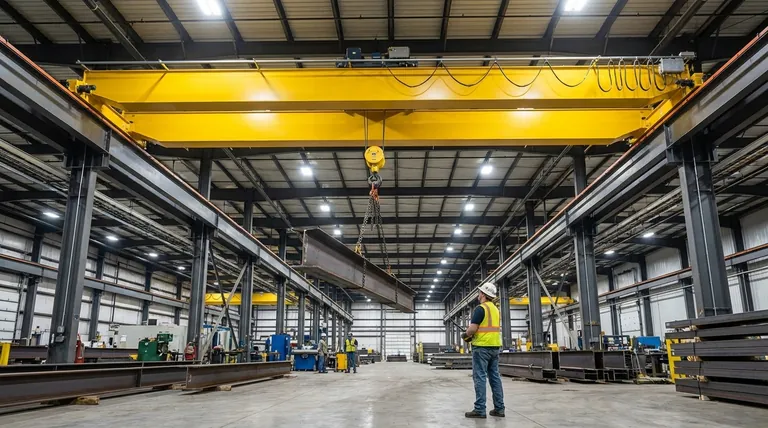
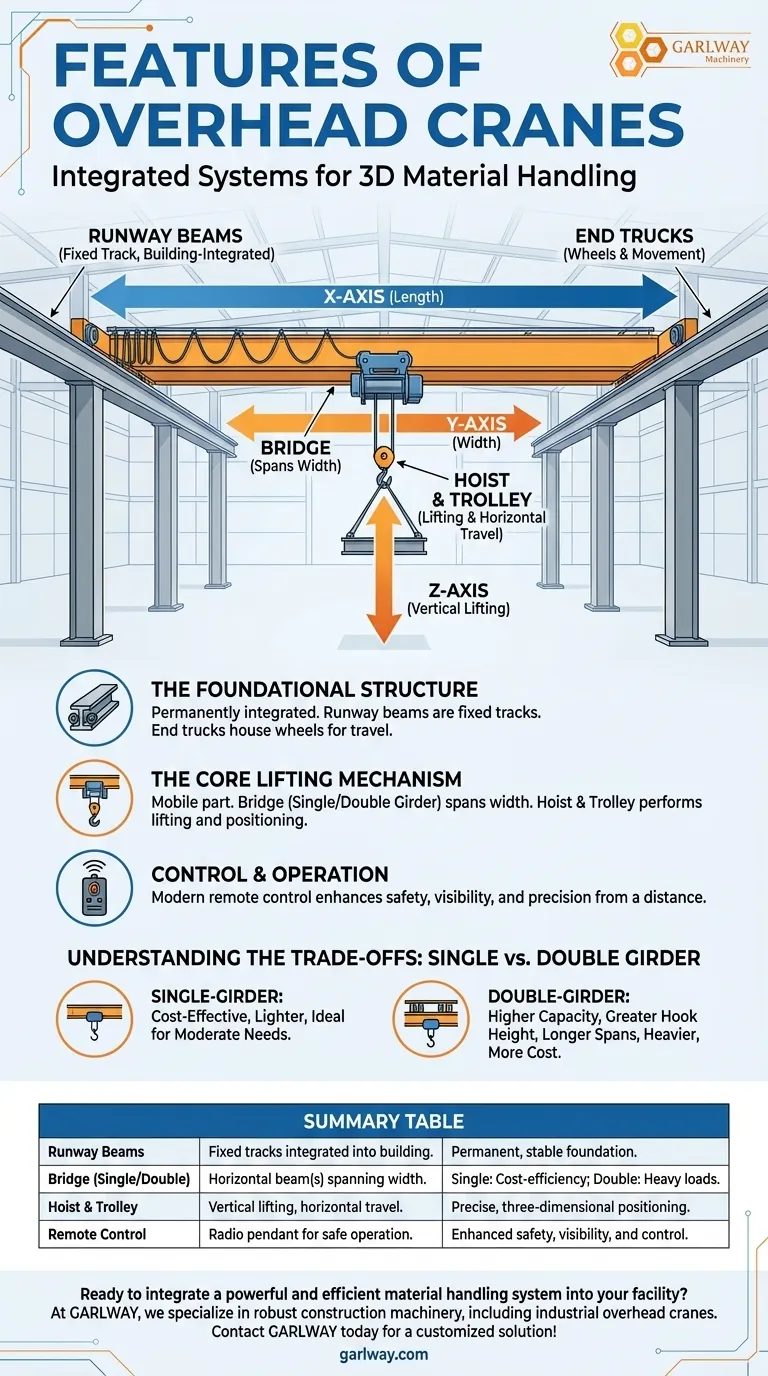
At their core, overhead cranes are defined by a specific set of structural and functional components. These features work in unison to provide powerful, three-dimensional material handling within a fixed area. The system consists of a hoist that moves along a bridge, which in turn travels on a runway supported by the building's structure, with all movements managed by a remote control.
An overhead crane is not merely a lifting device; it is an integrated system. Each core feature—from the foundational runway beams to the type of bridge girder—directly determines the crane's lifting capacity, operational coverage, and structural demands on your facility.
The Foundational Structure
The permanent nature of an overhead crane begins with its integration into the building itself. This foundation dictates the crane's entire operational footprint.
Runway Beams
The runway consists of parallel beams that run along the length of the work area. These beams act as a fixed track for the entire crane assembly.
As noted, these runways require significant structural support from the building's columns and are typically planned and installed during the building's construction phase.
End Trucks
End trucks are located at either end of the bridge. They house the wheels that ride along the runway beams, enabling the entire crane to travel up and down the length of the facility.
The Core Lifting Mechanism
This is the mobile part of the crane that performs the actual lifting and positioning of loads. It is composed of the bridge and the hoist trolley.
The Bridge
The bridge is the primary horizontal beam (or beams) that spans the width of the work area, connecting the two end trucks. Its design is a critical feature that defines the crane's capability.
A crane can have a single-girder bridge for lighter, general-purpose applications or a double-girder bridge for heavier loads and longer spans.
The Hoist and Trolley
The hoist is the true lifting component, containing the motor, drum, and wire rope or chain. The hoist is mounted on a trolley, which travels horizontally back and forth across the bridge girder.
Three-Axis Movement
Together, these components provide complete coverage. The end trucks move the bridge along the X-axis (length), the trolley moves the hoist along the Y-axis (width), and the hoist itself provides movement on the Z-axis (vertical).
Control and Operation
Modern overhead cranes are defined by their method of control, which directly impacts safety and efficiency.
Remote Control
The system is operated via a remote control, typically a radio transmitter pendant. This feature allows the operator to manage all movements from a safe distance, providing a better vantage point for positioning loads and avoiding hazards.
Understanding the Trade-offs
Selecting the right features involves balancing capability with cost and structural requirements. The most significant decision point is the bridge design.
Single vs. Double Girder
A single-girder crane is lighter and more cost-effective. It is ideal for workshops and facilities with moderate lifting needs.
A double-girder crane provides much higher lifting capacity, greater hook height, and longer span capabilities. The trade-off is a significantly higher cost and a much heavier unit, which requires a more robust runway and building structure to support it.
Structural Integration
The key feature of an overhead crane is its permanence. Unlike a mobile crane, it is part of the building. This provides unmatched efficiency within its coverage area but requires significant upfront engineering and investment during construction. It is not a system that can be easily added to an existing structure that wasn't designed for it.
Making the Right Choice for Your Goal
Your operational needs will determine which features to prioritize.
- If your primary focus is maximizing lifting capacity for heavy industrial use: A double-girder configuration is essential, integrated into a building structure engineered to support its substantial weight.
- If your primary focus is cost-effective material handling in a standard facility: A single-girder crane provides the best balance of performance and initial investment.
- If your primary focus is operational safety and precision: Prioritize a modern remote control system that gives the operator excellent visibility and fine-tuned control over all three axes of movement.
Understanding these core features allows you to see an overhead crane not as a single machine, but as a complete system designed for efficient, three-dimensional material handling.
Summary Table:
| Feature | Description | Key Benefit |
|---|---|---|
| Runway Beams | Fixed tracks integrated into the building structure. | Provides a permanent, stable foundation for the crane. |
| Bridge (Single/Double Girder) | Horizontal beam(s) spanning the work area's width. | Single girder for cost-efficiency; double girder for heavy loads. |
| Hoist & Trolley | Mechanism for vertical lifting and horizontal travel across the bridge. | Enables precise, three-dimensional positioning of loads. |
| Remote Control | Radio pendant for operating the crane from a safe distance. | Enhances operator safety, visibility, and control precision. |
Ready to integrate a powerful and efficient material handling system into your facility?
At GARLWAY, we specialize in providing robust construction machinery, including industrial overhead cranes, winches, and concrete plants, tailored for construction companies and contractors worldwide.
Let our experts help you select the perfect crane configuration—whether a cost-effective single-girder or a high-capacity double-girder system—to maximize your productivity and safety.
Contact GARLWAY today for a customized solution that lifts your operations to new heights!
Visual Guide
Related Products
- Portable Small Trailer Winch
- Electric and Hydraulic Winch for Heavy Duty Applications
- Electric Hoist Winch Boat Anchor Windlass for Marine Applications
- Electric 120V Boat Winch by Badlands
- Hydraulic Winding Engine Harbor Freight Winch
People Also Ask
- What features were incorporated into the upgraded portable winch system? Boost Your Recovery Power & Safety
- What are some uses mentioned for portable winches beyond vehicle recovery? Essential Versatility for Property & Work
- How could the twisting issue with a portable winch be mitigated? Achieve Safe, Centered Pulls with Proper Rigging
- What is the significance of trailer winches in the boating industry? Ensure Safe and Efficient Boat Recovery
- What should be considered when mounting a winch on a trailer? Ensure a Safe, Aligned Installation