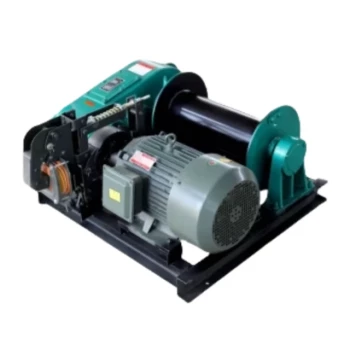
The primary durability benefit of a hydraulic winch is its ability to perform demanding, long-duration work under heavy loads without overheating or failing. This robustness comes from its fundamental design, which uses pressurized fluid for power, resulting in a system with superior heat management and fewer delicate electrical components susceptible to failure in harsh conditions.
A hydraulic winch trades the electrical complexity of its counterparts for mechanical simplicity and raw power. This makes it inherently more durable and reliable, especially for continuous, heavy-duty applications where other winches would falter.
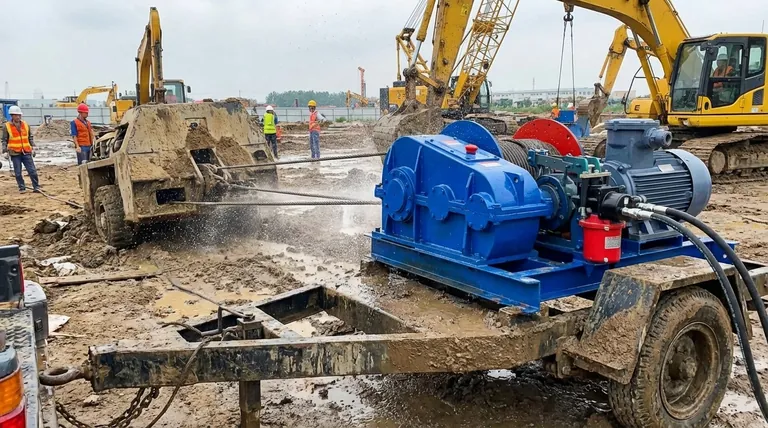
The Source of Hydraulic Durability
A hydraulic winch's durability isn't a single feature but the result of its core operational principle. Understanding this design reveals why it is built to last.
Mechanical Power, Not Electrical Complexity
Hydraulic winches are powered by an external pump (often driven by the vehicle's engine) that moves incompressible fluid. This system generates immense torque with fewer internal parts than a comparable electric winch.
An electric winch relies on a motor, couplings, gear reducers, and electromagnetic brakes. Each of these is a potential failure point, especially under high stress or in wet environments. A hydraulic system is mechanically more direct.
Superior Heat Management
The most common point of failure for winches under sustained load is overheating. The hydraulic fluid that powers the winch is also a highly effective coolant.
This fluid continuously circulates, carrying heat away from the winch motor and dissipating it through the system. This allows hydraulic winches to perform continuous duty cycles—running for long periods without the need for a cool-down period.
High Power-to-Size Ratio
Hydraulic systems can generate enormous force from a relatively compact motor. This means the winch can be built with stronger, more robust components without becoming excessively large, contributing to its overall structural integrity and long-term durability.
Durability in Demanding Environments
The true test of durability is performance under adverse conditions. This is where hydraulic systems consistently prove their worth.
Resisting Extreme Temperatures
Hydraulic winches are designed to function across a vast temperature range, from as low as -50° C to over +100° C. The hydraulic fluid remains stable, ensuring consistent performance in conditions that could damage electrical components or cause battery failure.
Reliability in Harsh Conditions
Because they don't rely on complex electrical systems, hydraulic winches are less vulnerable to damage from water, mud, and dust. This inherent resistance to environmental factors is why they are a standard for military, industrial, and heavy recovery applications.
Handling Overload Scenarios
While never recommended, hydraulic systems are often more forgiving during momentary overload situations. They are designed to stall under excessive load rather than burning out a motor, providing a crucial margin of safety that protects the equipment from permanent damage.
Understanding the Trade-offs
Unwavering durability comes with specific considerations. A hydraulic winch is not the right tool for every situation.
Reliance on a Hydraulic Power Source
The winch itself is only one part of the system. It requires a hydraulic pump, lines, and fluid reservoir to function. This adds installation complexity and means the vehicle's engine must be running for the winch to operate.
The Critical Role of Maintenance
A hydraulic system's longevity is directly tied to its maintenance. Clean fluid and leak-free hoses are essential. While mechanically simple, the system is less tolerant of neglect than a basic electric winch.
Higher Initial Investment
The components required for a hydraulic system—the pump, hoses, and the winch itself—typically result in a higher upfront cost compared to an equivalent-capacity electric winch. This is a direct trade-off for its enhanced robustness and performance longevity.
Making the Right Choice for Your Application
Selecting the right winch depends entirely on your operational needs.
- If your primary focus is maximum reliability for continuous, heavy recovery: A hydraulic winch is the definitive choice for its heat management and robust mechanical design.
- If your primary focus is occasional use, versatility, and simple installation: An electric winch offers a more practical and cost-effective solution.
- If your primary focus is operating in hazardous environments or without reliable electrical power: A hydraulic winch provides a safer and more dependable power source.
Ultimately, choosing a hydraulic winch is an investment in unwavering operational endurance for the most demanding tasks.
Summary Table:
| Key Benefit | Description |
|---|---|
| Superior Heat Management | Hydraulic fluid acts as a coolant, enabling continuous duty cycles without overheating. |
| Harsh Environment Resistance | Performs reliably in extreme temperatures (-50°C to +100°C) and wet/dusty conditions. |
| Mechanical Simplicity | Fewer electrical components reduce failure points, enhancing long-term reliability. |
| Overload Protection | Stalls under excessive load instead of burning out, preventing permanent damage. |
Need a winch built to last? GARLWAY specializes in robust construction machinery, including hydraulic winches designed for continuous, heavy-duty use by construction companies and contractors globally. Our winches deliver reliable performance in the toughest conditions. Contact GARLWAY today to discuss your specific needs and get a durable solution that won't let you down.
Visual Guide

Related Products
- Hydraulic Winding Engine Harbor Freight Winch
- Electric and Hydraulic Winch for Heavy Duty Applications
- Small Electric Winch 120V and 240V for Compact Applications
- Electric 120V Boat Winch by Badlands
- 12000 lb Electric Boat Trailer Winch with Windlass Anchor Warn
People Also Ask
- What role does hydraulic fluid play in hydraulic winches? It's the Lifeblood of Your Heavy-Duty Pulling Power
- What vehicles commonly use hydraulic winches? For Industrial Trucks Needing Unmatched Power
- What are the features of hydraulic winches? Unmatched Power and Continuous Duty for Heavy Loads
- What preventive measures can be taken to avoid oil leakage in hydraulic winches? Ensure Long-Term Reliability
- What does 'power out' mean in a hydraulic winch? Achieve Absolute Control When Lowering Heavy Loads