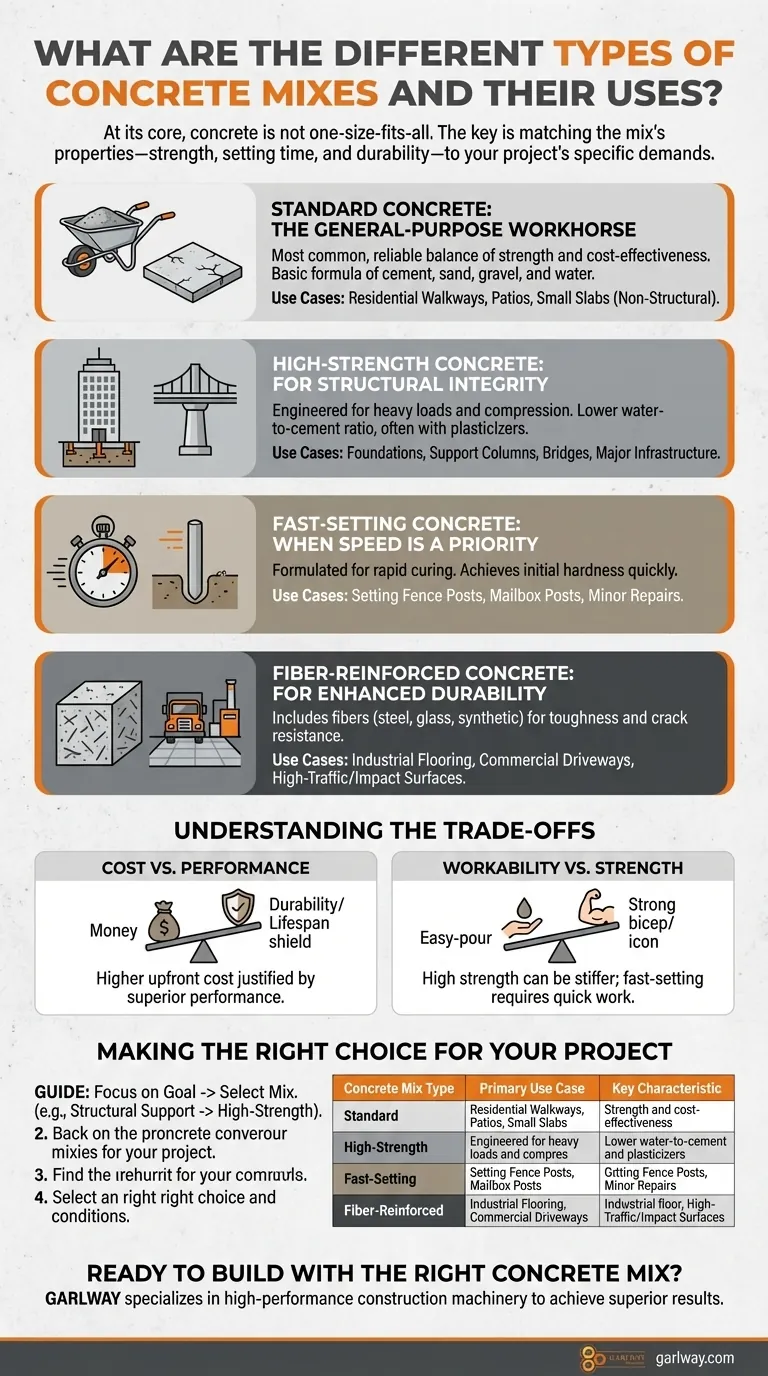
At its core, concrete is not a one-size-fits-all material. The primary types of concrete mixes are standard, high-strength, fast-setting, and fiber-reinforced, each engineered with a specific balance of aggregates, cement, and additives to perform a distinct job, from simple walkways to critical structural foundations.
Choosing the right concrete is less about finding the "best" mix and more about matching the material's specific properties—strength, setting time, and durability—to the precise demands of your project.
A Closer Look at Common Concrete Mixes
Understanding the fundamental differences between common mixes is the first step in ensuring your project has the structural integrity and longevity it requires. Each type is a purpose-built solution.
Standard Concrete: The General-Purpose Workhorse
Standard concrete is the most common and versatile mix. It consists of a basic formula of cement, sand, gravel, and water, offering a reliable balance of strength and cost-effectiveness.
This mix is the go-to choice for non-structural applications where moderate durability is sufficient. Think of projects like residential walkways, patios, and small slabs that don't bear significant loads.
High-Strength Concrete: For Structural Integrity
High-strength concrete is specifically engineered to withstand heavy loads and compression. It achieves this superior strength through a lower water-to-cement ratio and often includes special additives called plasticizers.
Its use is critical in large-scale construction and projects where structural failure is not an option. This includes building foundations, support columns, bridges, and major infrastructure like power generation facilities.
Fast-Setting Concrete: When Speed is a Priority
As the name implies, fast-setting concrete is formulated to cure very quickly. This rapid hydration process allows it to achieve initial hardness in a fraction of the time of standard mixes.
This characteristic makes it ideal for small-scale jobs where you need to secure an object quickly, such as setting fence posts, mailbox posts, or performing minor repairs where a fast turnaround is essential.
Fiber-Reinforced Concrete: For Enhanced Durability
This type of mix includes small, fibrous materials—such as steel, glass, or synthetic fibers—distributed evenly throughout. These fibers act as a secondary reinforcement system.
The primary benefit is a significant increase in toughness and resistance to cracking caused by shrinkage or impact. It is an excellent choice for industrial flooring, commercial driveways, and any surface exposed to heavy traffic or temperature fluctuations.
Understanding the Trade-offs
Selecting a concrete mix always involves balancing performance, cost, and ease of use. Understanding these trade-offs is key to avoiding common and costly mistakes.
Cost vs. Performance
Specialized mixes are more expensive than standard concrete. The additives, fibers, or precise aggregate ratios required for high-strength or fiber-reinforced concrete increase the material cost.
However, this higher upfront cost is often justified by superior performance and a longer service life in demanding applications, preventing future repair expenses.
Workability vs. Strength
There is often an inverse relationship between strength and workability. High-strength concrete, with its low water content, can be stiffer and more difficult to pour and finish than a standard mix.
Similarly, fast-setting concrete gives you a very limited window to work with the material before it hardens. This requires you to work quickly and efficiently.
Using the Right Tool for the Job
Misapplying a concrete mix is a frequent source of project failure. Using standard concrete for a heavy-duty structural foundation introduces a significant safety risk.
Conversely, using expensive, fiber-reinforced concrete for a simple garden path is unnecessary overkill. The goal is to align the mix's capabilities with the project's actual requirements.
Making the Right Choice for Your Project
Your project's specific goal should be the deciding factor. Use this guide to select the most appropriate mix for your needs.
- If your primary focus is general, non-structural work: Standard concrete provides the most cost-effective and reliable solution for walkways, patios, and light-duty slabs.
- If your primary focus is structural support: High-strength concrete is non-negotiable for ensuring the integrity of foundations, columns, and other load-bearing elements.
- If your primary focus is quick installation or repair: Fast-setting concrete is the ideal choice for jobs like setting posts where speed is the most important factor.
- If your primary focus is long-term durability and crack resistance: Fiber-reinforced concrete offers superior toughness for high-traffic or high-impact surfaces like driveways and industrial floors.
Choosing the correct concrete mix transforms it from a simple material into a precise engineering solution for your project.
Summary Table:
| Concrete Mix Type | Primary Use Case | Key Characteristic |
|---|---|---|
| Standard Concrete | Walkways, patios, light-duty slabs | Cost-effective, general-purpose |
| High-Strength Concrete | Foundations, columns, bridges | Superior load-bearing capacity |
| Fast-Setting Concrete | Fence posts, quick repairs | Rapid curing time |
| Fiber-Reinforced Concrete | Industrial floors, driveways | High crack and impact resistance |
Ready to Build with the Right Concrete Mix?
Choosing the correct concrete is critical for your project's safety, durability, and cost-effectiveness. GARLWAY specializes in providing high-performance construction machinery—including reliable concrete mixers and batching plants—to help construction companies and contractors globally achieve superior results.
Contact our experts today to discuss your project requirements and discover how our equipment can deliver the perfect mix for your success.
Visual Guide
Related Products
- Portable Concrete Mixer Machine Equipment for Mixing Concrete
- Construction Products Concrete Plant Machine Mixing Concrete Mixer
- Concrete Cement Mixer Machine Drum Mixer for Construction
- Ready Mixer Machine for Construction Ready Mix Machinery
- Harbor Freight JS1500 On Site Concrete Mixing Volumetric Cement Mixer
People Also Ask
- Why is it necessary to use a portable concrete mixer? Gain Total Control & Efficiency
- How much concrete can you pour with a portable mixer? Find the Perfect Fit for Your Project
- What types of projects are portable concrete mixers suitable for? Ideal for DIY & Small-Scale Construction
- How much does a portable concrete mixer hold? A Guide to Choosing the Right Capacity
- What types of portable concrete mixers exist? Find the Perfect Mixer for Your Project