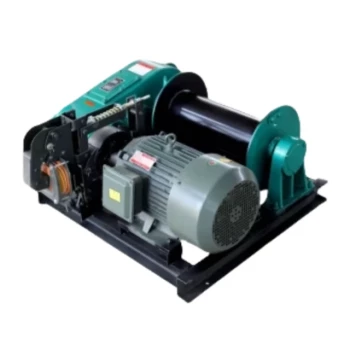
Contrary to a common assumption, a high-performance electric winch can often operate at a faster line speed than a typical electric hoist. While hoists are built for controlled, safe vertical lifting at moderate speeds, winches are fundamentally pulling devices that can be geared for rapid operation over much longer distances. The true difference is not just about speed, but about the core purpose for which each tool is engineered.
The choice between a winch and a hoist isn't about which is universally "faster." It's about matching the tool to the task: a hoist is a specialized machine for safe, repetitive vertical lifting, while a winch is a versatile tool for multi-directional pulling. The speed of each is simply a byproduct of its fundamental design.
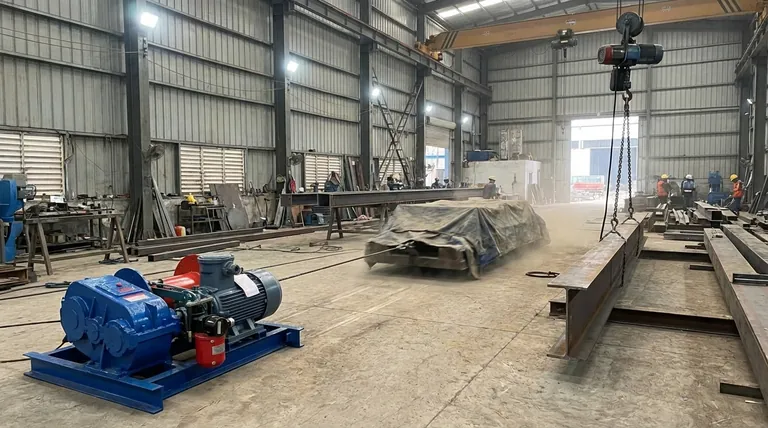
The Fundamental Difference: Pulling vs. Lifting
Understanding the core design philosophy of each device is the key to making an informed decision. Their differences in speed, braking, and construction all stem from one central distinction.
Hoists: The Vertical Lifting Specialist
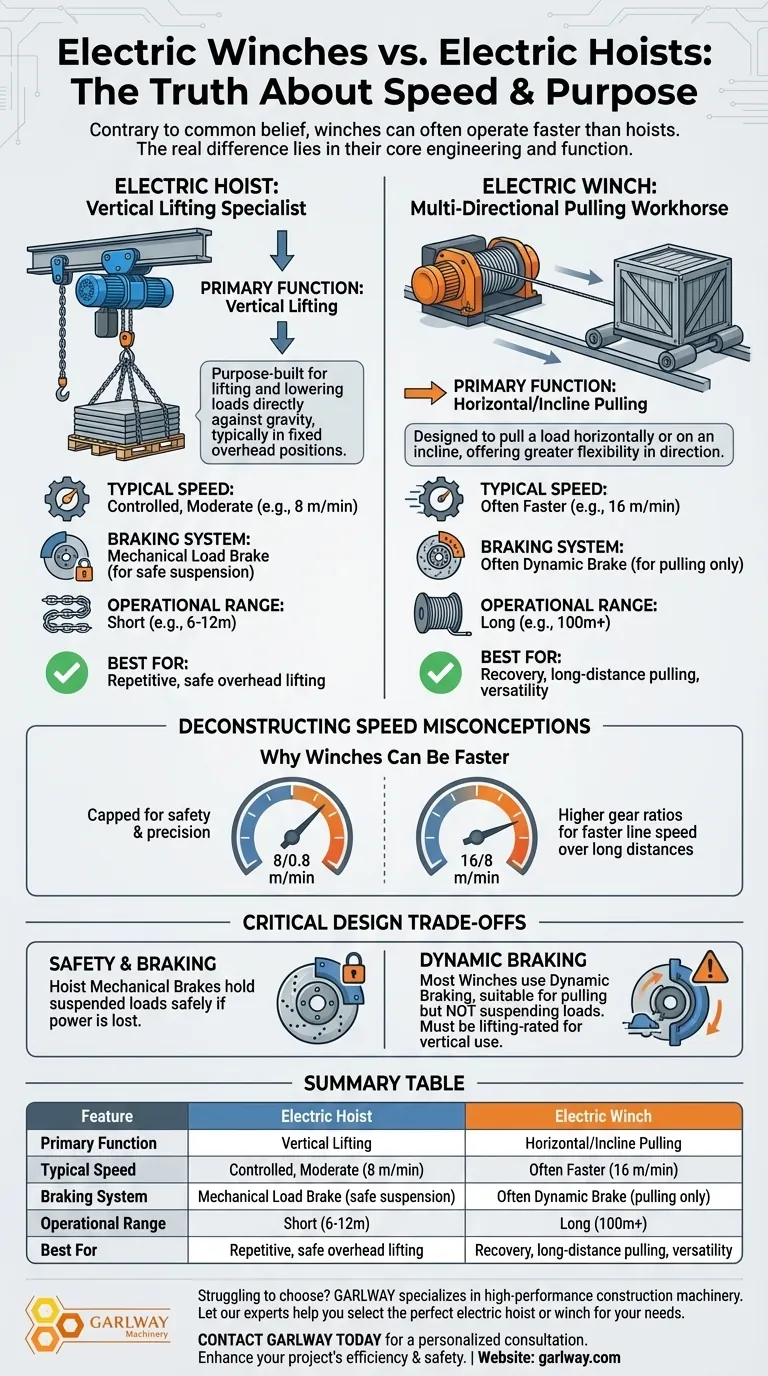
An electric hoist is purpose-built for one job: lifting and lowering a load directly against gravity.
Its entire design, from the gear train to the braking system, is optimized for vertical movement. They are typically installed in a fixed, overhead position on a beam or gantry crane.
Winches: The Multi-Directional Pulling Workhorse
An electric winch is designed to pull a load, most often horizontally or on an incline.
This makes them ideal for tasks like vehicle recovery or dragging heavy materials across a surface. While some winches are rated for lifting, their primary design offers greater flexibility in the direction of the pull.
Deconstructing Operating Speed
The idea that hoists are always the faster option is a frequent point of confusion. The reality depends entirely on the specific models being compared and their intended application.
The Source of the Misconception
Hoists are often used for rapid, repetitive lifting cycles in industrial settings, which creates the perception of high speed. However, their speed is often capped to ensure safe and precise load placement.
Why Winches Can Be Faster
A winch's main goal is to spool a long length of wire rope, often hundreds of feet, to move an object over a great distance. This task benefits from higher gear ratios that produce a faster line speed.
Example Speed Specifications
While speeds vary widely by model, it's not uncommon to find specifications that challenge the "hoist is faster" assumption.
For example, a typical hoist might offer a dual-speed setting of 8/0.8 meters per minute. In contrast, a comparable high-performance winch could have speeds of 16/8 meters per minute, making it significantly faster.
Understanding the Critical Design Trade-offs
Speed is only one part of the equation. The most important differences lie in the engineering choices that prioritize safety, installation flexibility, and operational range.
Braking Systems and Load Security
This is the most critical safety distinction. Hoists use mechanical load brakes designed to automatically engage and securely hold a suspended load if power is lost.
Many standard winches use dynamic braking, which is only suitable for pulling, not for suspending a load. If you need to use a winch for a vertical lift, you must select a model that is specifically rated for lifting and equipped with a mechanical brake system.
Size, Weight, and Installation
Hoists are generally larger, heavier machines designed for permanent or semi-permanent installation in a workshop or factory.
Winches are typically more compact and lightweight, making them easier to mount in constrained spaces like the front of a vehicle or on a trailer.
Reach and Distance Capability
Hoists are equipped with a fixed, relatively short length of chain or wire rope, often just 6 to 12 meters, which is sufficient for most vertical lifting tasks.
Winches, designed for long-distance pulling, can come with wire ropes exceeding 100 meters, offering far greater operational range.
Making the Right Choice for Your Application
Choosing the correct tool requires you to look past the single metric of speed and focus on the nature of the work you need to accomplish.
- If your primary focus is safety and repetitive vertical lifting (e.g., in a workshop or on a gantry crane): A hoist is the correct, purpose-built tool for the job.
- If your primary focus is horizontal pulling or recovery (e.g., on an off-road vehicle or trailer): A standard winch is designed specifically for this purpose and will perform best.
- If your primary focus is versatile, long-distance, or multi-angle pulling: You must select a winch, and if any of that work involves suspending a load, it must be specifically rated for lifting.
By understanding that function dictates form, you can confidently select the right machine for both performance and safety.
Summary Table:
| Feature | Electric Hoist | Electric Winch |
|---|---|---|
| Primary Function | Vertical Lifting | Horizontal/Incline Pulling |
| Typical Speed | Controlled, Moderate (e.g., 8 m/min) | Often Faster (e.g., 16 m/min) |
| Braking System | Mechanical Load Brake (for safe suspension) | Often Dynamic Brake (for pulling only) |
| Operational Range | Short (e.g., 6-12m) | Long (e.g., 100m+) |
| Best For | Repetitive, safe overhead lifting | Recovery, long-distance pulling, versatility |
Struggling to choose the right tool for your material handling needs?
GARLWAY specializes in high-performance construction machinery. Whether you need a robust electric hoist for safe, repetitive lifting or a powerful electric winch for versatile pulling tasks, our experts can help you select the perfect equipment for your construction company or contracting business.
Contact GARLWAY today for a personalized consultation and discover how our winches, concrete mixers, and batching plants can enhance your project's efficiency and safety.
Visual Guide
Related Products
- Electric 120V Boat Winch by Badlands
- Electric and Hydraulic Winch for Heavy Duty Applications
- Small Electric Winch 120V and 240V for Compact Applications
- 12000 lb Electric Boat Trailer Winch with Windlass Anchor Warn
- Electric Hoist Winch Boat Anchor Windlass for Marine Applications
People Also Ask
- How do electric boat winches work? Unlock Effortless Launching & Retrieval
- How much current does an electric boat winch draw? Plan Your Electrical System for Peak Performance
- Can I run a winch straight from a battery? Essential Power Setup for Safe Operation
- What are the types of electric winches available? Choose the Right Winch for Your Job
- What are the uses of electric winches in mining and tunneling? Enhance Safety and Efficiency Underground