A tilting drum mixer is defined by its core mechanical feature: the drum pivots or tilts downwards to discharge the mixed concrete. This simple, gravity-assisted design allows for rapid and efficient unloading with minimal manual effort, making it a highly effective tool for specific types of concrete and project scales.
The primary advantage of a tilting drum mixer is its speed. By using gravity to pour out its contents, it offers a much faster discharge rate than other drum mixer types, making it ideal for projects that demand efficiency and the use of stiffer, less-fluid concrete mixes.
The Core Mechanism: How a Tilting Drum Mixer Operates
A tilting drum mixer's operation is straightforward and built around the rotation and orientation of its drum. Understanding this process clarifies its primary benefits.
The Single Opening Design
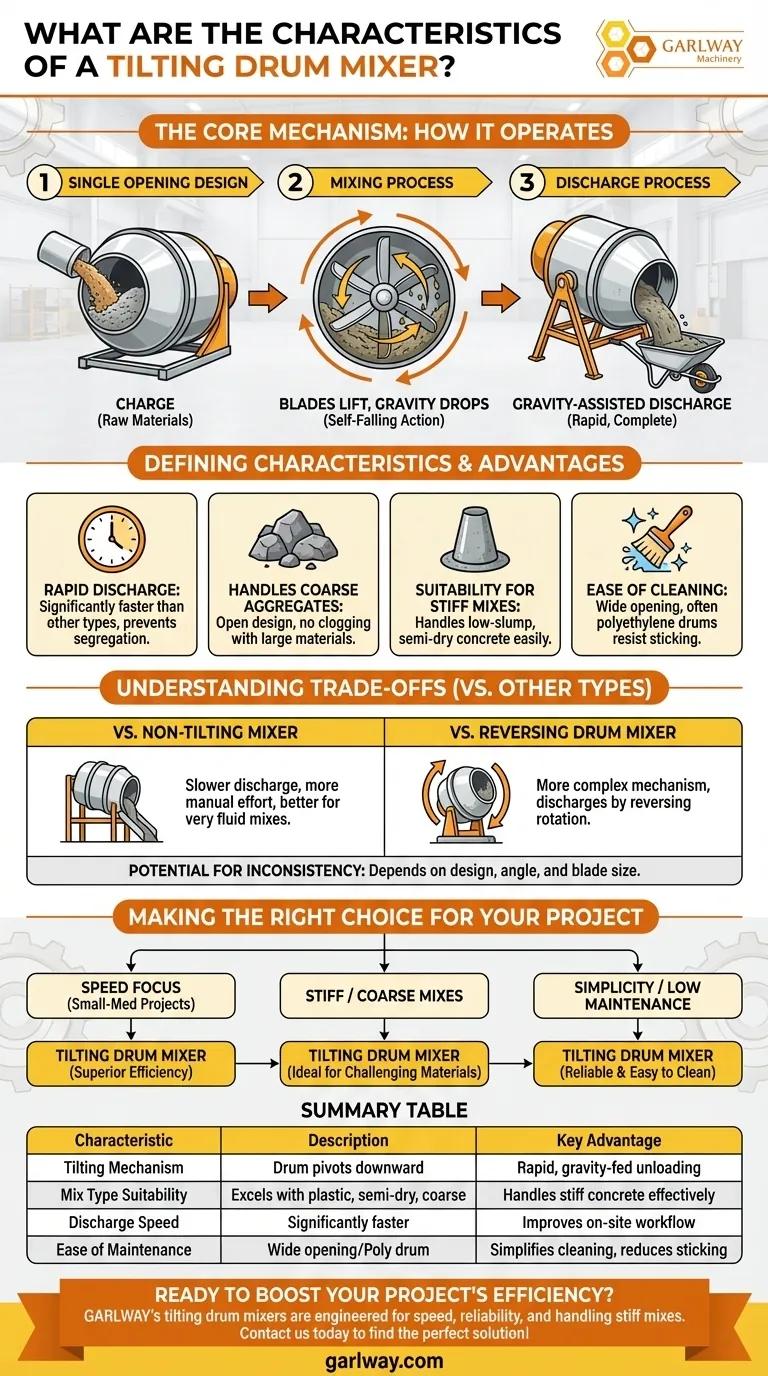
The mixer features one opening at the front of the drum. This single port serves a dual purpose: it's where raw materials like cement, sand, aggregates, and water are loaded (charged), and it's also where the final mixed concrete is discharged.
The Mixing Process
Once loaded, the drum rotates on its axis. Inside, blades or fins are fixed to the drum's interior wall. As the drum turns, these blades continuously lift the materials to the top, where they then tumble back down due to gravity. This "self-falling" action ensures a uniform and consistent mix.
The Discharge Process
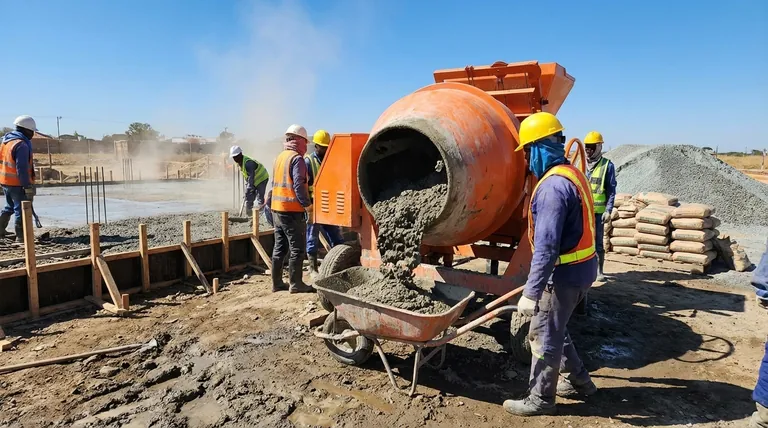
This is the defining characteristic. When mixing is complete, the entire drum is tilted downwards. This action allows the concrete to flow out of the opening quickly and completely under the force of gravity, directly into a wheelbarrow or concrete pump.
Defining Characteristics and Advantages
Several key features make the tilting drum mixer a popular choice for certain applications, distinguishing it from non-tilting or reversing models.
Rapid Discharge
The ability to tilt provides a significantly faster discharge rate compared to other mixer types. This efficiency prevents the mixture from segregating and is crucial for maintaining a steady workflow on site.
Handling Coarse Aggregates
These mixers are particularly well-suited for blending mixes that contain large-sized aggregates. The open design and tumbling action can effectively incorporate coarser materials without the clogging issues that can affect other systems.
Suitability for Stiff Mixes
Tilting drum mixers excel at handling plastic and semi-dry concrete. The powerful gravity-fed discharge can easily handle lower-slump (stiffer) concrete that might be difficult to unload from other types of mixers.
Ease of Cleaning
The wide opening and ability to tilt the drum to various angles make cleaning much simpler. Many modern units feature polyethylene drums, which resist corrosion and prevent hardened concrete from sticking, further simplifying maintenance.
Understanding the Trade-offs
While highly effective, the tilting drum mixer is not a universal solution. Its design presents specific trade-offs when compared to other common mixer types.
Comparison with Non-Tilting Mixers
A non-tilting mixer has a simpler design and discharges by inserting a chute into the drum to catch the concrete as it tumbles out. This process is slower and more labor-intensive than the tilting method. However, non-tilting designs can sometimes offer a more thorough mixing action for very wet, fluid mixes.
Comparison with Reversing Drum Mixers
A reversing drum mixer has two sets of internal blades and discharges by reversing the direction of its rotation. This "pushes" the concrete out of the opening. While also efficient, it is a more complex mechanical system than the simple tilting mechanism.
Potential for Inconsistency
The efficiency of a tilting drum mixer depends heavily on factors like the drum's shape, its angle of rotation, and the size of the internal blades. A poorly designed or operated mixer can lead to less-than-optimal mixing.
Making the Right Choice for Your Project
Selecting the right mixer comes down to the specific demands of your job, primarily the type of concrete you are using and the scale of the project.
- If your primary focus is speed on small to medium projects: The rapid, gravity-fed discharge of a tilting drum mixer makes it the superior choice for efficiency.
- If your primary focus is working with stiff or coarse aggregate mixes: A tilting drum mixer's design is ideal for handling and completely discharging these challenging materials.
- If your primary focus is simplicity and low maintenance: The straightforward mechanical design of a tilting drum mixer often results in reliable operation and easier cleaning.
Ultimately, the tilting drum mixer is a highly effective tool when its strengths are matched to the requirements of the project.
Summary Table:
| Characteristic | Description | Key Advantage |
|---|---|---|
| Tilting Mechanism | Drum pivots downward for discharge. | Rapid, gravity-fed unloading. |
| Mix Type Suitability | Excels with plastic, semi-dry, and coarse aggregate mixes. | Handles stiff concrete effectively. |
| Discharge Speed | Significantly faster than non-tilting or reversing drum mixers. | Improves on-site workflow efficiency. |
| Ease of Maintenance | Wide opening and often polyethylene drum. | Simplifies cleaning and reduces sticking. |
Ready to Boost Your Project's Efficiency?
If your construction projects demand speed, reliability, and the ability to handle stiff concrete mixes, a GARLWAY tilting drum mixer is the ideal solution. Our mixers are engineered for durability and peak performance, helping contractors and construction companies complete jobs faster and more efficiently.
Let GARLWAY's expertise in construction machinery power your success.
Contact us today to discuss your specific needs and find the perfect mixer for your operation!
Visual Guide
Related Products
- Concrete Cement Mixer Machine Drum Mixer for Construction
- Belle Mixer Drum Self Loading Mortar Mixers JS3000
- Portable Cement Mixer with Lift Concrete Machine
- Skid Steer Self Loading Concrete Mixers for Construction
- Shaft Mixer Machine for Cement and Regular Concrete Mixing
People Also Ask
- What are the key advantages of using drum mixers in concrete mixing? Boost Volume & Efficiency on Your Site
- What are the key components that maintain concrete mix consistency in the drum? Ensure Uniform Quality from Plant to Site
- How do cement mixers enhance safety on construction sites? Reduce Strain, Hazards, and Accidents
- When was the first concrete mixer developed and by whom? Discover the 1900 Breakthrough
- What is the average lifespan of a concrete mixer? Maximize Your Equipment's Lifespan & ROI