The primary benefit of consistent lifting power in an electric hoist is operational predictability. Unlike manual alternatives that depend on operator strength and endurance, an electric hoist delivers the same reliable performance for every lift, ensuring smoother workflows, enhanced safety, and greater overall efficiency.
Consistent power transforms lifting from a variable, human-dependent task into a reliable and optimized industrial process. It removes the guesswork, allowing you to plan operations around predictable cycle times and guaranteed load-handling capabilities.
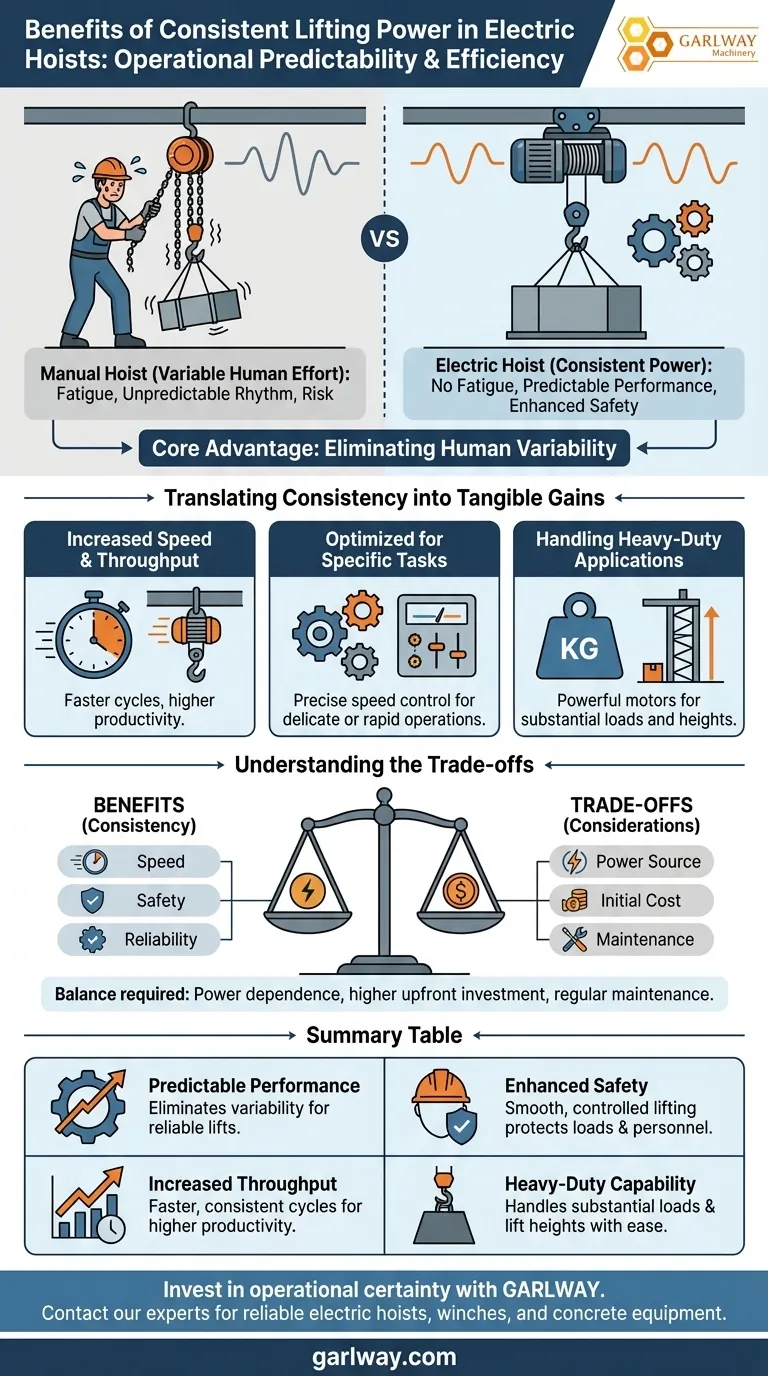
The Core Advantage: Eliminating Human Variability
The most significant impact of an electric hoist's consistent power is the removal of human physical effort as a variable in your lifting operations.
Predictable Performance, Every Time
An electric motor does not get tired or fatigued. It delivers the same torque and speed on the first lift of the day as it does on the last, ensuring that performance never fluctuates based on operator endurance.
Enhanced Operational Rhythm
This consistency creates a smooth, predictable workflow. You can accurately forecast how long a series of lifts will take, which is crucial for scheduling, production planning, and meeting deadlines. Operations become a steady rhythm rather than a series of stop-and-start efforts.
Improved Safety and Load Control
Manual hoists can introduce risk when an operator becomes fatigued, potentially leading to slips or unsteady movements. An electric hoist's constant power provides smooth, controlled lifts and lowers, reducing the risk of sudden jerks that could damage the load or endanger personnel.
Translating Consistency into Tangible Gains
Predictable power is not just a theoretical benefit; it delivers measurable improvements in speed, versatility, and capability.
Increased Speed and Throughput
Because the power is constant and readily available, electric hoists operate at significantly higher speeds than manual ones. This allows your team to complete more lifting cycles in a shorter amount of time, directly boosting productivity and throughput.
Optimized for Specific Tasks
Reliable power enables precise speed control. Hoists can be engineered with adjustable speeds—slower settings for handling delicate or heavy loads with precision, and faster speeds for rapid production environments.
Handling Heavy-Duty Applications
Consistent, powerful electric motors are what make heavy-duty lifting possible. Electric wire rope hoists are designed for substantial loads and greater lift heights, performing rapid lifting tasks that would be impractical or impossible with manual equipment.
Understanding the Trade-offs
While highly beneficial, transitioning to electric hoists involves key considerations that must be balanced.
Dependence on a Power Source
The most obvious trade-off is the need for a reliable electrical source. In the event of a power outage, the hoist is inoperable, which can bring operations to a halt unless a backup power system is in place.
Higher Initial Investment
Electric hoists represent a larger upfront capital expenditure compared to their manual counterparts. The motor, gearbox, and electrical components make them inherently more complex and costly to purchase.
Maintenance Considerations
While robust, electric hoists require regular maintenance of their electrical and mechanical components. Furthermore, the lifting medium itself has trade-offs; for instance, a wire rope may be ideal for speed but can be less durable than a chain in certain harsh environments.
Making the Right Choice for Your Operation
Choosing between hoist types depends entirely on your operational priorities.
- If your primary focus is maximum productivity and throughput: The consistent speed and power of an electric hoist are essential for any high-volume application.
- If your primary focus is safety and control with heavy loads: The unwavering strength and smooth operation of an electric hoist provide a level of security that manual systems cannot match.
- If your primary focus is infrequent use on a tight budget: A manual hoist may be sufficient, but you must accept the inherent variability in performance and speed.
Ultimately, investing in consistent lifting power is an investment in operational certainty.
Summary Table:
| Benefit | Key Impact |
|---|---|
| Predictable Performance | Eliminates human variability and fatigue for reliable lifts. |
| Enhanced Safety | Provides smooth, controlled lifting to protect loads and personnel. |
| Increased Throughput | Enables faster, more consistent lifting cycles for higher productivity. |
| Heavy-Duty Capability | Handles substantial loads and greater lift heights with ease. |
Ready to enhance your operation's lifting efficiency and safety? GARLWAY specializes in providing robust construction machinery, including reliable electric hoists, winches, and concrete equipment, designed for construction companies and contractors who demand consistent performance. Let us help you achieve operational certainty. Contact our experts today to discuss your specific needs!
Visual Guide
Related Products
- Electric Hoist Winch Boat Anchor Windlass for Marine Applications
- Electric and Hydraulic Winch for Heavy Duty Applications
- Hydraulic Winding Engine Harbor Freight Winch
- Heavy Duty Electric Boat Winch Windlass Anchor
- 12000 lb Electric Boat Trailer Winch with Windlass Anchor Warn
People Also Ask
- How does an electric anchor winch work? Power, Safety, and Reliable Operation Explained
- What are the advantages of installing an electric anchor winch on a boat? Boost Safety & Ease for Boaters
- What are the operational differences between electric hoists and winches? A Guide to Safe Lifting vs. Pulling
- What are the main benefits of a boat anchor winch? Boost Safety & Efficiency for Your Vessel
- How does a boat anchor winch work? A Guide to Reliable Anchor Handling