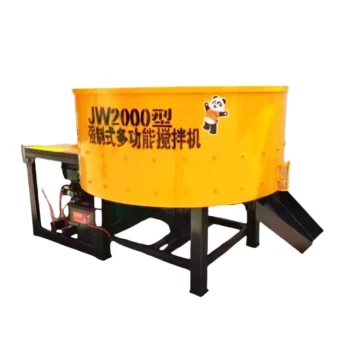
In short, a pan mixer offers superior speed and mix quality. Its design uses a stationary pan and rotating interior blades to create a forced mixing action, resulting in a highly consistent and homogeneous concrete product much faster than traditional drum mixers. This makes it the preferred choice for applications where quality and consistency are non-negotiable.
The core advantage of a pan mixer isn't just about mixing ingredients; it's about achieving precise control. Its design prioritizes forced material interaction over simple tumbling, delivering a superior, uniform product ideal for specialized and high-performance applications like precast concrete.
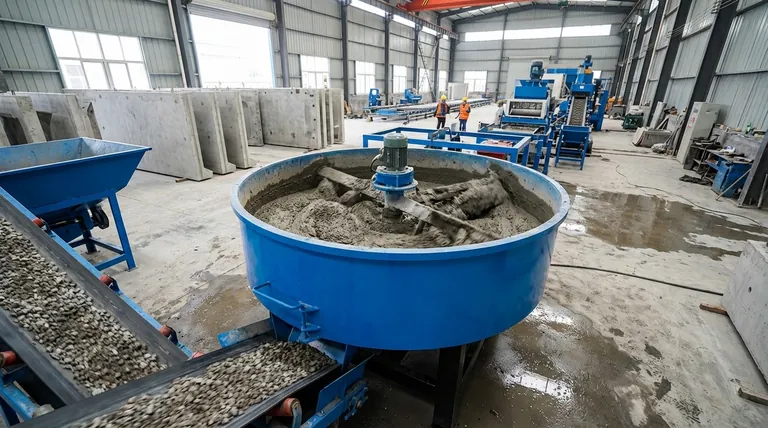
How a Pan Mixer Achieves a Superior Mix
Understanding the mechanics of a pan mixer reveals why it excels in specific applications. The design is simple but highly effective, focusing on an intense and controlled mixing process.
The Stationary Pan and Rotating Blades
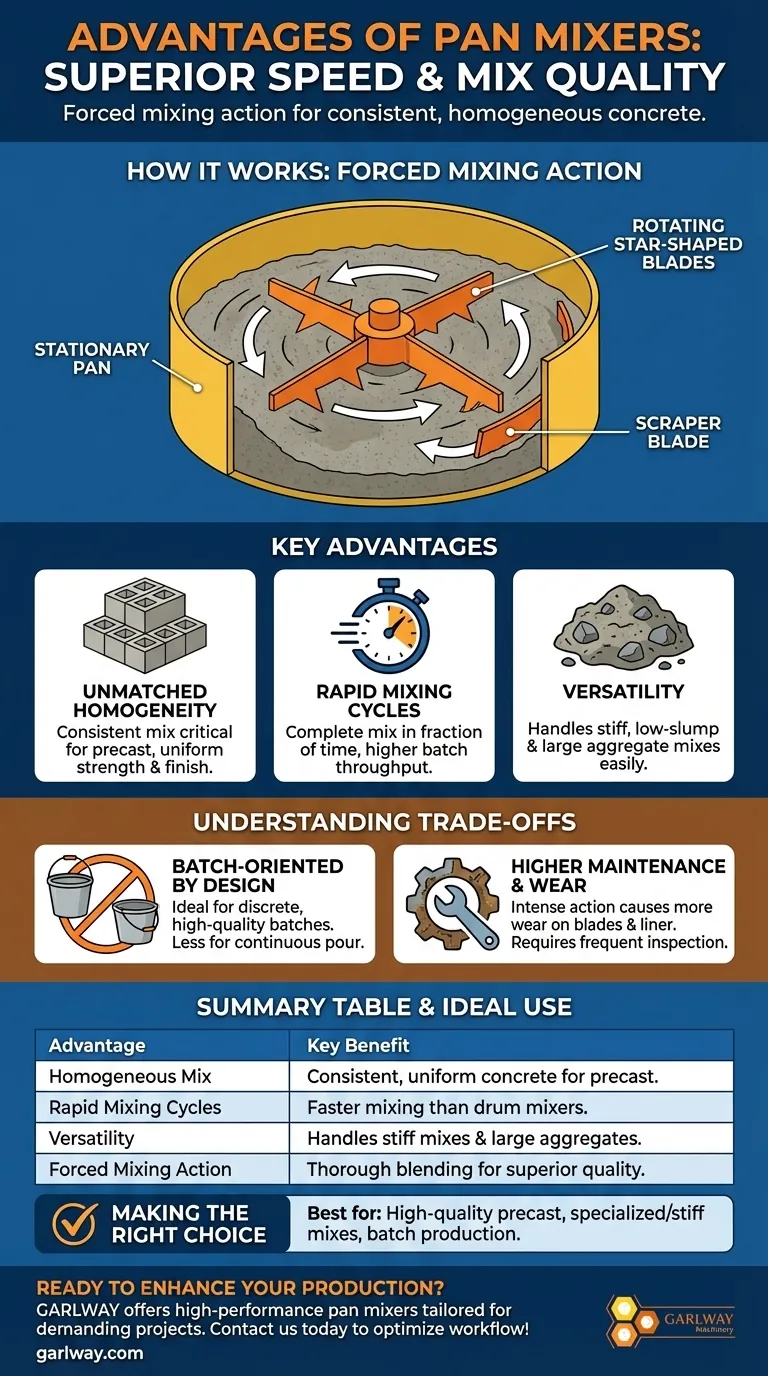
A pan mixer consists of a static, cylindrical pan that holds the materials. Inside, a set of star-shaped blades rotates on a central axis, moving through the concrete mixture.
This separation of roles is key: the pan contains, and the blades actively mix. This prevents the random tumbling effect seen in drum mixers.
Forced Mixing Action
The rotating blades create a forced mixing action. They shear through the aggregate, cement, and water, ensuring every particle is thoroughly coated and evenly distributed.
This intense action is highly effective for stiff or tough mixtures that would otherwise resist blending.
The Role of the Scraper Blade
Most pan mixers also include a scraper blade that travels along the interior wall of the pan.
This simple component constantly pulls material away from the sides and back into the path of the main mixing blades, eliminating unmixed pockets and guaranteeing a uniform batch.
Key Advantages in Practice
The mechanical design of a pan mixer translates directly into significant operational benefits, particularly for quality-controlled production.
Unmatched Homogeneity
The forced mixing action produces a remarkably homogeneous and consistent concrete mix. This is critical for precast manufacturing, where every piece must meet identical strength and finish specifications.
Rapid Mixing Cycles
Because the mixing action is so intense and efficient, pan mixers achieve a complete and uniform mix in a fraction of the time required by other mixer types. This leads to higher throughput in batch-production environments.
Versatility with Demanding Materials
Pan mixers excel where other mixers struggle. They can easily handle stiff, low-slump concrete, as well as mixes containing large aggregates or special additives, without compromising on quality.
Understanding the Trade-offs
While powerful, the pan mixer is a specialized tool. Its advantages in some areas create limitations in others.
Batch-Oriented by Design
Pan mixers are fundamentally batch mixers. They are perfect for producing discrete, high-quality batches one after another.
However, they are less suited for large-scale, continuous pour applications, such as major roadway or foundation work, where a continuous mixer might be more efficient.
Higher Maintenance and Wear
The intense, high-shear force of the mixing blades places significant stress on the internal components.
The blades and the pan liner are considered wear parts that will require more frequent inspection and replacement compared to the simpler mechanisms of a drum mixer.
Making the Right Choice for Your Goal
Selecting a mixer depends entirely on the demands of your project.
- If your primary focus is high-quality precast concrete: The pan mixer is the industry standard due to its speed and ability to produce exceptionally consistent results.
- If your primary focus is creating specialized or stiff mixes: The pan mixer's forced mixing action provides the power and control necessary to handle challenging materials effectively.
- If your primary focus is high-volume, continuous pouring: A continuous mixer or a large-capacity drum mixer would likely be a more appropriate and efficient choice.
Ultimately, choosing a pan mixer is a decision to prioritize mix quality, consistency, and speed within a batch-production workflow.
Summary Table:
| Advantage | Key Benefit |
|---|---|
| Homogeneous Mix | Produces consistent, uniform concrete ideal for precast applications. |
| Rapid Mixing Cycles | Achieves complete mixing faster than traditional drum mixers. |
| Versatility | Handles stiff, low-slump concrete and large aggregates with ease. |
| Forced Mixing Action | Ensures thorough blending of all materials for superior quality. |
Ready to enhance your concrete production with a reliable pan mixer?
GARLWAY specializes in construction machinery, offering high-performance pan mixers, concrete batching plants, and other equipment tailored for construction companies and contractors globally. Our solutions deliver the speed, consistency, and durability you need for demanding projects.
Contact us today to discuss how our pan mixers can optimize your workflow and elevate your output quality!
Visual Guide
Related Products
- Construction Products Concrete Plant Machine Mixing Concrete Mixer
- Belle Mixer Drum Self Loading Mortar Mixers JS3000
- Commercial Construction Mixer Machine for Soil Cement Mixing Concrete
- Portable Electric Small Cement Mixer Concrete Machine
- JDC350 Small Cement Concrete Mortar Mixer
People Also Ask
- What factors should be considered when choosing between volumetric and traditional mixers? Optimize Your Concrete Project Strategy
- What is the difference between pan and planetary mixers? Choose the Right Mixer for Your Concrete Project
- When was the first concrete mixer developed and by whom? Discover the 1900 Breakthrough
- What is the average lifespan of a concrete mixer? Maximize Your Equipment's Lifespan & ROI
- What are the two broad types of concrete mixers? Choose the Right Mixer for Your Project