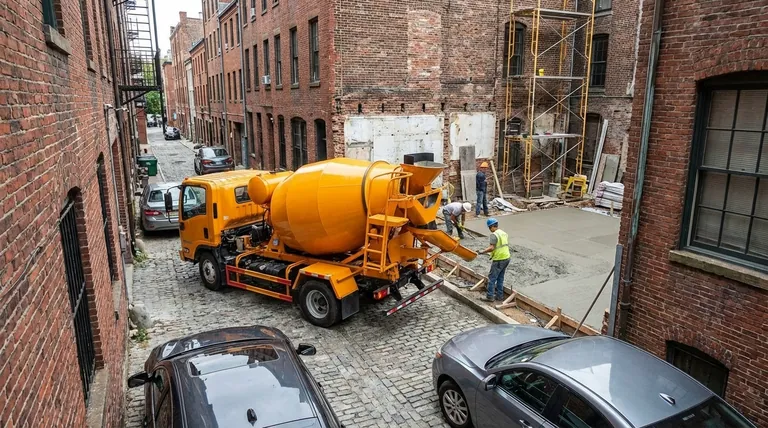
The fundamental advantage of a minimixer is its compact size, which grants it access to job sites that are impossible for standard concrete trucks to reach. This makes them the default solution for delivering ready-mix concrete in dense urban environments, narrow residential streets, and projects with restricted entry points.
Minimixers solve the critical problem of physical access. They trade the high-volume capacity of standard mixers for unparalleled maneuverability, enabling precision concrete delivery for small-scale or hard-to-reach projects.
The Defining Advantage: Navigating Constraints
The value of a minimixer isn't just that it's smaller; it's about what that smaller footprint enables. It fundamentally changes the logistics of concrete delivery for a specific class of projects.
Accessing Restricted Sites
A minimixer is typically mounted on a 4x2 cab/chassis, giving it a profile much closer to a small commercial truck than a large construction vehicle.
This compact design allows it to easily navigate narrow city streets, tight alleyways, and residential driveways where a larger truck would be blocked or cause damage.
Reducing Ground Impact
The reduced size and weight of a minimixer place significantly less stress on the surfaces it drives over.
This is a critical advantage for residential projects where a heavy, standard concrete truck could crack or destroy a customer's driveway, leading to costly repairs and client dissatisfaction.
Enabling Small-Batch Delivery
Minimixers are designed for small loads, typically holding around 4m³ of concrete.
This makes them highly efficient for jobs that don't require a full-sized truck, such as pouring footings for a deck, creating a small patio, or performing concrete repairs. It eliminates the waste and unnecessary expense of ordering a partially filled standard mixer.
Understanding the Trade-offs
While their advantages are clear, choosing a minimixer involves accepting a specific set of limitations. Understanding these trade-offs is key to using them effectively.
Limited Volume Capacity
The most obvious trade-off is the small 4m³ capacity. This makes them completely unsuitable for large-scale pours like building foundations or extensive commercial slabs.
Attempting to use a minimixer for a large job would require multiple trips, which is highly inefficient, increases labor costs, and introduces risks of cold joints forming between pours.
Potentially Higher Cost Per Meter
While the total delivery cost may be lower for a small job, the price per cubic meter of concrete from a minimixer is often higher than from a standard truck.
The operational costs—including the driver, fuel, and plant batching time—are similar for both vehicles, but those costs are spread over a much smaller volume of concrete in a minimixer.
When to Choose a Minimixer
Making the right choice comes down to a clear-headed assessment of your project's primary constraint: Is it volume or access?
- If your primary focus is site access: The minimixer is often the only viable solution for delivering concrete to a location with narrow streets, a restricted entrance, or a sensitive driveway.
- If your primary focus is a small volume pour (under 4m³): A minimixer provides a cost-effective, efficient way to get the exact amount of ready-mix concrete you need without waste.
- If your primary focus is a large volume pour: A standard-sized concrete mixer will always be the more efficient and economical choice, delivering more material with fewer trips.
Ultimately, selecting the right vehicle is about matching the tool precisely to the constraints of the job.
Summary Table:
| Advantage | Key Benefit | Ideal For |
|---|---|---|
| Compact Size | Navigates narrow streets and tight alleys | Urban environments, residential projects |
| Reduced Ground Impact | Protects driveways and sensitive surfaces | Homeowners, landscaping jobs |
| Small-Batch Delivery (~4m³) | Eliminates waste for small pours | Patios, footings, repairs |
| Enhanced Maneuverability | Access sites impossible for standard trucks | Projects with restricted entry points |
Ready to Find the Perfect Concrete Solution for Your Project?
GARLWAY specializes in providing robust construction machinery, including a range of concrete mixers and batching plants, tailored for contractors and construction companies globally.
If your next project involves navigating tight spaces or requires precise, small-batch concrete delivery, our experts can help you select the right equipment to maximize efficiency and minimize costs.
Contact GARLWAY today to discuss your specific needs and discover how our reliable machinery can deliver concrete success for your business.
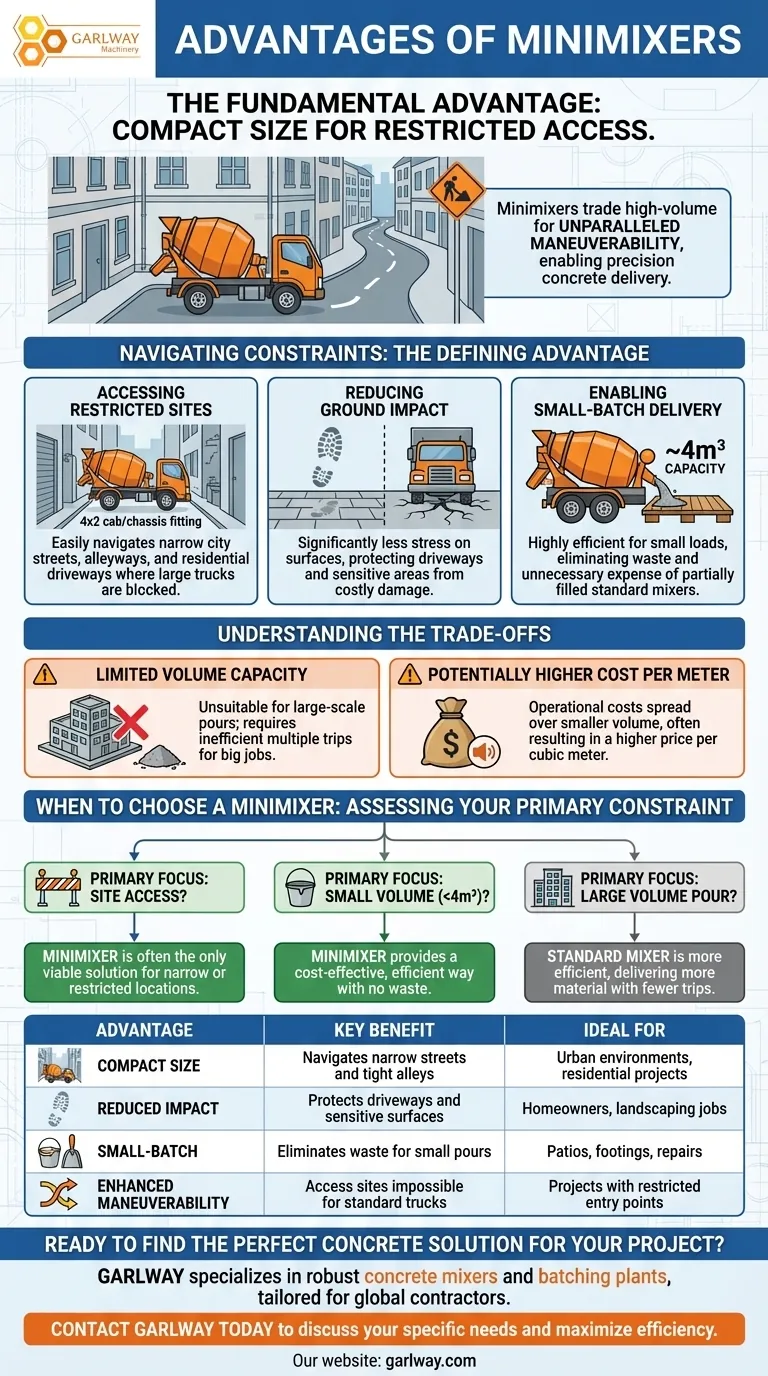
Visual Guide
Related Products
- Mini Cement Mortar Mixer Truck for Construction
- Portable Electric Small Cement Mixer Concrete Machine
- JZC400 Mobile Small Concrete Mixer Cement Mixer Machine
- JDC350 Small Cement Concrete Mortar Mixer
- Portable Concrete Mixer Machine Equipment for Mixing Concrete
People Also Ask
- Why might mixing mortar in a cement truck be problematic? Avoid Costly Mixing Mistakes
- What are the main types of construction cement mixers available? Choose the Right Mixer for Your Project
- What are the two primary methods for filling a cement mixer truck? Central vs. Transit Mix Explained
- What are the common uses of cement mixer trucks? Boosting Construction Efficiency and Quality
- What are the primary methods to fill a cement mixer truck? Central Mix vs. Transit Mix Explained