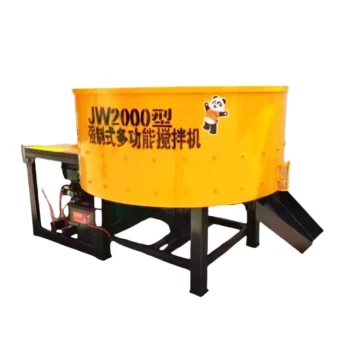
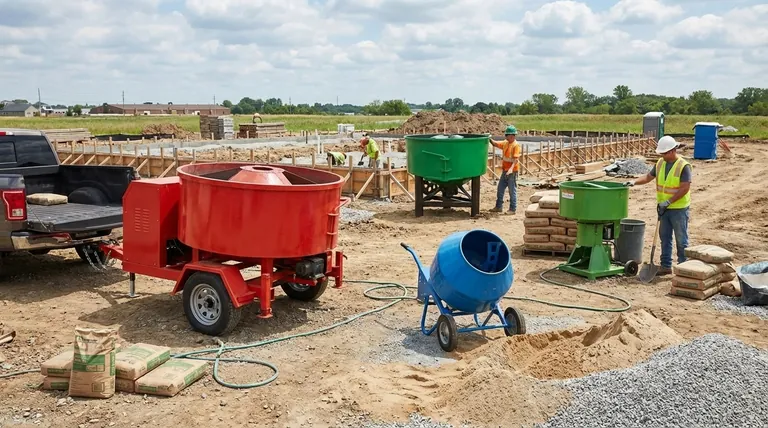
At its core, a portable cement mixer's size and portability are directly linked. Capacities typically range from 1.5 to 12 cubic feet, and the method of transport evolves from being hand-carried or fitting in a car trunk for the smallest models to requiring a vehicle hitch for the largest towable units.
The central decision is not just about the volume of concrete you need, but how you plan to move the mixer to your site and around your site. The right choice balances batch capacity with on-the-ground maneuverability.
Decoding Mixer Capacity and Project Scale
The "size" of a mixer is defined by its drum capacity, measured in cubic feet. This volume dictates how much concrete you can produce in a single batch, which directly impacts project workflow and efficiency.
The Small-Scale Range (1.5 - 5 cubic feet)
These mixers are the workhorses of DIY projects and small professional jobs. They are ideal for tasks like setting fence posts, pouring small slabs, or executing repairs. Their compact design makes them easy to store and operate with minimal setup.
The Mid-to-Large Range (6 - 12 cubic feet)
Once you exceed 6 cubic feet, you are entering the territory of serious construction work. These larger units are designed for efficiency on bigger projects like foundations, large patios, or jobs requiring a continuous supply of concrete for a small crew.
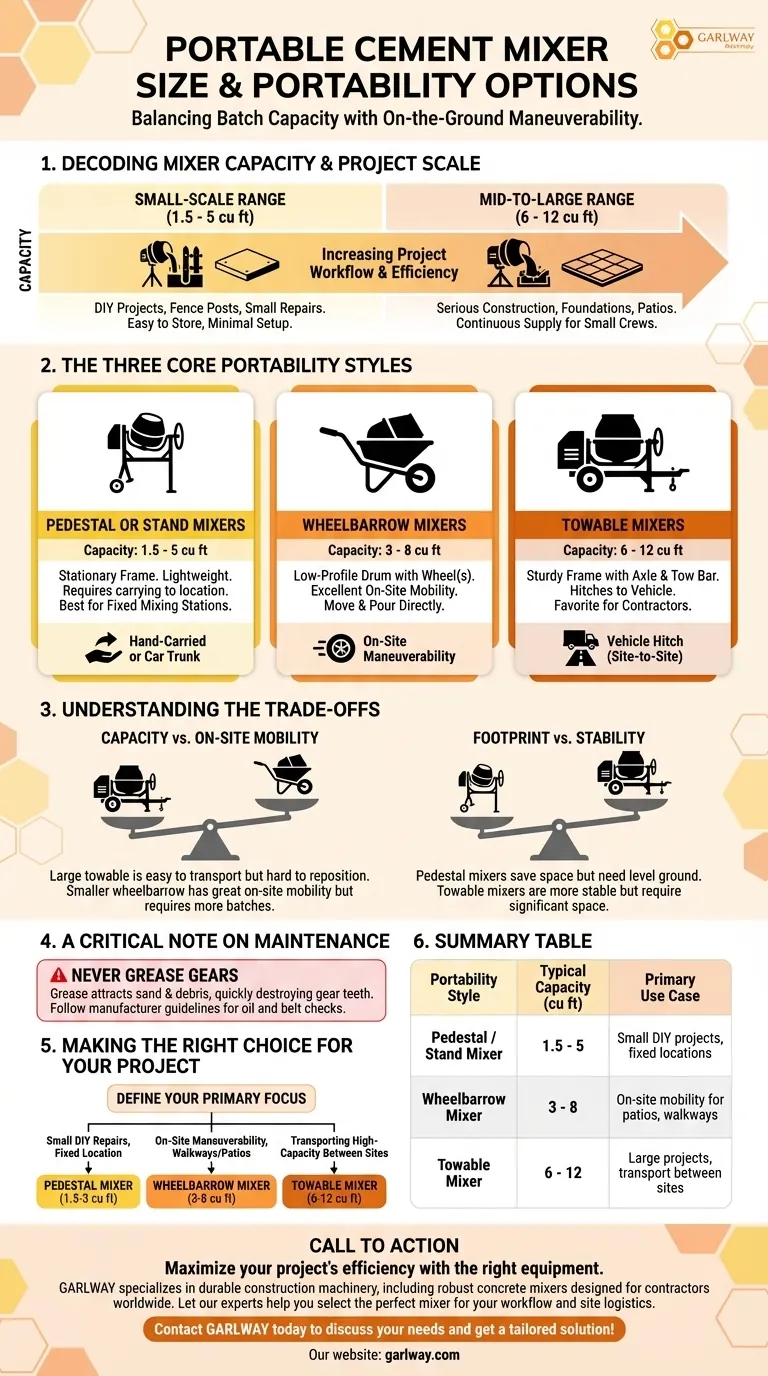
The Three Core Portability Styles
How a mixer moves is just as important as its capacity. Each design is engineered for a specific type of transport and on-site use.
Pedestal or Stand Mixers
These are often the smallest and most basic models. The mixing drum is mounted on a stationary frame or stand. While lightweight, they typically need to be carried to their mixing location and are best used when you can establish a single, fixed mixing station.
Wheelbarrow Mixers
This popular design features a low-profile drum mounted on a chassis with one or two wheels and handles, much like a traditional wheelbarrow. Their key advantage is on-site mobility, allowing you to easily move the mixer around a job site and pour directly into forms, even in confined spaces.
Towable Mixers
The largest portable mixers are built onto a sturdy frame with an axle, wheels, and a tow bar. They are designed to be hitched to a truck or vehicle for easy transportation between different job sites, making them a favorite for contractors.
Understanding the Trade-offs
Choosing a portable mixer involves balancing competing factors. Understanding these compromises is key to avoiding frustration.
Capacity vs. On-Site Mobility
This is the fundamental trade-off. A large, towable mixer is easy to get to the job site but can be difficult to reposition once unhitched. A smaller wheelbarrow mixer has excellent on-site mobility but requires you to mix more batches for the same total volume.
Footprint vs. Stability
Pedestal mixers have a very small footprint but must be placed on level, stable ground. Larger towable mixers are inherently more stable due to their wider, heavier base, but they demand significantly more space for operation and storage.
A Critical Note on Maintenance
Portability does not mean a lack of maintenance. All mixers require care, but it's crucial to remember that gears should never be greased. Grease attracts sand and debris, which will quickly grind down and destroy the gear teeth. Follow manufacturer guidelines for oil and belt checks.
Making the Right Choice for Your Project
To select the correct mixer, align the equipment's design with the primary demand of your work.
- If your primary focus is small DIY repairs or projects in a fixed location: A compact pedestal mixer (1.5-3 cu ft) provides the capacity you need without unnecessary cost or complexity.
- If your primary focus is on-site maneuverability for projects like walkways or patios: A wheelbarrow-style mixer is the ideal choice, blending a practical capacity with the ability to move and pour anywhere.
- If your primary focus is transporting a high-capacity mixer between different job sites: A towable mixer is the only option that delivers both the required volume and efficient site-to-site transport.
Ultimately, selecting the right portable mixer comes from clearly defining the logistics of your specific project.
Summary Table:
| Portability Style | Typical Capacity (cu ft) | Primary Use Case |
|---|---|---|
| Pedestal / Stand Mixer | 1.5 - 5 | Small DIY projects, fixed locations |
| Wheelbarrow Mixer | 3 - 8 | On-site mobility for patios, walkways |
| Towable Mixer | 6 - 12 | Large projects, transport between sites |
Maximize your project's efficiency with the right equipment. GARLWAY specializes in durable construction machinery, including robust concrete mixers designed for construction companies and contractors worldwide. Let our experts help you select the perfect mixer for your workflow and site logistics. Contact GARLWAY today to discuss your needs and get a tailored solution!
Visual Guide
Related Products
- Portable Cement Mixer with Lift Concrete Machine
- Portable Ready Mix Concrete Mixer Equipment
- JW1000 Mobile Cement Mixer Concrete Mixer Truck and Batching Plant
- Portable Electric Small Cement Mixer Concrete Machine
- Portable Electric Concrete Mixer Machine for Cement Mixing
People Also Ask
- Why is it necessary to use a portable concrete mixer? Gain Total Control & Efficiency
- How much concrete can you pour with a portable mixer? Find the Perfect Fit for Your Project
- What is a portable cement mixer? Achieve Consistent, On-Demand Concrete Mixing
- What are the power sources for portable cement mixers? Choose the Right Power for Your Job Site
- How does a portable concrete mixer benefit construction projects? Boost Efficiency & Cut Costs On-Site