
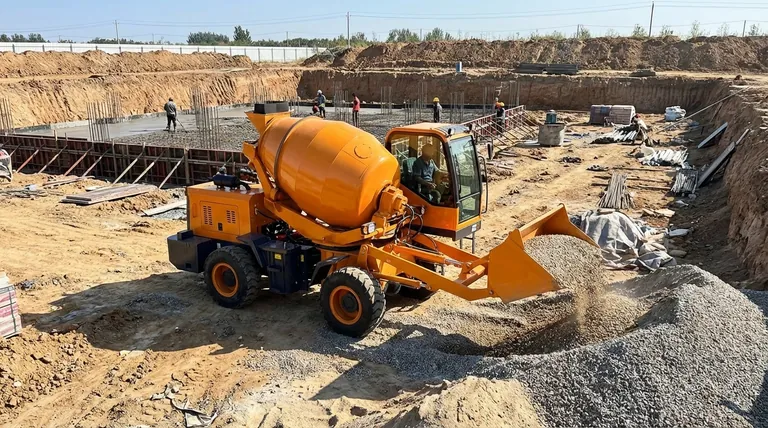
At its core, a self-loading concrete mixer is an integrated solution that combines a wheel loader, a traditional mixer, and a transport vehicle into a single, highly efficient machine. Its primary advantages are a dramatic reduction in labor costs, increased operational speed, and the versatility to handle concrete production on-site, even in constrained spaces.
The true value of a self-loading mixer is not just in mixing concrete, but in transforming the entire concrete production workflow into a streamlined, one-person operation that functions as a small, mobile batching plant.
A Mobile Batching Plant in a Single Machine
A self-loading mixer fundamentally changes the logistics of concrete production by consolidating multiple steps and machines into one unit.
The All-in-One Workflow
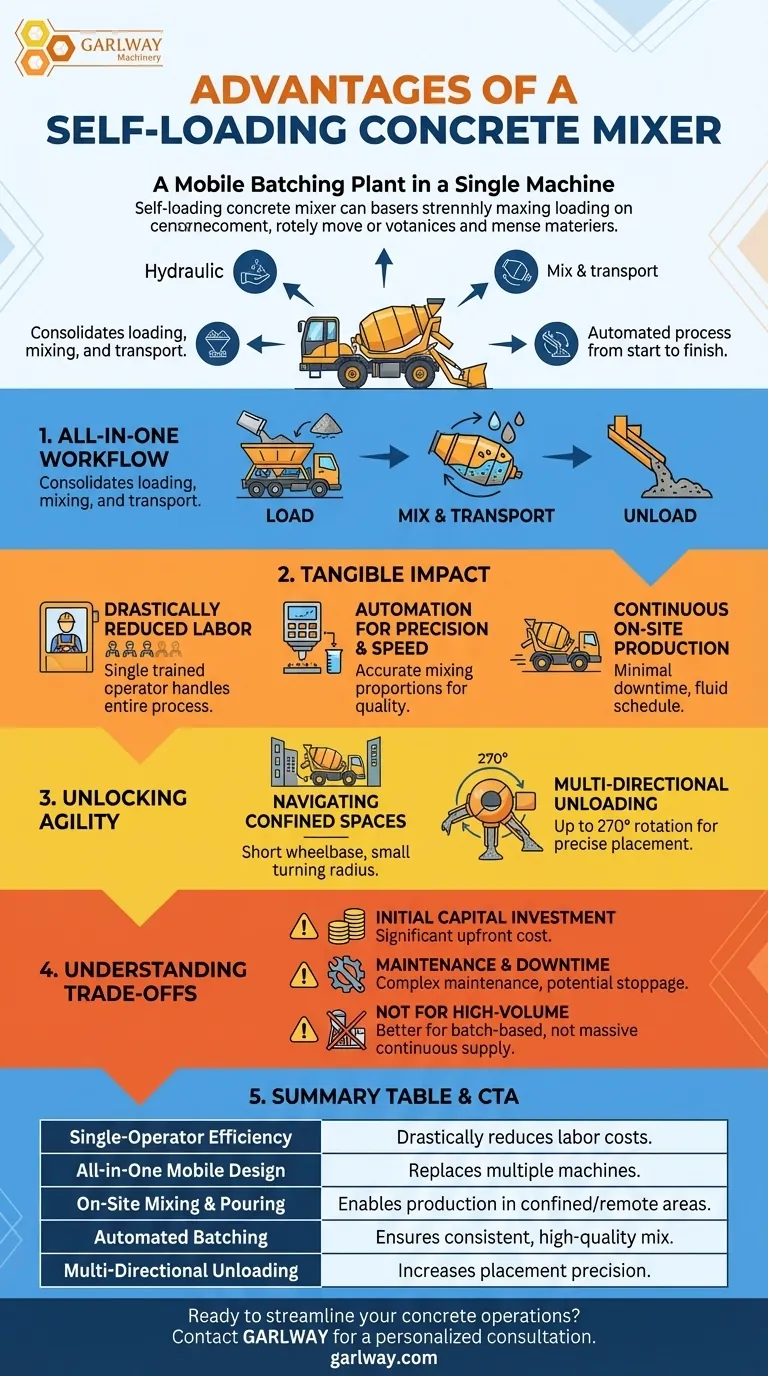
The machine executes a complete, self-contained process. The operator uses the hydraulic hopper to load aggregates and cement, adds water via an automated dosing system, mixes the materials in the drum during transit, and then precisely unloads the finished concrete.
Replacing Multiple Pieces of Equipment
Traditionally, you would need a wheel loader to handle materials, a stationary mixer or batching plant, and a transit mixer or dumper to transport the concrete. This single machine replaces that entire fleet for many small to medium-sized jobs.
The Tangible Impact on Project Efficiency
The integrated design translates directly into measurable benefits for time, cost, and quality on the job site.
Drastically Reduced Labor Costs
The most significant advantage is the reduction in manpower. Instead of requiring separate operators for loading, mixing, and transport, the entire process can be managed by a single trained operator from the cabin.
Automation for Precision and Speed
The automatic loading mechanism and water dosing system save time and, more importantly, ensure that mixing proportions are accurate and consistent for every batch. This improves the overall quality and structural integrity of the final concrete.
Continuous On-Site Production
Because the machine can transport materials to the pour site while continuously mixing, there is minimal downtime between batches. This creates a more fluid and efficient construction schedule.
Unlocking Agility on Challenging Job Sites
The physical design of these mixers makes them ideal for projects where traditional methods would be impractical or inefficient.
Navigating Confined Spaces
With a narrow body, short wheelbase, and a small turning radius, a self-loading mixer can operate effectively in tight urban construction sites, tunnels, or rural areas with limited access.
Multi-Directional Unloading
Many models feature a mixing drum that can rotate up to 270 degrees. This allows for multi-directional unloading, enabling the operator to place concrete precisely around the vehicle without constantly needing to reposition the entire machine.
Understanding the Trade-offs
While highly advantageous, it's critical to understand the limitations of this equipment to make an informed decision.
Initial Capital Investment
The upfront cost of a self-loading mixer is significant. It represents a larger initial investment compared to a single piece of traditional equipment, though it can offer a lower total cost of ownership when replacing multiple machines.
Maintenance and Downtime
As an all-in-one unit, a mechanical failure can bring your entire on-site concrete production to a halt. Maintenance can be more complex than servicing simpler, single-function machines.
Not a Replacement for High-Volume Plants
This machine is a solution for on-site, batch-based production. For large-scale projects requiring a massive, continuous supply of concrete, a dedicated, high-capacity batching plant and a fleet of transit mixers remain more effective.
Making the Right Choice for Your Project
Evaluate your primary operational needs to determine if this machine is the correct solution.
- If your primary focus is reducing labor and operational costs on small to medium sites: The self-loading mixer is an exceptional choice, consolidating roles and minimizing crew size.
- If your primary focus is working in tight, remote, or difficult-to-access locations: The machine's maneuverability and compact footprint provide a clear advantage over traditional setups.
- If your primary focus is consistent mix quality with minimal supervision: The automated loading and water systems help ensure reliable concrete batch after batch.
- If your primary focus is high-volume output for large infrastructure projects: A conventional batching plant and transit mixer fleet is the more appropriate and scalable solution.
Ultimately, choosing a self-loading mixer is a strategic decision that trades high-volume capacity for unparalleled on-site versatility and efficiency.
Summary Table:
| Key Advantage | Impact on Your Project |
|---|---|
| Single-Operator Efficiency | Drastically reduces labor costs and crew size. |
| All-in-One Mobile Design | Replaces multiple machines (loader, mixer, transporter). |
| On-Site Mixing & Pouring | Enables production in confined or remote locations. |
| Automated Batching | Ensures consistent, high-quality concrete mix every time. |
| Multi-Directional Unloading | Increases placement precision and saves time on-site. |
Ready to streamline your concrete operations and cut costs?
GARLWAY specializes in providing robust and efficient construction machinery, including self-loading concrete mixers, winches, and concrete batching plants, designed for construction companies and contractors worldwide. Our solutions are engineered to enhance your on-site productivity and profitability.
Contact GARLWAY today for a personalized consultation and discover the right equipment to power your projects.
Visual Guide
Related Products
- Skid Steer Self Loading Concrete Mixers for Construction
- Belle Mixer Drum Self Loading Mortar Mixers JS3000
- Portable Cement Mixer with Lift Concrete Machine
- Portable Concrete Mixer Machine Equipment for Mixing Concrete
- JW1000 Mobile Cement Mixer Concrete Mixer Truck and Batching Plant
People Also Ask
- How does the control system improve production efficiency in a self loading concrete mixer? Automate Mixing for Speed & Quality
- What is the purpose of keeping the drum rotating during transportation in a self loading concrete mixer? Ensure Quality & Consistency
- How does the weighing process work in a self loading concrete mixer? Achieve Precise, On-Site Concrete Batching
- What components are involved in the loading process of a self loading concrete mixer? A Guide to the Key Systems
- How should materials be loaded into a self-loading concrete mixer? Master the Step-by-Step Process





