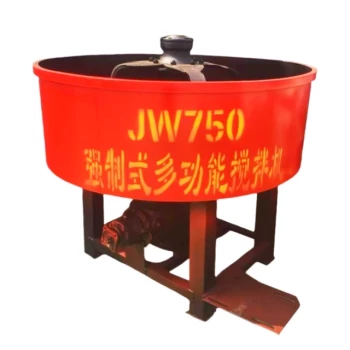
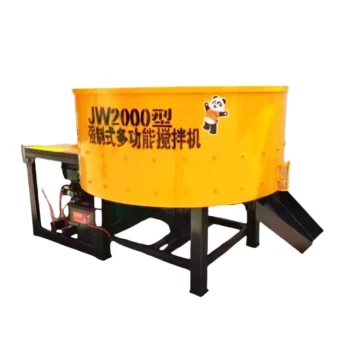
At its core, a pan mixer is a stationary mixing vessel that uses rotating blades to create a homogenous concrete mix. Unlike a drum mixer that tumbles materials, a pan mixer employs a forceful, active shearing and stirring action. This results in faster mixing times and exceptionally consistent, high-quality concrete, particularly for demanding applications.
The critical difference in a pan mixer is its "forced mixing" action. By keeping the pan static and moving powerful blades through the material, it guarantees a level of consistency and quality that simpler tumbling mixers cannot reliably achieve.
How a Pan Mixer Achieves a Superior Mix
A pan mixer’s effectiveness comes from its fundamental design, which prioritizes mechanical force over gravity. This approach offers significant control over the final product.
The Stationary Pan and Rotating Blades
The basic configuration consists of a circular, flat-bottomed pan that holds the aggregate, cement, and water. Inside this stationary pan, a central shaft drives a set of star-shaped blades that rotate horizontally.
This design ensures that all material is constantly forced into the path of the mixing blades, leaving no unmixed pockets.
Forced Mixing vs. Tumbling
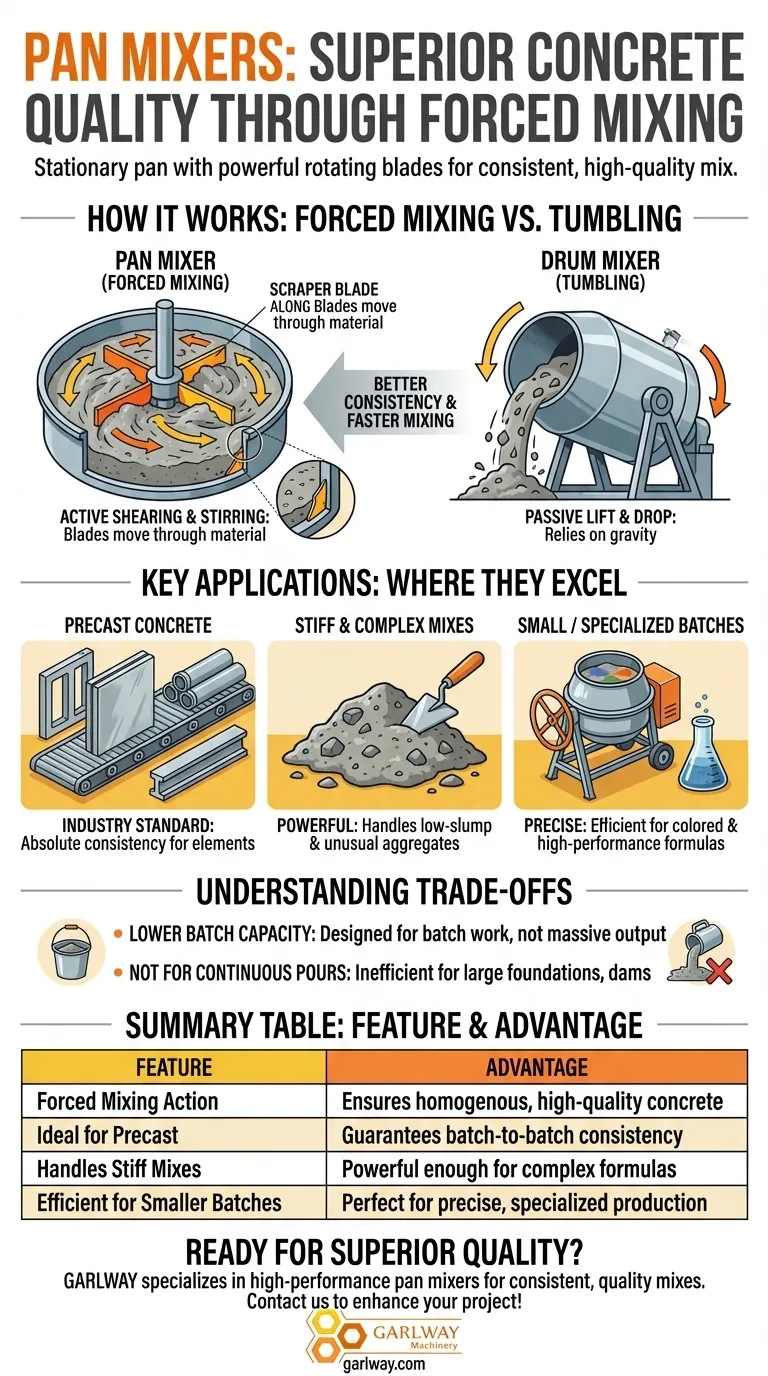
Standard drum mixers lift and drop materials, relying on gravity for a relatively passive mixing process. A pan mixer, however, uses a forced mixing action.
The blades actively shear, fold, and knead the mixture. This high-energy process is incredibly efficient at coating every particle of aggregate with cement paste, which is the key to producing a strong, uniform mix.
The Role of Scraper Blades
Most pan mixers also include one or more scraper blades. These are positioned to run along the inside wall and bottom of the pan as they rotate.
Their purpose is to prevent material from building up on the surfaces, ensuring that every bit of the batch is continuously folded back into the active mixing zone.
Key Applications: Where Pan Mixers Excel
The unique characteristics of pan mixers make them the ideal choice for specific, high-stakes applications where mix quality is non-negotiable.
Precast Concrete Production
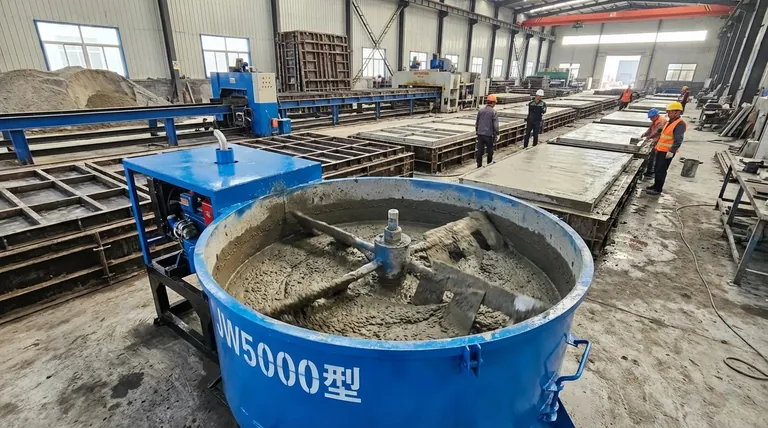
This is the most common application for pan mixers. Precast elements like panels, pipes, and beams require absolute consistency from one batch to the next. The pan mixer's ability to produce a perfectly homogeneous mix every time makes it the industry standard.
Handling Stiff and Complex Mixes
Pan mixers have the power to handle difficult mixtures that would challenge other designs. This includes stiff, low-slump concrete or mixes containing large or unusually shaped aggregates.
Small or Specialized Batches
The controlled mixing action and efficient clean-out make pan mixers well-suited for projects requiring precise, smaller batches of specialized concrete, such as colored concrete or high-performance formulas.
Understanding the Trade-offs
While highly effective, pan mixers are not the universal solution for every concrete job. Understanding their limitations is key to using them correctly.
Lower Batch Capacity
Compared to large-scale continuous mixers or massive reversing drum mixers, pan mixers generally have a smaller output capacity. They are designed for batch work, not massive, uninterrupted pours.
Less Ideal for Continuous Pouring
Because of their batch-based operation, pan mixers are not efficient for applications requiring a continuous supply of concrete, such as large foundations, dams, or paving projects.
Making the Right Choice for Your Project
Choosing a pan mixer is a deliberate decision based on the required quality and application of the concrete.
- If your primary focus is high-quality precast elements: The pan mixer is the industry standard for its unmatched batch-to-batch consistency.
- If your primary focus is handling stiff or specialized formulas: The pan mixer's forced mixing action provides the necessary power and control.
- If your primary focus is large-volume, continuous pours: You should consider a continuous mixing plant or a large-capacity drum mixer instead.
Ultimately, selecting a pan mixer is a strategic choice for any project where the quality and uniformity of the concrete mix are paramount.
Summary Table:
| Feature | Advantage |
|---|---|
| Forced Mixing Action | Ensures homogenous, high-quality concrete with no unmixed pockets. |
| Ideal for Precast Concrete | Guarantees batch-to-batch consistency for elements like panels and pipes. |
| Handles Stiff/Special Mixes | Powerful enough for low-slump concrete and complex formulas. |
| Efficient for Smaller Batches | Perfect for precise, specialized concrete production. |
Ready to achieve superior concrete quality for your precast or specialized projects?
At GARLWAY, we specialize in providing robust construction machinery, including high-performance pan mixers designed for demanding applications. Our equipment delivers the consistent, high-quality mixes that contractors and construction companies globally rely on.
Contact us today to discuss how a GARLWAY pan mixer can enhance your project's efficiency and final product quality!
Visual Guide
Related Products
- Belle Mixer Drum Self Loading Mortar Mixers JS3000
- Construction Products Concrete Plant Machine Mixing Concrete Mixer
- Commercial Construction Mixer Machine for Soil Cement Mixing Concrete
- Portable Electric Small Cement Mixer Concrete Machine
- JDC350 Small Cement Concrete Mortar Mixer
People Also Ask
- What are the features of mobile transporting in a self loading mixer? Boost On-Site Efficiency
- Why is timely cleaning important for a self loading mixer? Prevent Costly Downtime and Mix Failure
- How is discharging accomplished in a self loading mixer? Master Precise Concrete Placement
- What is the purpose of keeping the drum rotating during transportation in a self loading concrete mixer? Ensure Quality & Consistency
- What components are involved in the loading process of a self loading concrete mixer? A Guide to the Key Systems