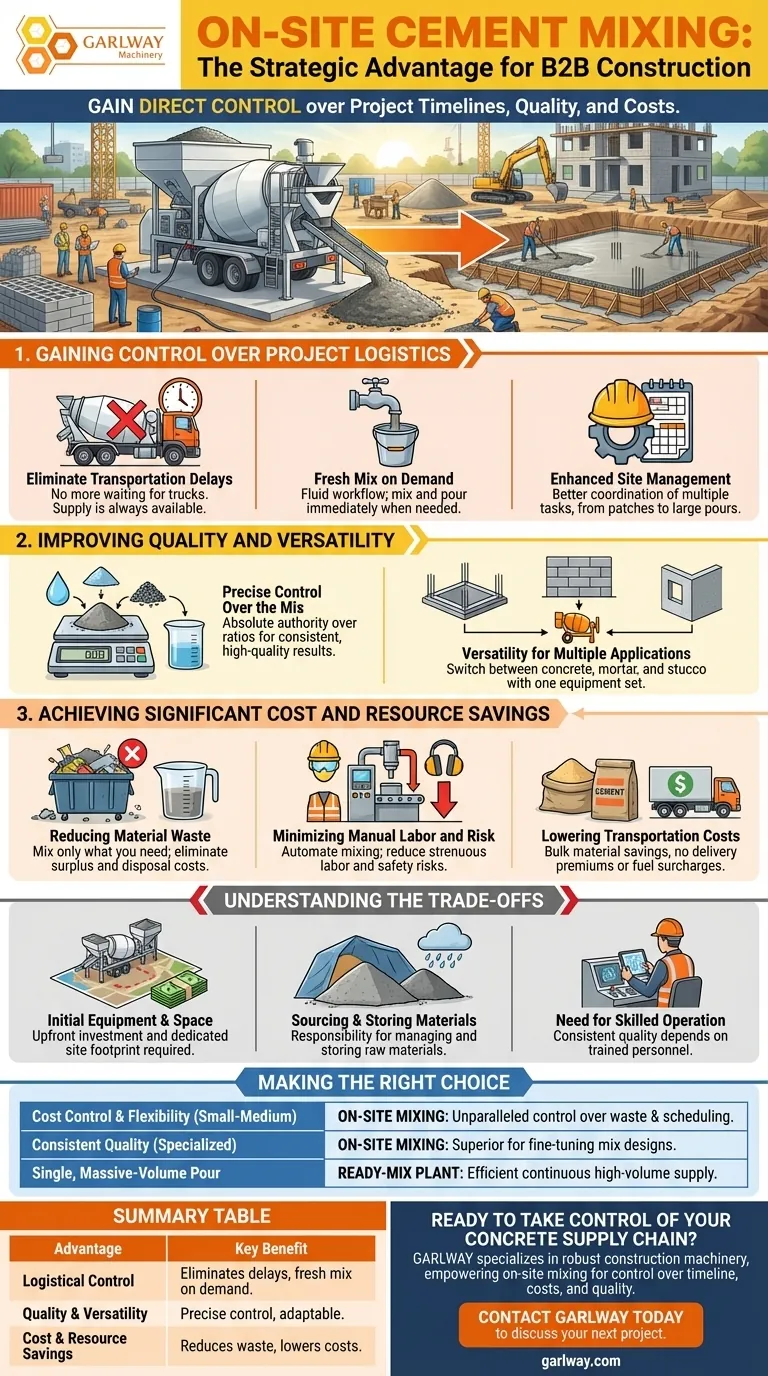
The primary advantage of on-site cement mixing is gaining direct control over your project's timeline, material quality, and costs. By eliminating the dependency on external suppliers and their delivery schedules, you can produce the exact amount of fresh mix precisely when and where it is needed, significantly boosting operational efficiency.
On-site mixing is more than a convenience; it is a strategic shift. It moves critical control over the concrete supply chain from a third-party supplier directly onto your construction site, reducing logistical risks and material waste.
Gaining Control Over Project Logistics
The most immediate impact of on-site mixing is the freedom it gives your project management team. You are no longer constrained by the schedule of a ready-mix concrete plant.
Eliminating Transportation Delays
Ready-mix concrete trucks can get stuck in traffic, arrive late, or be dispatched out of order, causing your entire crew to wait. On-site mixing completely removes this variable, as your supply is always available.
Fresh Mix on Demand
This capability allows for a much more fluid workflow. If a section of work is ready ahead of schedule, you can mix and pour immediately rather than waiting for a pre-scheduled delivery.
Enhanced Site Management
With a dedicated mixing station, contractors can better coordinate multiple tasks simultaneously. You can allocate a small batch for patch-work while preparing for a larger pour without complex scheduling.
Improving Quality and Versatility
Direct oversight of the mixing process ensures that the final product meets the exact specifications required for the job, every single time.
Precise Control Over the Mix
On-site mixing gives you absolute authority over the water-to-cement ratio, aggregate size, and any admixtures. This ensures consistent, high-quality results from the first batch to the last.
Versatility for Multiple Applications
The same equipment can be used to produce different materials as needed. You can easily switch between mixing concrete for a foundation, mortar for blockwork, or stucco for finishing, maximizing the utility of your on-site plant.
Achieving Significant Cost and Resource Savings
On-site mixing directly impacts the project's bottom line by optimizing material use and reducing associated expenses.
Reducing Material Waste
You mix only what you need. This eliminates the common problem of over-ordering ready-mix concrete to ensure you don't run short, which often results in costly and difficult-to-dispose-of surplus material.
Minimizing Manual Labor and Risk
Modern on-site mixing plants automate the batching and mixing process. This reduces the physically strenuous labor of manual mixing and minimizes the associated safety risks for your crew.
Lowering Transportation Costs
By bringing raw materials to the site in bulk, you eliminate the per-delivery premium and fuel surcharges associated with ready-mix trucks, leading to substantial cost savings on large projects.
Understanding the Trade-offs
While advantageous, on-site mixing is not a universal solution. It requires careful consideration of its own logistical demands.
Initial Equipment and Space Costs
There is an upfront cost to purchase or rent a mixer or batching plant. Furthermore, you must allocate a significant footprint on your site for the equipment and for storing raw materials.
Sourcing and Storing Raw Materials
Managing a steady supply of sand, aggregate, and cement powder becomes your responsibility. This requires planning and dedicated, weather-protected storage space to prevent material degradation.
Need for Skilled Operation
Achieving consistent quality depends on having trained personnel who can accurately manage mix designs and operate the equipment. Poor operation can negate the quality control benefits.
Making the Right Choice for Your Project
The decision to use on-site mixing should align directly with your project's specific goals and scale.
- If your primary focus is cost control and flexibility on varied tasks: On-site mixing provides unparalleled control over material waste and scheduling for small to medium-sized jobs.
- If your primary focus is consistent quality for specialized applications: On-site mixing is superior, as it allows you to fine-tune the mix design for specific structural or aesthetic requirements.
- If your primary focus is a single, massive-volume pour: A continuous, high-volume supply from a reliable ready-mix plant may be the more efficient logistical solution.
By understanding these factors, you can leverage on-site mixing to manage your resources and timelines with greater precision.
Summary Table:
| Advantage | Key Benefit |
|---|---|
| Logistical Control | Eliminates delivery delays, enables fresh mix on demand. |
| Quality & Versatility | Precise mix control, adaptable for different applications. |
| Cost & Resource Savings | Reduces material waste, lowers transportation and labor costs. |
Ready to take control of your concrete supply chain?
GARLWAY specializes in providing robust and efficient construction machinery, including concrete mixers and batching plants, for construction companies and contractors globally. Our equipment empowers you to mix high-quality concrete on-site, giving you direct control over your project's timeline, costs, and material quality.
Contact GARLWAY today to discuss how our on-site mixing solutions can optimize your next project.
Visual Guide
Related Products
- Harbor Freight JS1500 On Site Concrete Mixing Volumetric Cement Mixer
- JW1000 Mobile Cement Mixer Concrete Mixer Truck and Batching Plant
- HZS25 Best Cement Mixer for Quick Mix Concrete at Bunnings
- Portable Cement Mixer with Lift Concrete Machine
- JDC350 Small Cement Concrete Mortar Mixer
People Also Ask
- What is the basic working principle of volumetric concrete mixers? On-Demand Mixing for Zero Waste
- How does a volumetric concrete mixer contribute to sustainability? Reduce Waste, Water, and Emissions On-Site
- What is a volumetric concrete mixer? A Mobile Concrete Batch Plant for On-Demand Mixing
- What is the predicted future for volumetric concrete mixers? Growth Driven by On-Demand Efficiency
- How does volumetric concrete compare to ready-mix concrete? Choose the Right Method for Your Project