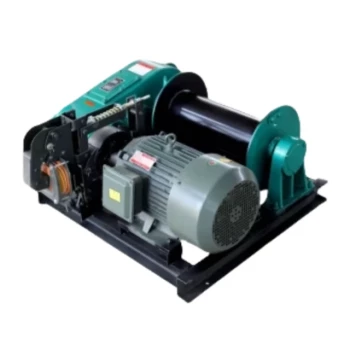
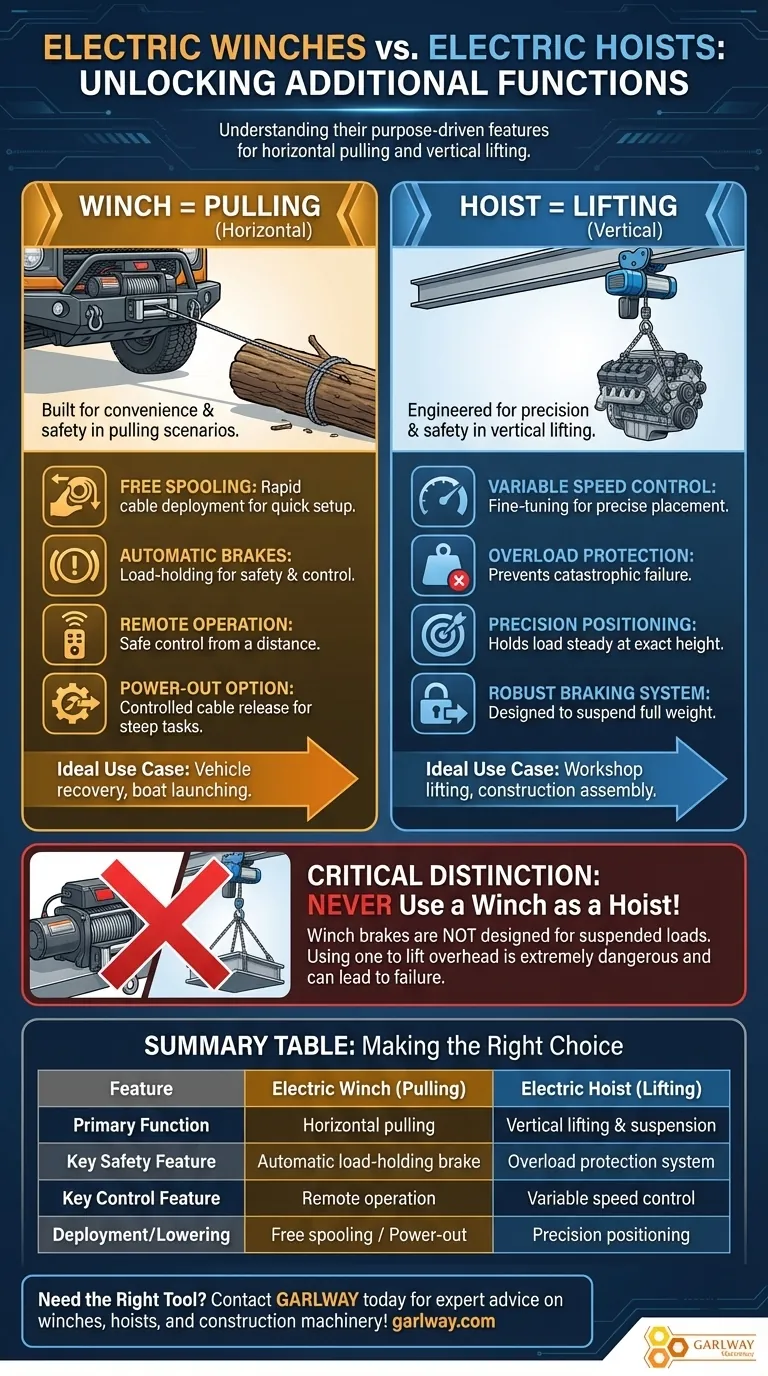
At their core, an electric winch's additional functions are built for convenience and safety in horizontal pulling scenarios, while an electric hoist's features are engineered for precision and safety in vertical lifting. A winch might offer free spooling for rapid cable deployment and remote control for safe operation from a distance. A hoist, in contrast, will often include variable speed control for precise placement and crucial overload protection to prevent catastrophic failure.
While both tools move heavy objects, their feature sets reveal their true purpose. A winch is a pulling device designed to overcome friction across a surface, while a hoist is a lifting device engineered to safely suspend a load in the air.
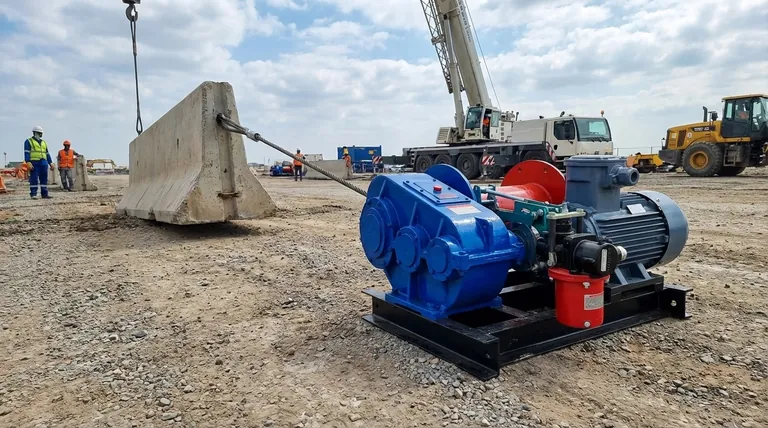
The Purpose-Driven Features of Electric Winches
The features found on an electric winch are designed to solve the unique challenges of pulling a heavy, often unpredictable load across the ground, such as recovering a vehicle.
Rapid Deployment with Free Spooling
Free spooling is a function that disengages the winch's gear train. This allows you to pull the wire rope out by hand quickly, without running the motor.
This is critical in recovery situations where you need to get the line to a solid anchor point that may be far away from the vehicle.
Safety and Control with Automatic Brakes
Electric winches are equipped with automatic load-holding brakes. These brakes, often electromagnetic, engage the moment you stop running the motor.
This prevents the vehicle or object from sliding backward, ensuring safety and control throughout the pulling operation.
Convenience and Safety via Remote Operation
Many electric winches include a wired or wireless remote control. This is a significant safety and convenience feature.
It allows the operator to stand clear of the winch line, which can be dangerous if it snaps, while maintaining a clear line of sight on the entire operation.
Controlled Release with a Power-Out Option
Some winches also offer a power-out feature. Instead of free-spooling, this uses the motor in reverse to pay out the line in a controlled manner.
This is especially useful for tasks like launching a heavy boat on a steep ramp, where you need to manage the descent carefully.
The Precision-Focused Features of Electric Hoists
An electric hoist's features are centered on the immense responsibility of safely lifting a heavy load overhead and placing it with accuracy.
Fine-Tuning with Variable Speed Control
Hoists frequently offer variable speed control, allowing the operator to lift or lower a load very slowly.
This is essential in workshops or on construction sites for tasks that require carefully aligning parts or gently setting down fragile, heavy equipment.
Preventing Failure with Overload Protection
Overload protection is a critical safety feature that automatically stops the hoist if the load exceeds its rated capacity.
This system prevents the motor, gearbox, or cable from being stressed to the point of failure, which could be catastrophic when a load is suspended overhead.
Accuracy Through Precision Positioning
The combination of variable speed and a robust braking system gives a hoist its precision positioning capabilities.
The entire device is engineered to lift a load and hold it steady at an exact height without slipping, which is a non-negotiable requirement for assembly or loading tasks.
Understanding the Critical Distinction: Pulling vs. Lifting
Confusing a winch and a hoist is a common but dangerous mistake. Their features are not interchangeable because their core engineering is fundamentally different.
Winches are Designed for Pulling
A winch is built to handle the dynamic loads of pulling horizontally or at an angle. Its gearing provides high pulling power to overcome the friction of an object on the ground.
Hoists are Engineered for Lifting
A hoist uses a different type of braking system and gear train specifically designed to vertically lift and suspend a load. Its primary job is to fight gravity safely and reliably.
Why You Should Never Use a Winch as a Hoist
The braking system in a winch is designed to hold a load against rolling or sliding friction, not to suspend its full weight in the air. Using a winch to lift a load overhead can lead to brake failure, creating an extremely dangerous situation.
Making the Right Choice for Your Task
Your goal dictates the correct tool. The features discussed here are not optional add-ons; they are essential components for doing the job safely and effectively.
- If your primary focus is vehicle recovery or pulling loads across a surface: You need an electric winch, where features like free spooling and remote control are vital.
- If your primary focus is safely lifting anything overhead: You must use an electric hoist with its critical overload protection and precision controls.
- If you need to move a heavy object in any way that involves suspending it: A hoist is the only safe and appropriate choice for the job.
Understanding how a tool's features align with its core purpose is the first step toward safe and efficient work.
Summary Table:
| Feature | Electric Winch (Pulling) | Electric Hoist (Lifting) |
|---|---|---|
| Primary Function | Horizontal pulling across surfaces | Vertical lifting and suspension |
| Key Safety Feature | Automatic load-holding brake | Overload protection system |
| Key Control Feature | Remote operation (wired/wireless) | Variable speed control |
| Deployment/Lowering | Free spooling or power-out | Precision positioning |
| Ideal Use Case | Vehicle recovery, boat launching | Workshop lifting, construction assembly |
Need the Right Tool for Your Heavy-Duty Project?
Choosing between an electric winch for pulling and an electric hoist for lifting is critical for safety and efficiency. GARLWAY specializes in construction machinery, offering robust and reliable electric winches, concrete mixers, and concrete batching plants tailored for construction companies and contractors globally.
Let our experts help you select the perfect equipment for your needs. Contact GARLWAY today to discuss your project requirements and discover how our solutions can enhance your operational safety and productivity!
Visual Guide
Related Products
- Electric 120V Boat Winch by Badlands
- Electric and Hydraulic Winch for Heavy Duty Applications
- Small Electric Winch 120V and 240V for Compact Applications
- 12000 lb Electric Boat Trailer Winch with Windlass Anchor Warn
- Electric Hoist Winch Boat Anchor Windlass for Marine Applications
People Also Ask
- How do electric boat winches work? Unlock Effortless Launching & Retrieval
- How much current does an electric boat winch draw? Plan Your Electrical System for Peak Performance
- Can I run a winch straight from a battery? Essential Power Setup for Safe Operation
- What are the types of electric winches available? Choose the Right Winch for Your Job
- What are the uses of electric winches in mining and tunneling? Enhance Safety and Efficiency Underground