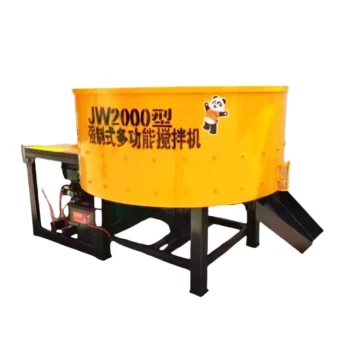
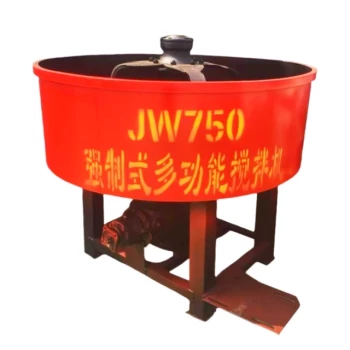
Self-loading mixers are most commonly used in projects where site accessibility, on-demand concrete production, and operational independence are critical. Their versatility makes them ideal for a wide range of applications, from infrastructure development in remote terrains to small-scale urban repairs and residential construction.
A self-loading mixer is essentially a mobile concrete batching plant. Its primary value isn't just mixing concrete, but solving the logistical challenge of getting fresh, precisely-batched concrete to sites where traditional ready-mix delivery is impractical or cost-prohibitive.
The Core Advantage: On-Demand Production Anywhere
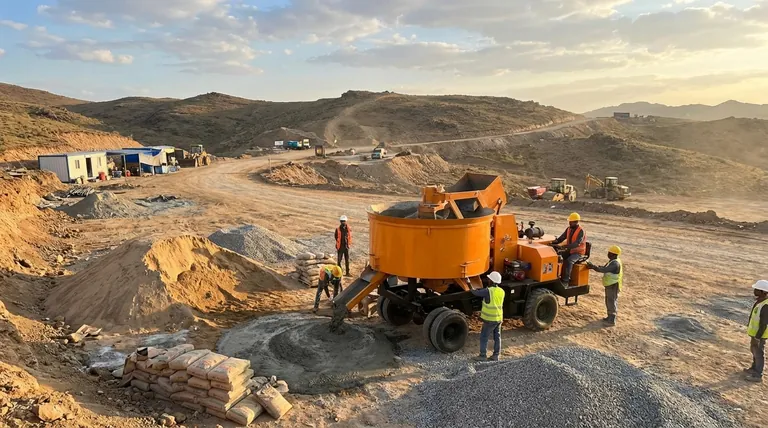
The defining feature of a self-loading mixer is its ability to load raw materials, mix them, and transport the concrete on its own. This creates a self-sufficient system that excels in specific scenarios.
### Eliminating Logistical Hurdles
Traditional concrete delivery relies on a central batching plant and a fleet of transit mixers. This chain can be broken by distance, traffic, or difficult terrain.
A self-loading mixer operates independently. It brings the production capability directly to the pour site, requiring only stockpiles of aggregate, cement, and water.
### Precision for Small to Medium Batches
These machines allow operators to produce the exact amount of concrete needed for a specific task, such as pouring a foundation, filling a form, or patching a road.
This on-demand capability significantly reduces the waste associated with ordering a minimum quantity from a ready-mix plant, which is often inefficient for smaller jobs.
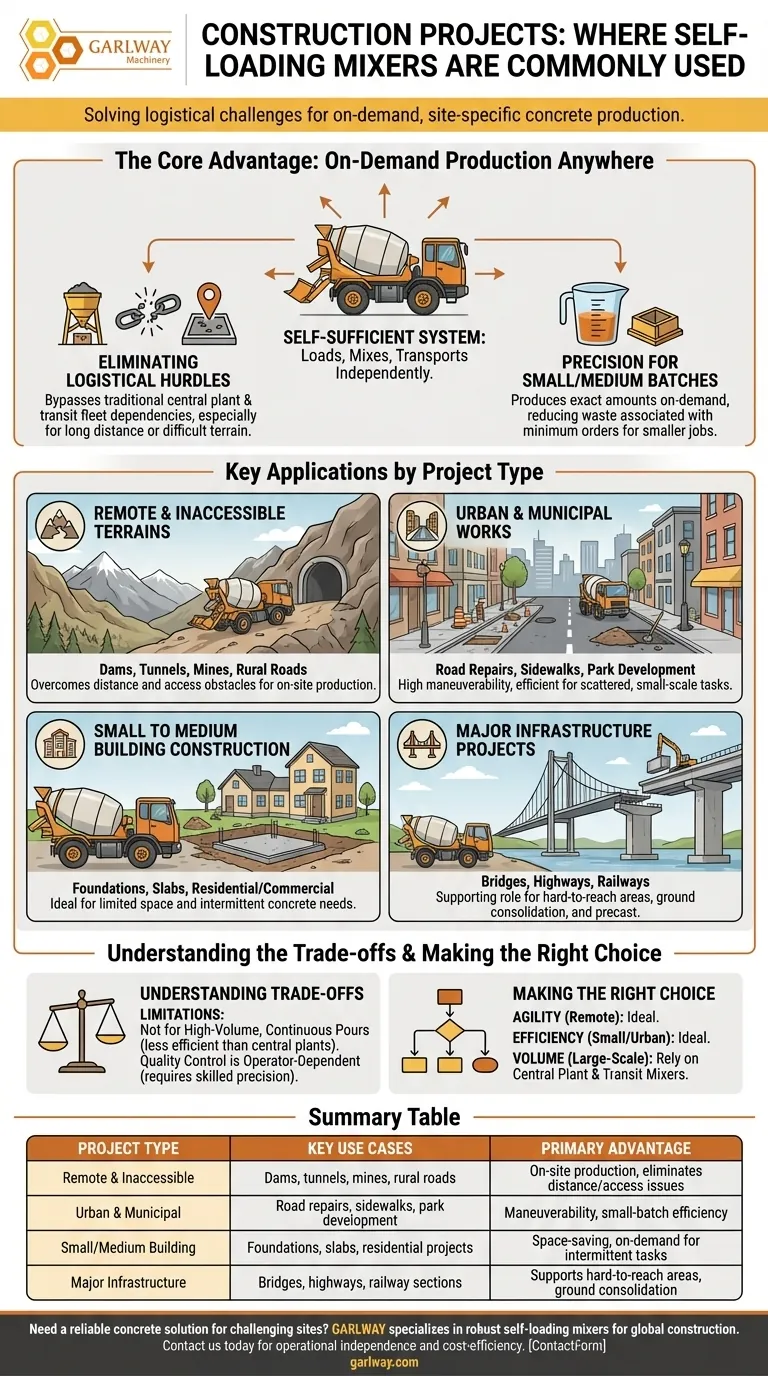
Key Applications by Project Type
The mixer's unique advantages make it a preferred choice across several distinct construction environments.
### Remote and Inaccessible Terrains
This is the quintessential use case. For projects like building dams, tunnels, mines, or rural roads, establishing a full batching plant is often impossible.
The self-loading mixer can navigate difficult terrain to deliver fresh concrete precisely where it's needed, overcoming the primary obstacle of distance and access.
### Urban and Municipal Works
In dense urban settings, these mixers provide critical flexibility. They are frequently used for sidewalk construction, road repairs, park development, and drainage system construction.
Their maneuverability and ability to produce small, fresh batches make them more efficient than coordinating multiple ready-mix trucks for scattered, smaller-scale tasks.
### Small to Medium-Scale Building Construction
For residential and commercial projects, self-loaders are used for pouring foundations, slabs, and other structural elements.
They are particularly valuable on sites where space is limited or where the pace of construction requires concrete at intermittent, unpredictable times.
### Major Infrastructure Projects
While not suited for massive, continuous pours, they play a vital supporting role in large infrastructure projects like bridges, highways, and railways.
They can handle specific tasks like ground consolidation, precast element production, or pouring concrete in sections of the project that are hard for larger vehicles to reach.
Understanding the Trade-offs
While highly versatile, a self-loading mixer is not a universal solution. Understanding its limitations is key to using it effectively.
### Not Designed for High-Volume Output
A self-loading mixer cannot compete with the sheer output of a dedicated central batching plant.
For projects requiring massive, uninterrupted concrete pours, such as high-rise building cores or large dam structures, a traditional supply chain is far more efficient.
### Quality Control is Operator-Dependent
The final quality and consistency of the concrete are heavily reliant on the skill of the operator.
Accurately loading the correct proportions of sand, aggregate, cement, and water requires precision and training to ensure the mix meets engineering specifications.
Making the Right Choice for Your Project
Selecting the right equipment depends entirely on the logistical realities of your job site.
- If your primary focus is project agility in remote or hard-to-access locations: A self-loading mixer is the ideal solution, providing complete autonomy from concrete plants.
- If your primary focus is frequent, small-batch repairs or urban infill projects: This equipment offers unparalleled efficiency by producing precise amounts of concrete on-demand, minimizing waste.
- If your primary focus is large-scale, continuous concrete pouring: Rely on a dedicated batching plant and a fleet of traditional ready-mix trucks for consistent volume and supply.
Ultimately, a self-loading mixer is a strategic tool chosen to overcome specific constraints of access, distance, and scale.
Summary Table:
| Project Type | Key Use Cases | Primary Advantage |
|---|---|---|
| Remote & Inaccessible Sites | Dams, tunnels, mines, rural roads | On-site production, eliminates distance/access issues |
| Urban & Municipal Works | Road repairs, sidewalks, park development | Maneuverability, small-batch efficiency |
| Small/Medium Building Construction | Foundations, slabs, residential projects | Space-saving, on-demand concrete for intermittent tasks |
| Major Infrastructure Projects | Bridges, highways, railway sections | Supports hard-to-reach areas, ground consolidation |
Need a reliable concrete solution for challenging sites? GARLWAY specializes in construction machinery, offering robust self-loading mixers that deliver on-demand concrete production for construction companies and contractors globally. Whether you're working in remote terrains or dense urban areas, our equipment ensures operational independence and cost-efficiency. Contact us today to find the perfect mixer for your project's unique needs!
Visual Guide
Related Products
- Skid Steer Self Loading Concrete Mixers for Construction
- Belle Mixer Drum Self Loading Mortar Mixers JS3000
- Portable Cement Mixer with Lift Concrete Machine
- Portable Concrete Mixer Machine Equipment for Mixing Concrete
- JW1000 Mobile Cement Mixer Concrete Mixer Truck and Batching Plant
People Also Ask
- How does the control system improve production efficiency in a self loading concrete mixer? Automate Mixing for Speed & Quality
- What is the purpose of keeping the drum rotating during transportation in a self loading concrete mixer? Ensure Quality & Consistency
- How does the weighing process work in a self loading concrete mixer? Achieve Precise, On-Site Concrete Batching
- What components are involved in the loading process of a self loading concrete mixer? A Guide to the Key Systems
- How should materials be loaded into a self-loading concrete mixer? Master the Step-by-Step Process