
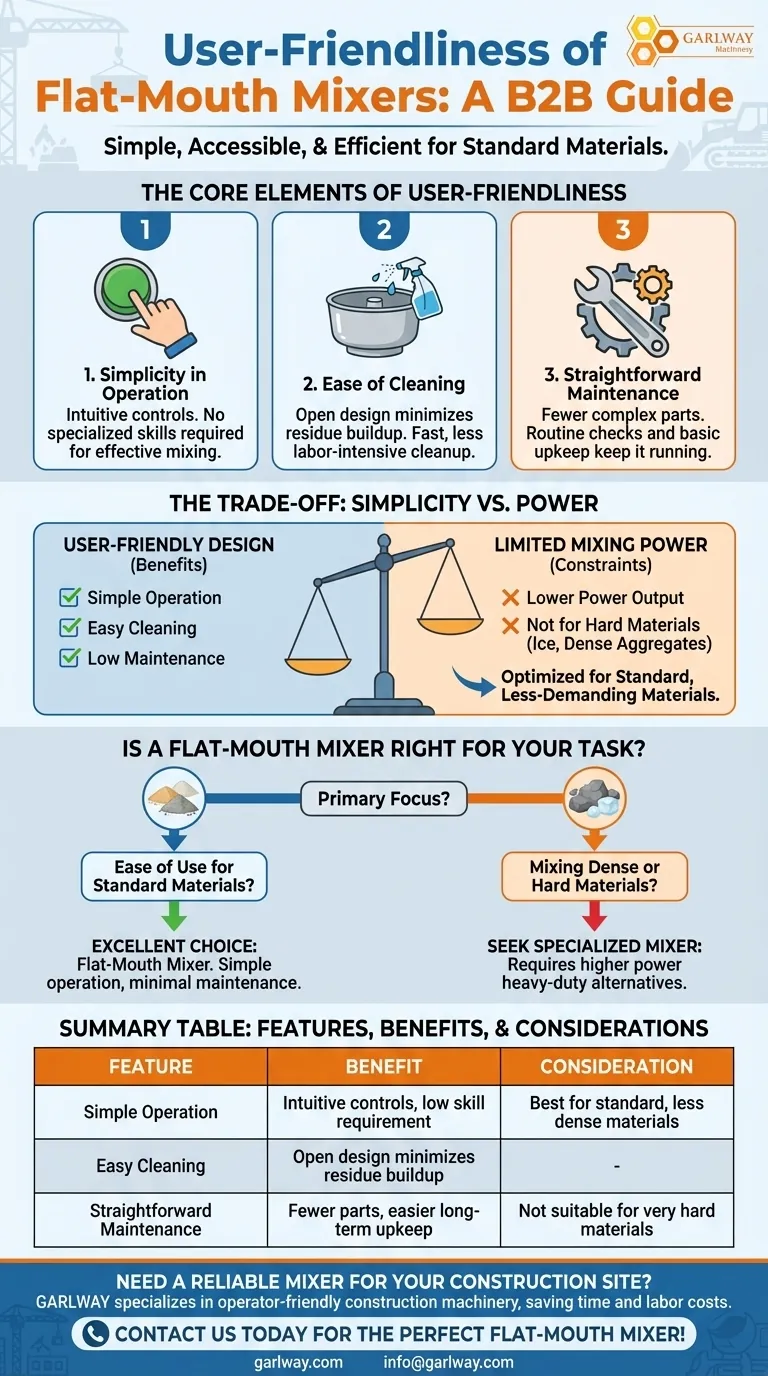
In short, flat-mouth mixers are exceptionally user-friendly. Their design prioritizes simplicity and ease of use, making them highly accessible for operators without extensive technical training. This user-friendliness extends from initial operation to routine cleaning and long-term maintenance.
The core reason for their user-friendliness is their simple structure. This design choice makes them easy to operate and maintain, but it also creates a clear trade-off: they often lack the power required for very hard or dense materials.
The Core Elements of User-Friendliness
A tool's true user-friendliness is measured by more than just its basic operation. For flat-mouth mixers, this extends across the entire lifecycle of a task, from mixing to cleanup.
Simplicity in Operation
Operating a flat-mouth mixer does not require specialized skills.
The controls are intuitive, and users only need to understand fundamental mixing techniques to achieve effective results. This significantly lowers the barrier to entry for new operators.
Ease of Cleaning
The physical design of a flat-mouth mixer is a major advantage for cleanup.
Its structure is less prone to trapping material, which reduces the buildup of residue like hardened concrete. This makes the cleaning process faster and less labor-intensive.
Straightforward Maintenance
The mechanical simplicity of these mixers directly translates to easier maintenance.
With fewer complex parts, routine checks and upkeep are straightforward. Regular, basic care is typically all that is needed to keep the mixer in good working condition for a long time.
Understanding the Trade-offs: Simplicity vs. Power
The simple design that makes these mixers so user-friendly is also the source of their primary limitation. Objectivity requires acknowledging what a tool cannot do as well as what it can.
Limited Mixing Power
Most flat-mouth mixers are engineered with lower power outputs compared to more complex, heavy-duty alternatives.
This design choice is intentional, aligning with their intended use for standard, less-demanding materials.
Constraints on Materials
This lower power means they are not suitable for all tasks.
They may struggle or fail to properly mix very hard materials, such as ice, meat, or particularly dense aggregates. Forcing the mixer to handle such materials can lead to ineffective results and potential damage.
Is a Flat-Mouth Mixer Right for Your Task?
Making the right choice depends entirely on the demands of your specific project. By aligning the tool's capabilities with your goals, you can avoid frustration and ensure efficiency.
- If your primary focus is ease of use for standard materials: A flat-mouth mixer is an excellent choice, offering simple operation and minimal maintenance overhead.
- If your primary focus is mixing dense or hard materials: You should seek out a more powerful, specialized mixer designed to handle the higher stress of these tasks.
By understanding this fundamental balance between simplicity and power, you can confidently select the right tool for your mixing needs.
Summary Table:
| Feature | Benefit | Consideration |
|---|---|---|
| Simple Operation | Intuitive controls, low skill requirement | Best for standard, less dense materials |
| Easy Cleaning | Open design minimizes residue buildup | - |
| Straightforward Maintenance | Fewer parts, easier long-term upkeep | Not suitable for very hard materials like ice or dense aggregates |
Need a reliable and easy-to-use mixer for your construction site?
At GARLWAY, we specialize in construction machinery, including concrete mixers designed for efficiency and operator-friendly performance. Our equipment helps construction companies and contractors globally save time and reduce labor costs through simple operation and minimal maintenance.
Contact us today to find the perfect flat-mouth mixer for your project requirements!
Visual Guide
Related Products
- JDC350 Small Cement Concrete Mortar Mixer
- Portable Ready Mix Concrete Mixer Equipment
- JDY350 Electric Hydraulic Mortar Mud Concrete Mixer
- Portable Concrete Mixer Machine Equipment for Mixing Concrete
- JZC400 Mobile Small Concrete Mixer Cement Mixer Machine
People Also Ask
- What are the primary uses of a small cement mixer? Boost Efficiency for Small to Medium Construction Jobs
- What are the physical benefits of using a small cement mixer? Reduce Strain and Prevent Injury
- What are the cost benefits of using a small cement mixer? Save on Labor, Materials & Time
- What makes small cement mixers easy and convenient to use? Boost Productivity on Any Job Site
- What factors should be considered before purchasing a small cement mixer? Find the Perfect Match for Your Project


