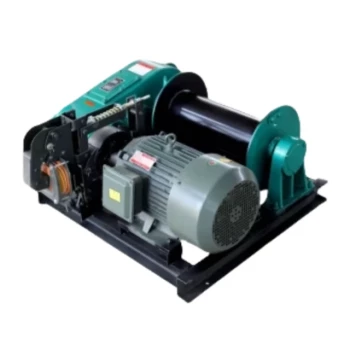
A boat winch's lifting capacity is not a single number but a specification tied directly to its intended purpose. Capacities can range from a few hundred pounds for small anchor winches to tens of thousands of pounds for large boat lift systems, but the most crucial factor is whether the winch is rated for pulling a rolling load or for true vertical lifting.
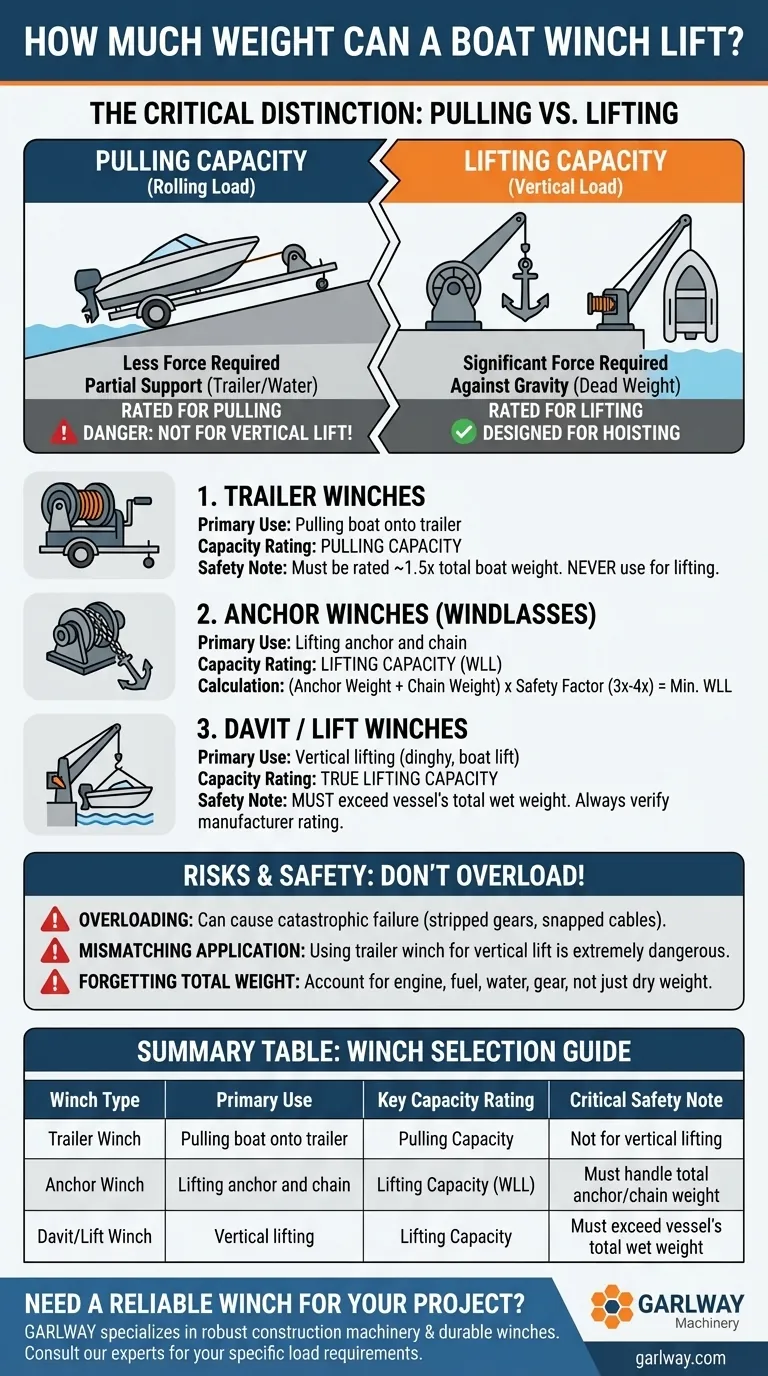
The most important distinction to understand is the difference between a winch's "pulling capacity" (for trailers) and its "lifting capacity" (for hoists and davits). Using a winch designed for pulling to perform a vertical lift is extremely dangerous and can lead to catastrophic failure.
The Critical Distinction: What Kind of "Boat Winch"?
The term "boat winch" is broad and can refer to several different devices, each with a specific design and capacity rating. Understanding which type you are dealing with is the first step.
Trailer Winches
These are the most common type of winch boat owners encounter. They are designed to pull a boat from the water onto its trailer.
Their capacity is rated for a pulling load, not a vertical lift. A 2,000 lb trailer winch is rated to pull a 2,000 lb boat up a gentle slope, not lift it straight into the air.
Anchor Winches (Windlasses)
An anchor winch, or windlass, is designed specifically to lift the combined weight of your anchor and chain (the "ground tackle").
Their capacity is much lower than a trailer winch but is engineered for a vertical lift. It must be sufficient to handle the dead weight of the anchor and all deployed chain, plus a safety margin.
Davit or Lift Winches
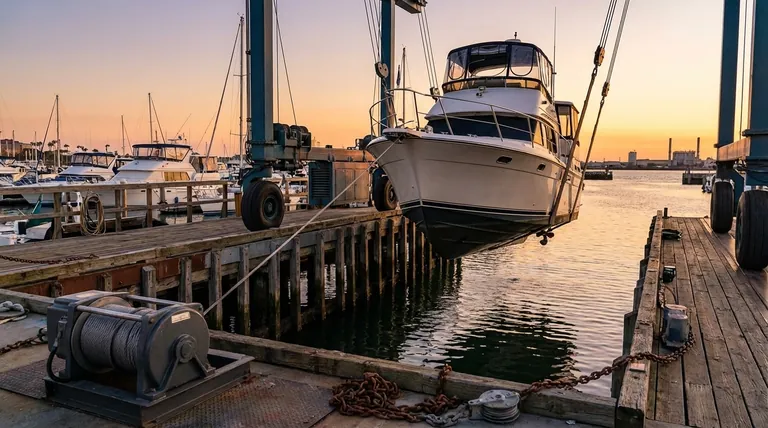
These winches are designed for true vertical lifting. They are used in boat lifts to raise the entire vessel out of the water or on davit systems to lift a dinghy or PWC.
These are the only "boat winches" with a true lifting capacity rating, which is always clearly specified by the manufacturer.
How Winch Capacity is Determined
The number stamped on a winch is the result of engineering calculations that account for the task it's designed to perform.
Pulling Capacity vs. Lifting Capacity
A winch needs significantly less force to pull a rolling or sliding object up an incline than it does to lift that same object vertically against gravity.
A trailer winch rating assumes the boat's weight is partially supported by the trailer's rollers or bunks and the water, dramatically reducing the required force.
Calculating a Working Load Limit (WLL)
For lifting applications like an anchor winch, you must calculate the total weight and apply a safety factor. This determines the required Working Load Limit (WLL).
For example, a 35 lb anchor with 40 feet of chain that weighs 1.5 lbs/ft has a total dead weight of 95 lbs (35 + 60). Applying a common safety multiplier of 3x means you need a winch with a WLL of at least 285 lbs.
Always Trust the Manufacturer's Label
The definitive capacity is always stated by the manufacturer on the winch itself or in its documentation. Never guess or assume a winch's capacity.
Understanding the Trade-offs and Risks
Choosing the wrong winch or exceeding its capacity is not a matter of inconvenience; it is a critical safety failure.
The Danger of Overloading
Overloading a winch can strip its gears, snap the cable or strap, and send components flying with lethal force. A winch is a tool that stores enormous potential energy.
Mismatching the Application
Using a trailer winch for a vertical lift is the most common and dangerous mistake. The braking systems and gear ratios are not designed to safely suspend a dead-weight load.
Forgetting the "Total Weight"
When selecting a trailer winch, you must account for the total weight of the boat, engine, fuel, water, and all gear onboard. The "dry weight" listed by the boat manufacturer is often much lower than its real-world operational weight.
How to Select the Right Winch Capacity
Your choice must be based on the specific task you need to accomplish. Use these guidelines to make a safe and effective decision.
- If your primary focus is pulling a boat onto a trailer: Choose a winch with a pulling capacity rated for at least 1.5 times the total weight of your boat, motor, and gear.
- If your primary focus is lifting an anchor: Calculate the total weight of your anchor and chain, then multiply by a safety factor of 3 to 4 to find the minimum Working Load Limit (WLL) required.
- If your primary focus is vertically lifting a vessel (dinghy or boat lift): You must use a winch specifically rated as a "hoist" with a lifting capacity that exceeds the total wet weight of the vessel.
Always prioritize safety by selecting a winch with a capacity that comfortably exceeds your heaviest expected load.
Summary Table:
| Winch Type | Primary Use | Key Capacity Rating | Critical Safety Note |
|---|---|---|---|
| Trailer Winch | Pulling boat onto trailer | Pulling Capacity | Not for vertical lifting |
| Anchor Winch (Windlass) | Lifting anchor and chain | Lifting Capacity (WLL) | Must handle total anchor/chain weight |
| Davit/Lift Winch | Vertical lifting (dinghy, boat lift) | Lifting Capacity | Must exceed vessel's total wet weight |
Need a Reliable Winch for Your Construction or Marine Project?
Choosing the right winch is critical for safety and efficiency. GARLWAY specializes in robust construction machinery, offering durable winches, concrete mixers, and batching plants trusted by construction companies and contractors globally.
Let our experts help you select the perfect winch for your specific load requirements and safety standards.
Contact GARLWAY today for a consultation and ensure your project's success with the right equipment.
Visual Guide
Related Products
- Electric 120V Boat Winch by Badlands
- 12000 lb Electric Boat Trailer Winch with Windlass Anchor Warn
- 12000 lb Heavy Duty Electric Boat Winch
- Heavy Duty Electric Boat Winch Windlass Anchor
- Quick Windlass Portable Winch for Truck and Boat Best Boat Winch
People Also Ask
- How do electric boat winches work? Unlock Effortless Launching & Retrieval
- How much current does an electric boat winch draw? Plan Your Electrical System for Peak Performance
- Can I run a winch straight from a battery? Essential Power Setup for Safe Operation
- What are the types of electric winches available? Choose the Right Winch for Your Job
- What are the uses of electric winches in mining and tunneling? Enhance Safety and Efficiency Underground